India To Lead The World In Churning Out Ultra-Rich

The number of ultra-wealthy individuals is expected to rise the most in India compared with other Asian peers in the next five years.
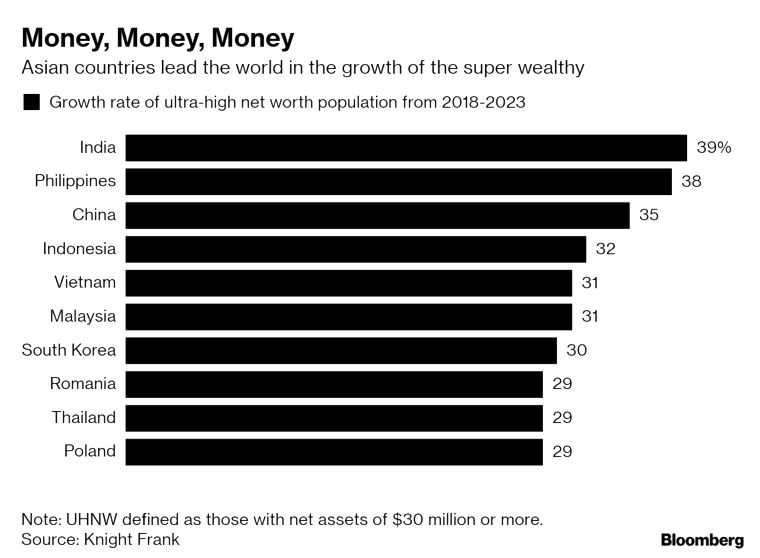
Ultra-high net worth individuals—people with net assets of $30 million or more, excluding primary residence—is expected to grow 39 percent to 2,697 in India between 2018 and 2023, according to a report by property consultant Knight Frank. That compares with growth of 38 percent in the Philippines and 35 percent in China during the period.
“This is primarily because of the general confidence in growth of the Indian economy, hovering at 7-7.5 percent. This is a big growth number. Also, there are several other factors like India breaking into the top 100 in the ease of doing business ranking a few years ago. All this put together increases the confidence in the economy,” said Arvind Nandan, executive director (research) at Knight Frank India.
The ultra-high net worth individual population of Asia's third-biggest economy grew 30 percent in the last five years, fuelling increased appetite for overseas real estate investments, the report said.
In 2018, about 24 percent of ultra-rich Indians invested in properties, excluding first and second homes, outside the country, up from 21 percent in the previous year, the report said. They consider factors such as world-class education, opportunities for children, new business ventures and stable investment returns while choosing overseas markets for investments, it said. London, Melbourne and Dubai, according to the property consultant, draw significant interest. Other markets popular among Indian investors are Cyprus, Malaysia and Sri Lanka.
That's despite the restrictions under the Liberalised Remittance Scheme—that permits citizens of India to transfer funds abroad for permitted current or capital account transactions or for both. Since the implementation of higher permit under the scheme (up to $250,000), Indian residents have sent nearly $30 billion overseas, the report said. The remittances are up by 144 percent between 2015-16 and 2017-18 financial years.
India also witnessed a substantial rise in personal wealth. In 2018, equities emerged as the most preferred asset class for investment among ultra-rich Indians, followed by bonds and real estate, Knight Frank said in a media statement. The ultra-high net worth individual are also expected to reduce their cash exposure and increase allocation to private equity in 2019, it said.
“This should be seen in the context of events like the upcoming general election and uncertainty in the global market. During such times the tendency of any asset allocation will be to hold those assets which are likely to provide returns quickly with an upside,” Nandan said. “Properties are usually long term and safer assets but they take longer to deliver returns. Under current circumstances, property markets have been under pressure. So, people move towards more liquid and high-return assets.”
Future Property Investments
Bengaluru and not Delhi or Mumbai will be a likely target of future property investments, the report said. The city, also the most preferred future property investment destination globally, is home to more than 400 multinational companies. It has also been grossing the country's highest office space absorption for 10 straight years, it said.
Watch the video here:

-
Talking Points This Week: Tech Nerves, FII Buying, And A Faraway Banking Shock

The global markets are not shining this Diwali. The exception in the large markets is, India.
-
Midterm Rally Lasted A Day. The Hard Reality Of A Divided US May Last Two Years | Opinion
Between a contested AI boom, a debt ceiling that arrives in 2027 and a president with every incentive to act alone, the next two years may prove more volatile than the first day's rally suggests.
-
Blue Wave Will Derail the AI Trade but Won't Dismantle the AI Era | Unhedged Position
The Democrats' sweep of the US Congress will see politics collide with economic forces both over the long and short term.
-
It's Time To Take The GST Council's Bet On Trust Global
Payment records can prove India's services exports, and clear, proportionate rules can bring foreign digital sellers into the tax net.
-
Opinion | India at 38: From Innovation Overperformer to Innovation Powerhouse
India now has 453 VC-backed deep science startups, 18 of them late-stage, after 117 percent growth since 2020. Laurus Labs, at USD 9.3 billion, is the most valuable deep science company in any middle-income economy outside China.
-
Navigating Energy Crossroads: S Jaishankar's Call For Diversified Supply Chains At G20 Ministerial Meeting
As geopolitical fault lines continue to test maritime trade routes and commodity flows, Jaishankar's message remains pertinent: true economic resilience requires open markets, protected transit lines, and a genuine commitment to multilateral cooperation rather than coercion.
-
Indians Are Travelling, But Not Every Journey Is A Holiday | The Week In Whys
Pilgrims, patients and working women are the real travellers, and the system hasn't quite caught up with them.
-
Getting To Work Costs Women More | The Reason Why
It is not just about women paying more than men. It is about women paying much more in cities than in villages.
-
AI Bias In Investing Cannot Be Eliminated, But It Can Be Governed
Framing is a particularly important example as identical financial information presented in terms of gains rather than losses can lead an LLM to reach a different assessment.









