India Seeks Permanent Solution To Food Stockholding At Trade Body Meet
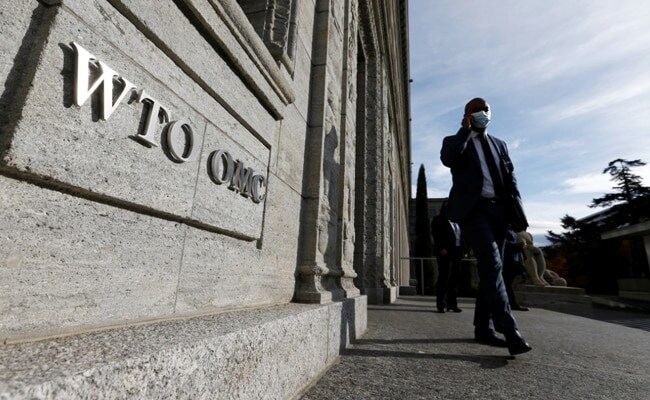
India has called for finding a permanent solution to the issue of public stockholding for food security in the ministerial-level meeting of the World Trade Organisation (WTO) in February 2024, an official said.
It has dismissed arguments for alternative food security solutions beyond PSH (public stock holding) and SSM (special safeguard mechanism) and believes that market access and export restriction are not worth the effort, the Geneva-based official said.
India has also pitched for the need to recalculate the external reference prices to reflect the impact of inflation and other economic factors on food stock prices.
The issue was discussed during a special session of the WTO's Committee on Agriculture on May 3 and 4 in Geneva.
"India declared that it has no intention of revising the existing proposal for public stockholding for food security purposes and suggested that it is the only way forward. India called for a permanent solution for PSH at MC13 (13th ministerial conference)," the official said.
The 13th World Trade Organization (WTO) Ministerial Conference (MC13) will take place in the week of February 26, 2024 in Abu Dhabi, United Arab Emirates. MC is the highest decision making body of the 164-member multi-lateral body.
In the meeting, China, India, Sri Lanka, South Africa, and Egypt joined the call for initiating text-based negotiations on PSH.
They highlighted the importance of PSH being applied to all developing countries, particularly least developed countries (LDCs) and net-food importing developing countries (NFIDCs), to help address the severe food security problem.
"India criticized non-proponents for their stubbornness and unwillingness to move from old positions when negotiations begin to discuss details," the official added.
As part of a permanent solution, India has asked for things like amendments in the formula to calculate the food subsidy cap and inclusion of programmes implemented after 2013 under the ambit of 'Peace Clause'.
As an interim measure, the WTO members at the Bali ministerial meeting in December 2013 had agreed to put in place a mechanism popularly called Peace Clause and committed to negotiating an agreement for a permanent solution.
Under the Peace Clause, WTO members agreed to refrain from challenging any breach in the prescribed ceiling by a developing nation at the dispute settlement forum of the WTO.
This clause will stay till a permanent solution is found to the food stockpiling issue.
Under global trade norms, a WTO member country's food subsidy bill should not breach the limit of 10 per cent of the value of production based on the reference price of 1986-88.
Subsidies over and above the prescribed ceiling are seen as trade distorting. The limit is fixed at 10 per cent of the value of food production for developing countries like India.
India has earlier informed the World Trade Organisation that it has used the peace clause to provide excess support measures to rice farmers for marketing year 2020-21, in order to meet the domestic food security needs of its poor population.
India also asked for SSM, which aims at protecting poor and marginal farmers from any surge in imports or a steep decline in prices.
The Geneva-based 164 member multi-lateral body deals with global exports and import-related norms. Besides, it adjudicates trade disputes between the member countries.
The WTO's agriculture negotiations encompass various topics, including domestic support, market access, export competition, export restrictions, cotton, public stockholding for food security purposes, special safeguard mechanism, and the cross-cutting issue of transparency.
At the 12th ministerial conference in Geneva, despite making progress on the food security front, members were unable to arrive at an agreement on the agriculture reform work plan.
(Except for the headline, this story has not been edited by NDTV staff and is published from a syndicated feed.)

-
Navigating Friction And Energy Realities: An Analysis Of Marco Rubio's October Visit To India

Occurring at a critical juncture marked by stalled trade negotiations and escalating geopolitical pressures over global energy supplies, the visit offers a profound window into modern US-India relations.
-
India Exports Capital. Why Not Export Trusteeship?
The big question, then, is whether India can build an institution that global borrowers, investors, banks, and lawyers can trust, even without an Indian connection.
-
France's Economy & Politics Are In Crisis | The Reason Why
Let's look at how the French economy and politics evolved under Nicolas Sarkozy, Franois Hollande and Emmanuel Macron.
-
You May Inherit The Business. You Must Earn Its Credibility.
Succession tests the founder's ability to share authority as much as it tests the next generation's readiness to assume it.
-
Signing Deals Is One Thing; Making Them Work Is Another | The Week In Whys
Sometimes, things don't turn out as planned. Indian companies have lost some bids to rivals, some projects won't produce until 2030.
-
FOMC Wall, PERM Suspension, Hospital Stocks | Talking Points This Week
A PERM suspension would directly affect green-card sponsorship rather than H-1B visas, so the near-term earnings impact could remain relatively limited. The key question is whether this marks a new phase in US scrutiny of Indian IT.
-
Everything, Everywhere, All At Once: Dalal Street's Week To Forget | Joining The Dots
Visa curbs, a Starlink spat and cancer drug caps: what connects this week's shocks for Indian markets
-
India Is Going Abroad For Critical Minerals. But It May Take Years To Pay Off | The Reason Why
Although India's steps are in the right direction, they remain modest compared with India's growing dependence.
-
When Everyone Has AI, What Gives You An Edge?
India's young workforce is entering an uncertain world of work where powerful AI tools are becoming widely accessible. The advantage will belong to those who combine deep expertise with digital fluency, and the distinctly human capabilities that technology cannot manufacture.
-
Wrong Labels, High Pesticide Residues Holding Back Agri Exports | The Reason Why
India needs stronger domestic food-safety and labelling standards, with best practices becoming part of everyday business for farmers, traders and food companies.