India Jumps 23 Places On World Bank’s Ease Of Doing Business Index
India jumped 23 places on the World Bank's Doing Business Index as the country made it easier to start a business, deal with construction permits and facilitated quicker cross-border trade.
It's now ranked at 77, the highest in South Asia, up from 100 last year, according to the World Bank's Doing Business 2019 report. “India, with six reforms, is among the top-ten improvers for the second consecutive year,” the report said.
The improved ranking will boost the sentiment of Prime Minister Narendra Modi's government ahead of the general election, at a time it's facing flak for rising fuel prices and falling rupee. Last year, Finance Minister Arun Jaitley had said Modi wanted various ministries to target the top 50, which he thought was “doable”.
Modi had vowed to improve the ease of doing business when he came to power in 2014. Since then his government has overhauled the country's indirect tax structure by introducing the goods and services tax, brought in a new real estate law and consolidated the numerous bankruptcy laws into one.
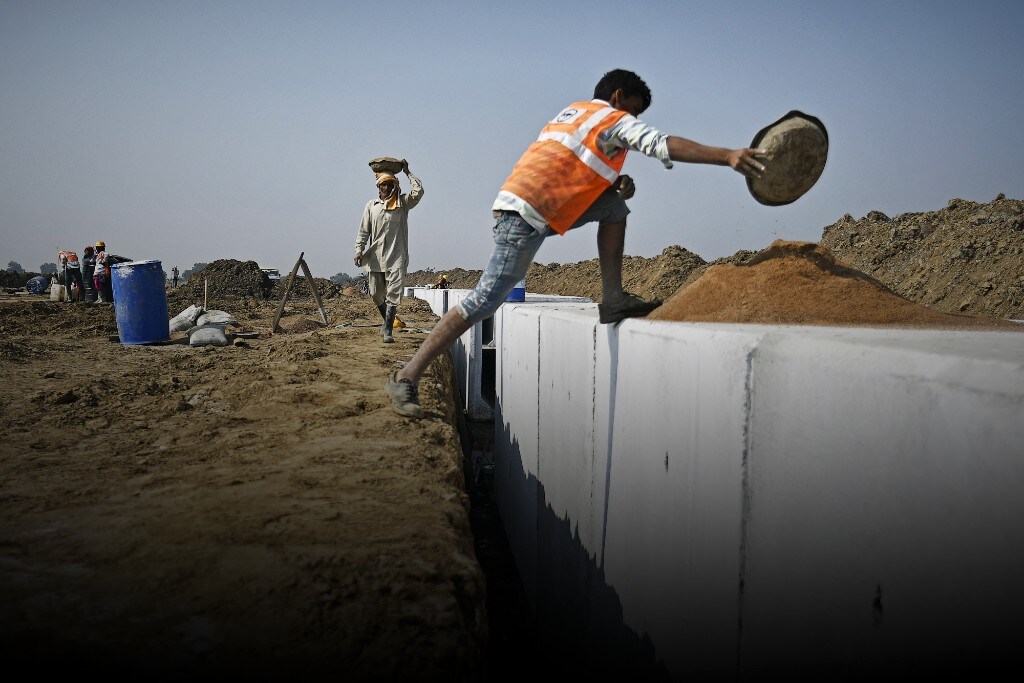
And that seemed to have paid off. India's ranking in dealing with construction permits—one of the 10 parameters the World Bank looks at—jumped to 52 from 181 last year. “India streamlined the process of obtaining a building permit and made it faster and less expensive to obtain a construction permit,” the report said. “It also improved building quality control by introducing decennial liability and insurance.”

The other significant improvement in ranking was in trading across borders. India's ranking for cross-border trade improved by 66 places to 80. That's because of various initiatives taken to reduce the time and cost to export goods.
India now allows exporters to electronically seal containers at their own facilities, the report said. This means as little as 5 percent of the shipments now undergo physical inspection, it said. That, coupled with upgrading of port infrastructure and electronic submission of documents using digital signatures, led to an improvement in ranking.
India has supported its ambitious reform agenda by providing regular training to both customs officials and private sector agents, as well as by establishing Customs Clearance Facilitation Committees that bring together actors involved in international trade at regular meetings.World Bank's Doing Business 2019

The other improvements come through the GST, which wasn't included in last year's ranking, and the Insolvency and Bankruptcy Code. The GST made it easier to start businesses as it integrates multiple application forms into a single general incorporation form. World Bank said this speeds up the registration process.
India, the report said, has not only made paying taxes easier, but also made it less costly by reducing the corporate income tax rate and the employees' provident funds scheme rate paid by the employer.
The amendements to the IBC also strengthened access to credit, the report said. “Secured creditors are now given absolute priority over other claims within insolvency proceedings.”

Job Half Done
Yet, in some areas, India's rank has worsened. In registering property, the country's ranking fell to 166 from 92 when Modi took over. It takes over two months in India to register for property and the procedures end up costing almost 8 percent of the property value.
India's efforts in protecting minority investors also stagnated. Its rank fell from fourth in the world to seventh, with no improvement in reforms. Similarly, in paying taxes, the ranking slipped by two places to 121 this year.
Enforcing contracts still remains a huge problem, with the country's rank at 163. The World Bank report shows that it takes more than three years to enforce a contract and it ends up costing a third of the claim value itself.
“Registering property and enforcing contracts have been two major challenges in the last four years,” Ramesh Abhishek, secretary of the Department of Industrial Policy and Promotion, told BloombergQuint. He said that reforms are being put in place and it is just a matter of time before they show up in the ranking. “It is one of the more difficult reform to implement but we are definitely on track.”
Abhishek also explained that the World Bank factored in data only from July to December which meant it does not include the further tax rate cuts and alleviation of the teething issues with GST. That too, he said, will show up in next year's numbers.
Beyond that there are many things need to be done. We are in the process of drafting an industrial policy which will become a roadmap for sustainable growth of all business enterprises in India.Ramesh Abhishek, Secretary, DIPP
Methodology?
Earlier this year, World bank's former chief economist had raised questions about the methodology to rank countries on the Doing Business Index.
Justin Sandefur, a senior fellow at the Center for Global Development, analysed the historical rankings and said India's big leap in rankings were only visible due to a change in methodology. The World Bank has since defended its stance.
This year, World Bank said there have been no changes the way it calculates the score. It continues to calculate rankings based on the data covered from two cities for each country. For India, these are Delhi and Mumbai.
It, however, renamed the “distance-to-frontier score” to “ease of doing business score” to reflect its “main purpose of measuring the absolute progress”. It said this happened without any change in the actual calculation.

-
Navigating Energy Crossroads: S Jaishankar's Call For Diversified Supply Chains At G20 Ministerial Meeting

As geopolitical fault lines continue to test maritime trade routes and commodity flows, Jaishankar's message remains pertinent: true economic resilience requires open markets, protected transit lines, and a genuine commitment to multilateral cooperation rather than coercion.
-
Indians Are Travelling, But Not Every Journey Is A Holiday | The Week In Whys
Pilgrims, patients and working women are the real travellers, and the system hasn't quite caught up with them.
-
Getting To Work Costs Women More | The Reason Why
It is not just about women paying more than men. It is about women paying much more in cities than in villages.
-
AI Bias In Investing Cannot Be Eliminated, But It Can Be Governed
Framing is a particularly important example as identical financial information presented in terms of gains rather than losses can lead an LLM to reach a different assessment.
-
Joining The Dots | Dark Skies, Steady Diya: Why Hope Holds This Diwali
With war, a weak rupee and foreign outflows weighing on sentiment, policymakers at the NDTV World Summit and market veterans at NDTV Profit Ignite: Diwali Edition offered the same advice: stay invested and filter out the noise.
-
The Curious Case of Equitas Small Finance Bank And A CEO Who Quit For Stock
PN Vasudevan believes persistent investor concerns over a perceived conflict of interest had become a governance overhang on Equitas Small Finance Bank's stock, even as the lender improved profitability and asset quality.
-
Talking Points This Week: AI Cash Burn, A Tiger Comeback And An India That Still Finds Its Own Path
India is not immune to higher oil or tighter global liquidity, yet its earnings base is broader, its domestic policy levers are still available.
-
Foreign Investors Own Half Of HDFC Bank and ICICI Bank. An LTCG Cut Could Matter Most Here
Foreign portfolio investors have US$115 billion parked in HDFC Bank, ICICI Bank. If the government cuts long-term capital gains tax, Jefferies says returning foreign money could land here first.
-
'Never Seen This Level Of Negativity': Sandeep Tandon Says The Next Rally May Be Closer Than You Think
Veteran investor Sandeep Tandon says foreign selling is easing, large-caps are due a comeback and mid-caps are crowded, while he turns positive on gold, power and pharma this Diwali.
-
Indians Stay With Family, Not In Hotels | The Reason Why
India still lacks enough clean, reliable and affordable hotels for budget-conscious travellers.










