India In Historic Technical Recession, RBI Says In First "Nowcast"
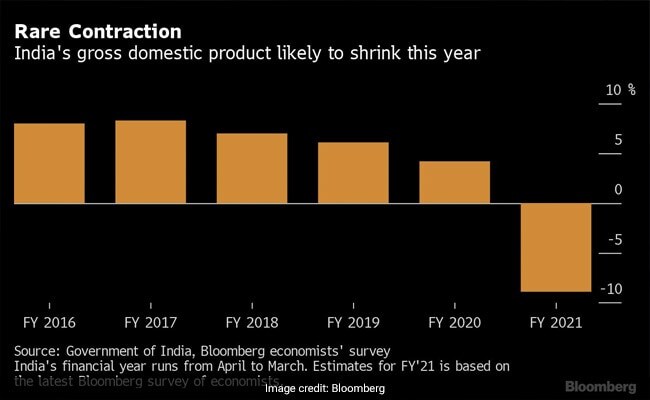
India's economy probably shrank for a second straight quarter, according to a team of economists including Michael Patra, the central bank's deputy governor in charge of monetary policy, pushing the country into an unprecedented recession.
Gross domestic product contracted 8.6 per cent in the quarter ended September, the Reserve Bank of India showed in its first ever published 'nowcast,' which is an estimate based on high-frequency data. The economy had slumped about 24 per cent in April to June.
"India has entered a technical recession in the first half of 2020-21 for the first time in its history," the authors wrote. The government is due to publish official statistics on November 27.
The Reserve Bank's number is buoyed by cost cuts at companies that boosted operating profits even as sales dipped. The team of authors also used a range of indicators from vehicle sales to flush banking liquidity to signal brightening prospects for October. If this upturn is sustained, the Indian economy will return to growth in the October-December quarter, earlier than projected by Governor Shaktikanta Das last month, when he pledged to keep monetary policy accommodative.
However, "there is a grave risk of generalization of price pressures, unanchoring of inflation expectations feeding into a loss of credibility in policy interventions," the team of economists wrote in the Reserve Bank's bulletin. They also highlighted risks to global growth from a second wave of coronavirus infections.
‘Challenging Times'
"Lurking around the corner is the third major risk -- stress intensifying among households and corporations that have been delayed but not mitigated, and could spill over into the financial sector," the economists concluded. "We live in challenging times."
Consumers cut back on spending as millions lost their jobs, preferring instead to squirrel away cash. Preliminary estimates presented in the central bank's bulletin showed a jump in household financial savings to 21.4 per cent of GDP in April-June, up from 7.9 per cent in the same period a year ago and 10% in January-March. The bulk of these savings are bank deposits.
“The trend of higher than usual household financial savings can persist for some time till the pandemic recedes and consumption levels get normalized,” the RBI's Sanjay Kumar Hansda, Anupam Prakash and Anand Prakash Ekka wrote, adding that this could taper as the virus curve flattens and economic activity revives.
(Except for the headline, this story has not been edited by NDTV staff and is published from a syndicated feed.)

-
Unhedged Position: Can India See An Indonesia-Style Time Correction?

The Nifty is trading below levels it first clocked in 2024. Is there, then, as I have suggested in the headline, potential that the current time correction drags on painfully for the next three-five, even ten years?
-
Navigating Friction And Energy Realities: An Analysis Of Marco Rubio's October Visit To India
Occurring at a critical juncture marked by stalled trade negotiations and escalating geopolitical pressures over global energy supplies, the visit offers a profound window into modern US-India relations.
-
India Exports Capital. Why Not Export Trusteeship?
The big question, then, is whether India can build an institution that global borrowers, investors, banks, and lawyers can trust, even without an Indian connection.
-
France's Economy & Politics Are In Crisis | The Reason Why
Let's look at how the French economy and politics evolved under Nicolas Sarkozy, Franois Hollande and Emmanuel Macron.
-
You May Inherit The Business. You Must Earn Its Credibility.
Succession tests the founder's ability to share authority as much as it tests the next generation's readiness to assume it.
-
Signing Deals Is One Thing; Making Them Work Is Another | The Week In Whys
Sometimes, things don't turn out as planned. Indian companies have lost some bids to rivals, some projects won't produce until 2030.
-
FOMC Wall, PERM Suspension, Hospital Stocks | Talking Points This Week
A PERM suspension would directly affect green-card sponsorship rather than H-1B visas, so the near-term earnings impact could remain relatively limited. The key question is whether this marks a new phase in US scrutiny of Indian IT.
-
Everything, Everywhere, All At Once: Dalal Street's Week To Forget | Joining The Dots
Visa curbs, a Starlink spat and cancer drug caps: what connects this week's shocks for Indian markets
-
India Is Going Abroad For Critical Minerals. But It May Take Years To Pay Off | The Reason Why
Although India's steps are in the right direction, they remain modest compared with India's growing dependence.
-
When Everyone Has AI, What Gives You An Edge?
India's young workforce is entering an uncertain world of work where powerful AI tools are becoming widely accessible. The advantage will belong to those who combine deep expertise with digital fluency, and the distinctly human capabilities that technology cannot manufacture.