Economy Estimated To Grow At 9.2% In 2021-22: Government Data
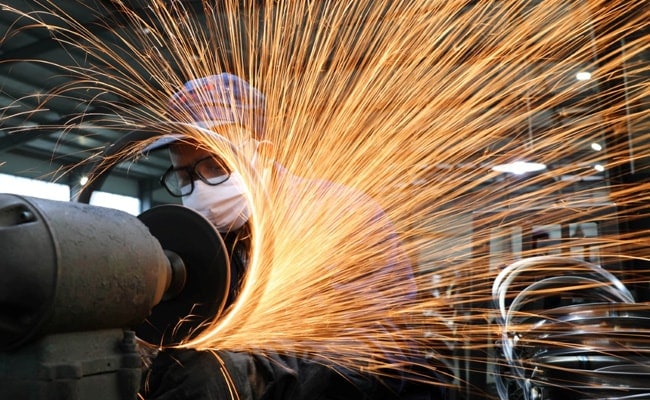
The economy is estimated to grow at 9.2 per cent in the current financial year 2021-22, compared to a contraction of 7.3 per cent in the previous fiscal, mainly due to improvement in the performance of agriculture and manufacturing sectors, government data showed on Friday. Recording its worst-ever performance in more than four decades, India registered a de-growth of 7.3 per cent for the fiscal year 2020-21, putting it among those major economies hit hardest by the COVID-19 pandemic.
The Reserve Bank of India (RBI) had earlier predicted a growth of 9.5 per cent for the current fiscal. Many private economists have trimmed their growth forecasts for the current fiscal year from over 10 per cent as disruptions from the Omicron COVID-19 variant's surge hits consumer sentiment and economic activity.
Releasing the first advance estimates of National Income for 2021-22, the Ministry of Statistics today said that the growth in real gross domestic product (GDP) during 2021-22 is estimated at 9.2 per cent as compared to the contraction of 7.3 per cent in 2020-21.
"Real GVA at Basic Prices is estimated at Rs 135.22 lakh crore in 2021-22, as against Rs 124.53 lakh crore in 2020-21, showing a growth of 8.6 percent," it added.
In the current fiscal, the manufacturing sector is likely to see a growth 12.5 per cent against a contraction of 7.2 per cent a year ago. The government estimates significant growth in 'mining and quarrying' at 14.3 per cent), and 'trade, hotels, transport, communication and services related to broadcasting' at 11.9 per cent.
The agriculture sector is estimated to see a growth of 3.9 per cent in the current fiscal, higher than 3.6 per cent growth recorded in the previous financial year.
The nominal GDP or GDP at current prices in the year 2021-22 is estimated at Rs 232.15 lakh crore, as against the provisional estimate of GDP for the year 2020-21 of Rs 197.46 lakh crore. The growth in nominal GDP during 2021-22 is estimated at 17.6 per cent.
The economy rebounded in the July-September quarter of the current fiscal 2021-22, as the GDP grew by 8.4 per cent from a year earlier on stronger consumer spending. India grew at the fastest pace among major economies - surpassing the pre-COVID levels in the second quarter.
However, in the corresponding quarter of the previous fiscal 2020-21, the GDP contracted by 7.5 per cent- which resulted in India's first technical recession - upon two consecutive quarters of GDP contraction, since 1996, as the pandemic-induced lockdown threatened the pace of the economy and brought industrial activity to a halt.
Meanwhile, India's benchmark 10-year bond yields on Friday recorded the biggest weekly rise in six months amid concerns of heavy debt supplies and inflation, while the rupee inched higher to register a third straight week of gains.
The Reserve Bank of India (RBI) has so far held rates at record lows and said its expects inflation to start dropping from recent highs, but traders are growing worried as global crude prices gain.
The price rise has a direct impact on domestic inflation as India imports around 80 per cent of its oil requirements. Oil prices were heading for their biggest weekly gains since mid-December.
The benchmark 10-year bond yield ended at 6.54 per cent, its highest closing level since January 31, 2020, up one basis point (bp) on the day. On the week, the yield rose nine bps, its biggest weekly rise since the week ending July 9.

-
Navigating Energy Crossroads: S Jaishankar's Call For Diversified Supply Chains At G20 Ministerial Meeting

As geopolitical fault lines continue to test maritime trade routes and commodity flows, Jaishankar's message remains pertinent: true economic resilience requires open markets, protected transit lines, and a genuine commitment to multilateral cooperation rather than coercion.
-
Indians Are Travelling, But Not Every Journey Is A Holiday | The Week In Whys
Pilgrims, patients and working women are the real travellers, and the system hasn't quite caught up with them.
-
Getting To Work Costs Women More | The Reason Why
It is not just about women paying more than men. It is about women paying much more in cities than in villages.
-
AI Bias In Investing Cannot Be Eliminated, But It Can Be Governed
Framing is a particularly important example as identical financial information presented in terms of gains rather than losses can lead an LLM to reach a different assessment.
-
Joining The Dots | Dark Skies, Steady Diya: Why Hope Holds This Diwali
With war, a weak rupee and foreign outflows weighing on sentiment, policymakers at the NDTV World Summit and market veterans at NDTV Profit Ignite: Diwali Edition offered the same advice: stay invested and filter out the noise.
-
The Curious Case of Equitas Small Finance Bank And A CEO Who Quit For Stock
PN Vasudevan believes persistent investor concerns over a perceived conflict of interest had become a governance overhang on Equitas Small Finance Bank's stock, even as the lender improved profitability and asset quality.
-
Talking Points This Week: AI Cash Burn, A Tiger Comeback And An India That Still Finds Its Own Path
India is not immune to higher oil or tighter global liquidity, yet its earnings base is broader, its domestic policy levers are still available.
-
Foreign Investors Own Half Of HDFC Bank and ICICI Bank. An LTCG Cut Could Matter Most Here
Foreign portfolio investors have US$115 billion parked in HDFC Bank, ICICI Bank. If the government cuts long-term capital gains tax, Jefferies says returning foreign money could land here first.
-
'Never Seen This Level Of Negativity': Sandeep Tandon Says The Next Rally May Be Closer Than You Think
Veteran investor Sandeep Tandon says foreign selling is easing, large-caps are due a comeback and mid-caps are crowded, while he turns positive on gold, power and pharma this Diwali.
-
Indians Stay With Family, Not In Hotels | The Reason Why
India still lacks enough clean, reliable and affordable hotels for budget-conscious travellers.










