How India-China Clash Can Impact Alibaba, Xiaomi, Tata Motors, Others
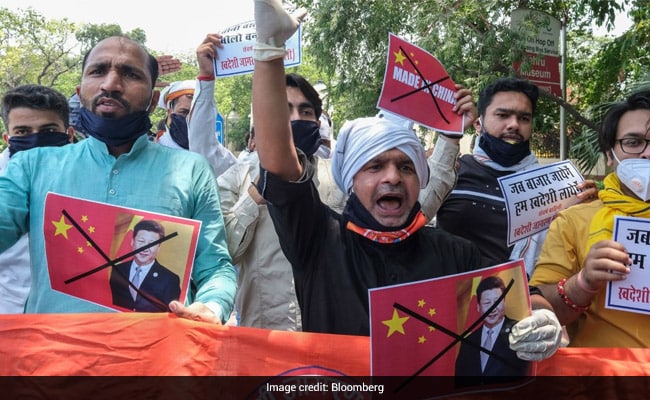
The first deadly face-off between Indian and Chinese troops in more than four decades adds another layer of uncertainty to companies already reeling from the coronavirus pandemic on both sides of the border.
The clashes that left 20 Indian soldiers dead, along with an unknown number of Chinese casualties, followed a seven-week military standoff between the two nuclear-armed powers. While India in a statement late Tuesday said it remains committed to peace on the border with China, an escalation risks disruption for firms from Alibaba Group Holding Ltd. and Xiaomi Corp. to Tata Motors Ltd. that have customers -- and investors -- in two of the world's biggest economies.
"A gamut of companies importing parts or capital from China will have to find alternative sources quickly if tensions escalate," said Aneesh Srivastava, chief investment officer at Star Health and Allied Insurance Co. "The makers of white goods, luggage bags, auto components and some of the e-commerce companies may have to rework their business strategy."

Swathes of Indian businesses that rely on raw materials from China suffered in the initial phase of the outbreak that shuttered plants that feed the global supply chain with all sorts of industrial parts. Another bout of disruption can further prolong a recovery in India's economy that's set for its first annual contraction in more than four decades this year.
For now, Indian equities and the currency are holding up as the Asian giants have a history of face-offs. They fought a war in 1962 over their 3,488 kilometer (2,167 mile) unmarked boundary. The challenge now is to de-escalate as the scale of the previous conflicts "was very small," according to Dai Ming, Shanghai-based fund manager at Hengsheng Asset Management Co.
"I don't think the tensions will affect Chinese firms' investments or businesses in India just yet," he said.
India and China, which together account for a population exceeding 2.7 billion, are key markets for each other's firms. Here are some companies that are seeking to expand their footprint in the two countries.
Business Exposure
Alibaba operates data centers in India and its "UC Browser" is a popular mobile browser in India by page views, according to its prospectus in Hong Kong listing. Xiaomi, on the hand, was the top smartphone brand in India by shipments in the fourth quarter of 2019, with 29 per cent market share, according to its annual report.
Huawei Technologies Co., the Chinese wireless network giant blocked from selling its equipment in the U.S., got approval from the Indian government last year to provide 5G gear in the world's number two wireless market.
India's state-run telecom companies may stop sourcing equipment from Chinese companies, the Economic Times reported Thursday. The government may also prohibit private mobile phone operators from using gear supplied by the likes of Huawei and ZTE, the newspaper cited a senior government official as saying.
Tata Motors, parent of Jaguar Land Rover, this week said it's seeing the beginnings of a demand rebound in China as the world's second-largest economy opens up. The success of JLR is crucial for Tata, which is struggling with an Indian sales slump that began even before Covid-19 wiped out demand.
E-Commerce Investments
Rising tensions may dull China's appetite for India's e-commerce companies as they add to the recent change in policy that put Chinese investors on a list mandating prior clearance for all investments.
Plenty of India's e-commerce firms, including ride-hailing startup Ola and food delivery service Swiggy, count Chinese companies including Alibaba, Tencent Holdings Ltd. and funds like Fosun Capital as their investors.
Supply Chain
An escalation may undermine India's plan to exploit economic opportunities as governments from the U.S. to Europe, Japan and Australia move to cut dependence on China exposed by the pandemic.
Drugmakers including Dr Reddy's Laboratories Ltd. and Aurobindo Pharma Ltd. either buy some ingredients from China, or export final products, while appliances makers including Voltas Ltd. and Bajaj Electricals Ltd. import parts fabricated there.
Defense Players
Meantime, companies producing defense-related products may emerge as winners if the standoff prolongs.
Shares of China's Beijing Emerging Eastern Aviation Equipment Co. and Anhui Great Wall Military Industry Co. soared by their daily limit of 10 per cent on Wednesday. AVIC Aircraft Co., China Avionics Systems Co., AECC Aviation Power Co., Jiangxi Hongdu Aviation Industry Co. are among the stocks that rallied.
In India, Zen Technologies Ltd., a designer of military simulators, jumped 1 per cent in a third day of gains on Thursday, while electronic communication product manufacturer Bharat Electronics Ltd. climbed for a second straight day.

-
High US Salaries, No Green Card Certainty: The Financial Calculation Facing Indian H-1B Families

The suspension of PERM processing at eight technology employers does not cancel existing H-1B visas. What it does is force a question many Indian families have been avoiding: is the US salary worth tying your career and family plans to one employer?
-
Swiggy vs Eternal: Food Delivery's Two Rivals Are No Longer In The Same Race
Eternal is building a private AI assistant, dark.ai. Swiggy is still working out how to make Instamart pay, with an operating loss of Rs 895 crore in the July-September quarter while Blinkit stayed profitable.
-
Where You Live Shapes How You Get To Work | The Reason Why
Two-wheelers are the most popular way to get to work in India, accounting for nearly 43% of workplace commutes.
-
Unhedged Position: Can India See An Indonesia-Style Time Correction?
The Nifty is trading below levels it first clocked in 2024. Is there, then, as I have suggested in the headline, potential that the current time correction drags on painfully for the next three-five, even ten years?
-
Navigating Friction And Energy Realities: An Analysis Of Marco Rubio's October Visit To India
Occurring at a critical juncture marked by stalled trade negotiations and escalating geopolitical pressures over global energy supplies, the visit offers a profound window into modern US-India relations.
-
India Exports Capital. Why Not Export Trusteeship?
The big question, then, is whether India can build an institution that global borrowers, investors, banks, and lawyers can trust, even without an Indian connection.
-
France's Economy & Politics Are In Crisis | The Reason Why
Let's look at how the French economy and politics evolved under Nicolas Sarkozy, Franois Hollande and Emmanuel Macron.
-
You May Inherit The Business. You Must Earn Its Credibility.
Succession tests the founder's ability to share authority as much as it tests the next generation's readiness to assume it.
-
Signing Deals Is One Thing; Making Them Work Is Another | The Week In Whys
Sometimes, things don't turn out as planned. Indian companies have lost some bids to rivals, some projects won't produce until 2030.
-
FOMC Wall, PERM Suspension, Hospital Stocks | Talking Points This Week
A PERM suspension would directly affect green-card sponsorship rather than H-1B visas, so the near-term earnings impact could remain relatively limited. The key question is whether this marks a new phase in US scrutiny of Indian IT.









