India Bullish On Russian Crude, But Exports Face Sanctions Risk: Report
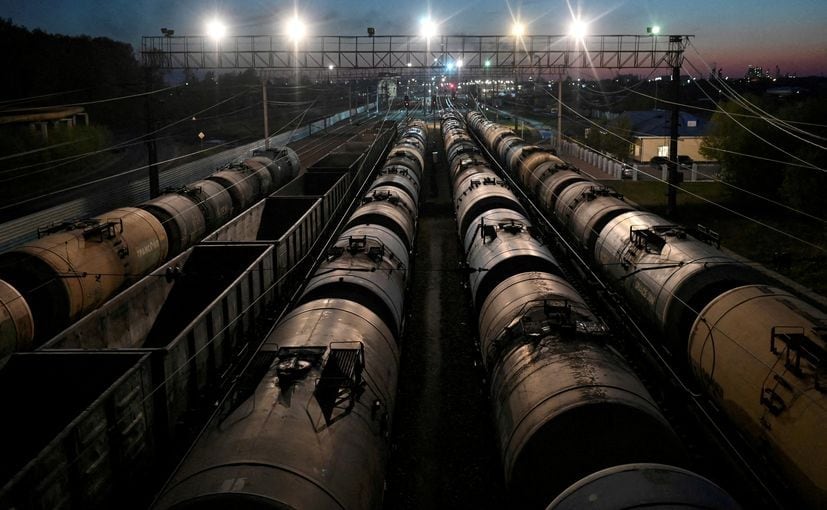
Indian oil refiners are sucking up cheap Russian crude, but the risk is that their exports of refined products will eventually attract sanctions from countries determined to cut Russian energy out of global markets.
Imports of Russian crude by India hit a record high in May, and will likely rise again in June, according to data compiled by commodity analysts Kpler.
India imported 840,645 barrels per day (bpd) of Russian crude in May, up from 388,666 bpd in April and 136,774 bpd in May last year, Kpler data showed.
June imports are estimated at 1.05 million bpd, meaning that Russia's share of India's total imports will rise to just under one quarter, a dramatic spike considering that they were around 2% of the total last year.
Indian refiners are happy to buy heavily discounted Russian crude, which is being offered at up to $40 a barrel below benchmark Brent crude prices.
Russia's crude exports have been targeted by Western countries as part of sanctions aimed at punishing Moscow for its Feb. 24 invasion of Ukraine.
The European Union announced this week a ban on seaborne imports from Russia, and together with Germany and Poland committing to ending pipeline imports, about90% of Russia's exports to the 27-nation bloc will end.
Other importers of Russian crude have said they also aim to either end or reduce their purchases, including major buyers of Russia's Pacific exports such as Japan and South Korea.
However, China, the world's biggest crude importer, and India, the third largest, have thrown a lifeline to Russian exporters, buying increasing volumes to take advantage of the cheaper price relative to other suppliers.
The risk for India's refiners is that buyers of their refined product exports start to target these cargoes, given the possibility that some of the diesel or gasoline was refined out of Russian crude.
India's Reliance Industries is a case in point.
It operates a 1.2 million bpd refinery complex at Jamnagar on India's west coast and while it does supply fuel to the domestic market, much of the output is exported.
The port of Sikka handles Reliance's crude imports, and Kpler data shows that 10.81 million barrels of Russian crude arrived in May, or about 348,000 bpd.
The same port exported 2.0 million barrels of diesel, or about 64,500 bpd, to Australia in May, according to Kpler.
Australia imposed a ban on imports of Russian oil and refined products on March 11, which came into force on April 24.
It's not clear whether the ban applies to fuel refined from Russian crude in a third country, such as India.
But it's likely that the Australian government is going to be asked these questions and will have to work out whether it extends the ban on Russian fuels to those coming from third country refineries.
The port of Sikka also exported 2.56 million barrels of diesel to Europe in May, while it shipped 890,000 barrels of gasoline to the United States in April.
SECONDARY SANCTIONS
It's not just Reliance that may be exporting refined fuel made from Russian crude, with Nayara Energy, which operates India's second-largest refinery, also at risk.
Nayara is owned by a subsidiary of Russia's Rosneft and a subsidiary of commodity trader Trafigura and it operates a refinery at Vadinar on India's west coast.
This port exported 340,000 barrels of diesel to Australia in May, which Kpler said was sold by Nayara.
Overall, it's likely that at some point countries buying and processing Russian crude, and then exporting refined fuels, such as India and possibly China, will find themselves under scrutiny from those governments trying to isolate Russia's energy exports.
There is the risk of secondary sanctions being imposed, but also of measures to make the physical trade more difficult, such as sanctions on ships that have visited Russian ports, bans on insuring Russian crude cargoes, or cargoes of refined products made from Russian oil.
As the world has seen with the sanctions against Iran's oil and product exports, countries and organisations facing such measures try to stay one step ahead, employing subterfuge to mask the true origins of cargoes.
A new game of cat-and-mouse involving Russia's energy exports is just getting started.
(Except for the headline, this story has not been edited by NDTV staff and is published from a syndicated feed.)

-
High US Salaries, No Green Card Certainty: The Financial Calculation Facing Indian H-1B Families

The suspension of PERM processing at eight technology employers does not cancel existing H-1B visas. What it does is force a question many Indian families have been avoiding: is the US salary worth tying your career and family plans to one employer?
-
Swiggy vs Eternal: Food Delivery's Two Rivals Are No Longer In The Same Race
Eternal is building a private AI assistant, dark.ai. Swiggy is still working out how to make Instamart pay, with an operating loss of Rs 895 crore in the July-September quarter while Blinkit stayed profitable.
-
Where You Live Shapes How You Get To Work | The Reason Why
Two-wheelers are the most popular way to get to work in India, accounting for nearly 43% of workplace commutes.
-
Unhedged Position: Can India See An Indonesia-Style Time Correction?
The Nifty is trading below levels it first clocked in 2024. Is there, then, as I have suggested in the headline, potential that the current time correction drags on painfully for the next three-five, even ten years?
-
Navigating Friction And Energy Realities: An Analysis Of Marco Rubio's October Visit To India
Occurring at a critical juncture marked by stalled trade negotiations and escalating geopolitical pressures over global energy supplies, the visit offers a profound window into modern US-India relations.
-
India Exports Capital. Why Not Export Trusteeship?
The big question, then, is whether India can build an institution that global borrowers, investors, banks, and lawyers can trust, even without an Indian connection.
-
France's Economy & Politics Are In Crisis | The Reason Why
Let's look at how the French economy and politics evolved under Nicolas Sarkozy, Franois Hollande and Emmanuel Macron.
-
You May Inherit The Business. You Must Earn Its Credibility.
Succession tests the founder's ability to share authority as much as it tests the next generation's readiness to assume it.
-
Signing Deals Is One Thing; Making Them Work Is Another | The Week In Whys
Sometimes, things don't turn out as planned. Indian companies have lost some bids to rivals, some projects won't produce until 2030.
-
FOMC Wall, PERM Suspension, Hospital Stocks | Talking Points This Week
A PERM suspension would directly affect green-card sponsorship rather than H-1B visas, so the near-term earnings impact could remain relatively limited. The key question is whether this marks a new phase in US scrutiny of Indian IT.









