IMF Chief Economist Gita Gopinath To Leave Job, Return To Harvard University
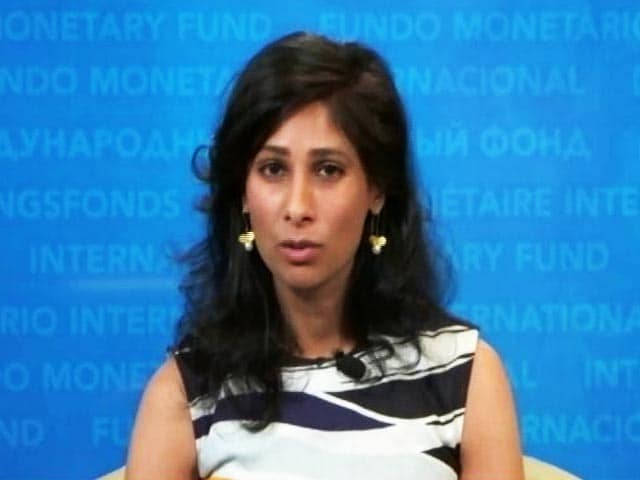
Washington: IMF's Chief Economist Gita Gopinath will leave her job in January next year and return to the prestigious Harvard University, according to the global financial institution.
The 49-year-old prominent Indian-American economist had joined the International Monetary Fund (IMF) as the Chief Economist in January 2019.
She was the John Zwaanstra Professor of International Studies and Economics at Harvard University when she joined the Washington-based global lender.
IMF Managing Director Kristalina Georgieva on Tuesday announced that the search for Gopinath's successor would begin shortly.
“Gita's contribution to the Fund and our membership has been truly remarkable - quite simply, her impact on the IMF's work has been tremendous,” Georgieva said.
Ms Gopinath, Mysuru-born, is the first-ever woman Chief Economist of the IMF.
Harvard University had extended her leave of absence on an exceptional basis by one year, which has allowed her to serve as Chief Economist at the IMF for three years.
“She made history as the first female Chief Economist of the Fund and we benefited immensely from her sharp intellect and deep knowledge of international finance and macroeconomics as we navigate through the worst economic crisis since the Great Depression.
“Gita also won the respect and admiration of colleagues in the Research Department across the Fund, and throughout the membership for leading analytically rigorous work and policy-relevant projects with high impact and influence,” Georgieva said.
The IMF said that as part of her many significant initiatives, Ms Gopinath co-authored the “Pandemic Paper” on how to end the Covid-19 pandemic that set globally endorsed targets for vaccinating the world.
This work led to the creation of the Multilateral Task Force made up of the leadership of the IMF, the World Bank, the World Trade Organisation and the World Health Organisation to help end the pandemic and the establishment of a working group with vaccine manufacturers to identify trade barriers, supply bottlenecks, and accelerate delivery of vaccines to low- and lower-middle income countries, the IMF said in a statement.
Among her other key accomplishments, Ms Gopinath helped set up a Climate Change team inside the IMF to analyse, among other things, optimal climate mitigation policies.
“I would like to express my personal appreciation to Gita for her impressive contributions, her always wise counsel, her devotion for the mission of the Research Department and the Fund more broadly, as well as her widely recognised inclusive and accessible approach to colleagues and staff,” Georgieva added.
Born in December 1971 to Malayalee parents, Ms Gopinath had her schooling in Kolkata and graduated from the Lady Shri Ram College of Commerce in Delhi. She did Masters from the Delhi School of Economics as well as from the University of Washington.
Ms Gopinath did her Ph.D in economics from Princeton University in 2001 and she was guided by Kenneth Rogoff, Ben Bernanke and Pierre-Olivier Gourinchas.
She joined the University of Chicago in 2001 as an Assistant Professor before moving to Harvard in 2005. She became a tenured Professor there in 2010.
She is the third woman in the history of Harvard to be a tenured professor at its esteemed economics department and the first Indian since the Nobel laureate Amartya Sen to hold that position.
(This story has not been edited by NDTV staff and is auto-generated from a syndicated feed.)

-
Talking Points This Week: Tech Nerves, FII Buying, And A Faraway Banking Shock

The global markets are not shining this Diwali. The exception in the large markets is, India.
-
Midterm Rally Lasted A Day. The Hard Reality Of A Divided US May Last Two Years | Opinion
Between a contested AI boom, a debt ceiling that arrives in 2027 and a president with every incentive to act alone, the next two years may prove more volatile than the first day's rally suggests.
-
Blue Wave Will Derail the AI Trade but Won't Dismantle the AI Era | Unhedged Position
The Democrats' sweep of the US Congress will see politics collide with economic forces both over the long and short term.
-
It's Time To Take The GST Council's Bet On Trust Global
Payment records can prove India's services exports, and clear, proportionate rules can bring foreign digital sellers into the tax net.
-
Opinion | India at 38: From Innovation Overperformer to Innovation Powerhouse
India now has 453 VC-backed deep science startups, 18 of them late-stage, after 117 percent growth since 2020. Laurus Labs, at USD 9.3 billion, is the most valuable deep science company in any middle-income economy outside China.
-
Navigating Energy Crossroads: S Jaishankar's Call For Diversified Supply Chains At G20 Ministerial Meeting
As geopolitical fault lines continue to test maritime trade routes and commodity flows, Jaishankar's message remains pertinent: true economic resilience requires open markets, protected transit lines, and a genuine commitment to multilateral cooperation rather than coercion.
-
Indians Are Travelling, But Not Every Journey Is A Holiday | The Week In Whys
Pilgrims, patients and working women are the real travellers, and the system hasn't quite caught up with them.
-
Getting To Work Costs Women More | The Reason Why
It is not just about women paying more than men. It is about women paying much more in cities than in villages.
-
AI Bias In Investing Cannot Be Eliminated, But It Can Be Governed
Framing is a particularly important example as identical financial information presented in terms of gains rather than losses can lead an LLM to reach a different assessment.









