Ignoring Rajan's 2005 Prediction Was a Big Mistake: IMF Chief
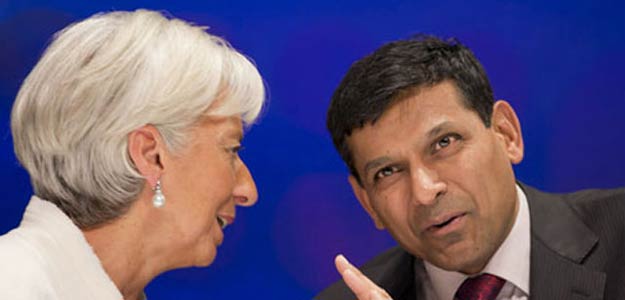
Mumbai: Showering fulsome praise on Reserve Bank of India Governor Raghuram Rajan, International Monetary Fund chief Christine Lagarde on Tuesday said not listening to his prediction of 2008 credit crisis was a big mistake of the multilateral funding agency.
Mr Rajan was the Chief Economist and Research Director at the IMF during 2003-2006.
(Also read: Why IMF Chief Said Rajan is 'Not Bad')
He is credited with correctly forecasting in 2005 an impending global financial crisis at the annual meeting of prominent economists and bankers at Jackson Hole, US.
"The period when nobody was really forecasting the prices that what he did... was one of his many-many accomplishments. One of the many drawbacks of the fund (IMF) was not listen to him enough at that time," Ms Lagarde said.
"But, we do now pay attention to anything that 'Raghu' says," Ms Lagarde said at an event organised by the RBI, which its Governor chaired on Tuesday evening.
Ms Lagarde said India's monetary policy "rests in good hands" and that Mr Rajan is taking several encouraging steps including allowing a greater role for private sector banks.
She praised Mr Rajan for "deftly" steering the Indian economy after the Federal Reserve hinted at withdrawing its easy money policy in May 2013.
"Raghu certainly has been very busy since he took over as the RBI Governor in September 2013. He has deftly steered the Indian economy to safer waters after it was hit by the market turmoil following the 'taper tantrum' episode of mid- 2013," she told a gathering of economists and bankers.
Ms Lagarde, who is here for a two-day visit, welcomed the RBI Governor's recent step to introduce flexible inflation targeting as the new regime for conducting monetary policy.
Mr Rajan's 2005 comments got him few friends and appreciation but lots of opprobrium and ridicule. His Jackson Hole prediction came when the US investor community was reveling in the high growth and stable financial conditions then prevalent around the world.
He had argued that the rising complexities of the markets, which spawned more and more complicated instruments like credit-default swaps and mortgage-backed securities, had in fact made the global financial system a much riskier place, not less so as many believed.
Such statements were not taken seriously then. But just three years later, his comments proved right as the worst financial collapse since the Great Depression of the 1930s hit the world economy by September 2008.

-
Where You Live Shapes How You Get To Work | The Reason Why

Two-wheelers are the most popular way to get to work in India, accounting for nearly 43% of workplace commutes.
-
High US Salaries, No Green Card Certainty: The Financial Calculation Facing Indian H-1B Families
The suspension of PERM processing at eight technology employers does not cancel existing H-1B visas. What it does is force a question many Indian families have been avoiding: is the US salary worth tying your career and family plans to one employer?
-
Unhedged Position: Can India See An Indonesia-Style Time Correction?
The Nifty is trading below levels it first clocked in 2024. Is there, then, as I have suggested in the headline, potential that the current time correction drags on painfully for the next three-five, even ten years?
-
Navigating Friction And Energy Realities: An Analysis Of Marco Rubio's October Visit To India
Occurring at a critical juncture marked by stalled trade negotiations and escalating geopolitical pressures over global energy supplies, the visit offers a profound window into modern US-India relations.
-
India Exports Capital. Why Not Export Trusteeship?
The big question, then, is whether India can build an institution that global borrowers, investors, banks, and lawyers can trust, even without an Indian connection.
-
France's Economy & Politics Are In Crisis | The Reason Why
Let's look at how the French economy and politics evolved under Nicolas Sarkozy, Franois Hollande and Emmanuel Macron.
-
You May Inherit The Business. You Must Earn Its Credibility.
Succession tests the founder's ability to share authority as much as it tests the next generation's readiness to assume it.
-
Signing Deals Is One Thing; Making Them Work Is Another | The Week In Whys
Sometimes, things don't turn out as planned. Indian companies have lost some bids to rivals, some projects won't produce until 2030.
-
FOMC Wall, PERM Suspension, Hospital Stocks | Talking Points This Week
A PERM suspension would directly affect green-card sponsorship rather than H-1B visas, so the near-term earnings impact could remain relatively limited. The key question is whether this marks a new phase in US scrutiny of Indian IT.
-
Everything, Everywhere, All At Once: Dalal Street's Week To Forget | Joining The Dots
Visa curbs, a Starlink spat and cancer drug caps: what connects this week's shocks for Indian markets









