Huawei’s Mystery Phone Rallies China In Fight Against U.S. Curbs
(Bloomberg) -- The surprise launch of a sophisticated $900-plus Huawei Technologies Co. smartphone has captivated China's technology industry, inspiring hopes that the country's biggest firms can overcome US sanctions seemingly designed to thwart their ascendancy.
The slim-bezeled Mate 60 Pro, which appeared this week for sale on online malls with little fanfare, ignited buzz among Chinese online users who saw in the gadget Huawei's resurgence after years of fighting American curbs on software and circuitry. Many posted screenshots and videos of the gadget's fast wireless performance, triggering speculation Huawei had managed to achieve 5G capabilities.
Investors bought in. On Wednesday, shares in more than a dozen Chinese chip designers, gearmakers and Huawei suppliers surged between 8% and 20%. The rally grew out of hopes that Huawei had somehow managed to design, manufacture and deploy a 5G chip capable of matching some of the best America has to offer, despite a lack of access to advanced chipmaking at players including Taiwan Semiconductor Manufacturing Co.
Bloomberg News wasn't able to verify the authenticity of those reports. The Chinese telecom regulator's website didn't show registration details for the model, as required of all wireless smartphones sold in the country.
But the torrent of online reports only gained momentum, in part because of Huawei's unique status as Chinese national champion and American bugbear. On Wednesday, it topped the list of trending topics on Weibo, China's X-like equivalent. The very idea appeared to endorse the “whole nation” narrative Beijing has espoused, where a nationwide effort can produce breakthroughs to counter the US.
The Mate 60 Pro is powered by a Kirin processor designed by Huawei's chip arm HiSilicon, according to multiple teardown videos circulating online. Several online outlets reported the chip employed 5-nanometer node technology — just a generation behind the latest. Bloomberg News couldn't determine the manufacturer or sophistication of the chip.
Chinese chipmakers aren't known to have mastered technologies as advanced as 5-nm. Huawei stockpiled such chips from TSMC right before US sanctions hit, but it's unclear whether the Mate 60 Pro might have used remnants of the company's inventory.
The phone's emergence coincides with a high-profile visit by US Commerce Secretary Gina Raimondo to Beijing and Shanghai. Her agency has been at the forefront of curbs on Chinese entities including Huawei.
“This new phone has huge significance. Though it is evident that Huawei was able to build this model only by sourcing and production in a roundabout way, regardless of what it went though to achieve this, Huawei did it,” said Shi Junbo, a fund manager at Hangzhou XiYan Asset Management Co.
Chinese chip firms and Huawei suppliers including Lontium Semiconductor Corp., Cambricon Technologies Corp. and Anker Innovations Technology Co. climbed between 8% and 11%. Biwin Storage Technology Co. and Guangdong Leadyo IC Testing Co. surged their 20% daily limits. Top Chinese chipmaker Semiconductor Manufacturing International Corp. climbed as much as 6.4% in Hong Kong.
“But in terms of the sentiment lift for the industry today, that shares have been at their lows probably is the more important factor than the phone. One model is probably not going to be enough to have a lasting impact on the sector,” Shi added.
The rally was unusual not just for a lack of evidence to support the online enthusiasm, but also because it coincides with warning signs of Chinese financial and economic stress — in part because of US pressure.
Huawei is one of several Chinese companies at the center of Washington-Beijing tensions, the target of sanctions over allegations it aids China's military. The company, once the world's biggest telecommunications provider, has been pulling out the stops since the Trump administration added Huawei to its Entities List in 2019.
Huawei began by assigning thousands of engineers to try and replicate American technology, for instance in wireless chips. And it also began putting in place the infrastructure to ensure its future survival.
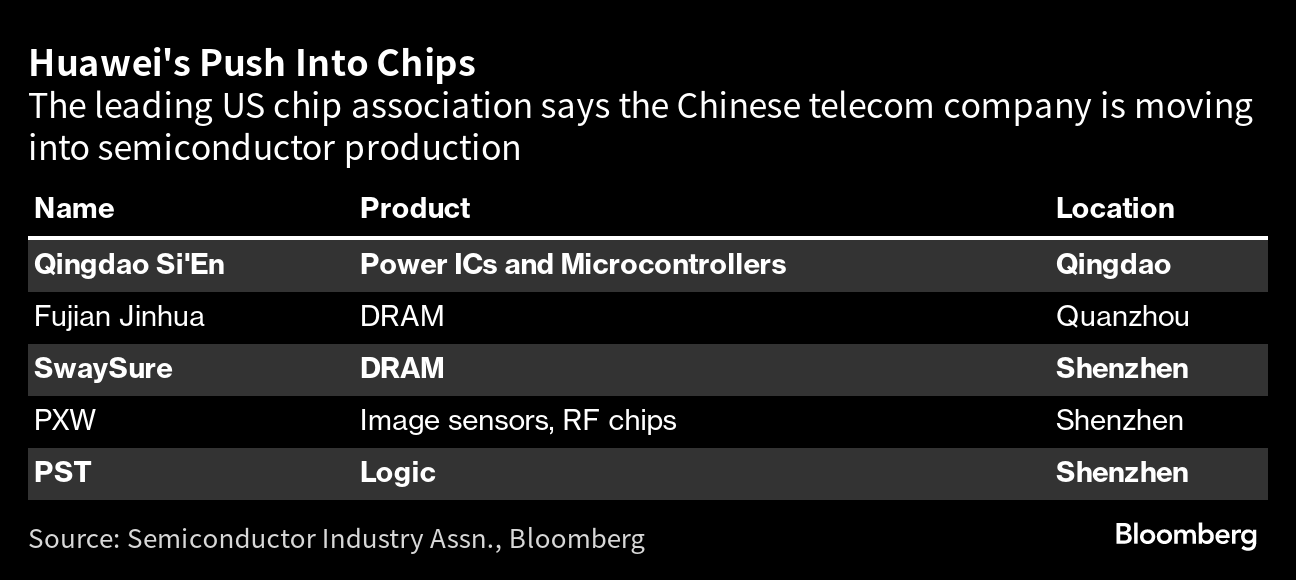
The leading association of global chip companies warned this year that Huawei is building a collection of semiconductor-fabrication facilities across China, a shadow manufacturing network that would let the blacklisted company turn its chip designs into reality.
Read more: Asian AI Chip Stocks Climb as Nvidia, Google Expand Partnership
It remains unclear how Huawei could have found workarounds to some of the most sweeping restrictions on China that the US has ever imposed. Many in America have said Huawei enjoys broad government support, in part because of its critical role in domestic infrastructure and its stature overseas. When then-Chief Financial Officer Meng Wanzhou was detained in Canada, Beijing officials intervened to secure her freedom.
Now, investors hope that Huawei can inspire its peers, several of which also labor under sanctions of varying severity. The Mate 60's launch will be a catalyst for more homegrown, high-end smartphones, and trigger demand in the supply chain especially amid a downturn in semiconductors, Huajin Securities analysts including Sun Yuanfeng wrote in a note.
“It paves the way for Huawei to recover its shipments even quicker in its home country, with an almost zero-cost launch event,” Canalys Senior Vice President Nicole Peng said. “If the rumors are true, it means Huawei's R&D capabilities have largely exceeded the industry development timeline, which means it creates huge disruption to the semi industry and its competitors.”
--With assistance from Debby Wu.
More stories like this are available on bloomberg.com
©2023 Bloomberg L.P.

-
High US Salaries, No Green Card Certainty: The Financial Calculation Facing Indian H-1B Families

The suspension of PERM processing at eight technology employers does not cancel existing H-1B visas. What it does is force a question many Indian families have been avoiding: is the US salary worth tying your career and family plans to one employer?
-
Swiggy vs Eternal: Food Delivery's Two Rivals Are No Longer In The Same Race
Eternal is building a private AI assistant, dark.ai. Swiggy is still working out how to make Instamart pay, with an operating loss of Rs 895 crore in the July-September quarter while Blinkit stayed profitable.
-
Where You Live Shapes How You Get To Work | The Reason Why
Two-wheelers are the most popular way to get to work in India, accounting for nearly 43% of workplace commutes.
-
Unhedged Position: Can India See An Indonesia-Style Time Correction?
The Nifty is trading below levels it first clocked in 2024. Is there, then, as I have suggested in the headline, potential that the current time correction drags on painfully for the next three-five, even ten years?
-
Navigating Friction And Energy Realities: An Analysis Of Marco Rubio's October Visit To India
Occurring at a critical juncture marked by stalled trade negotiations and escalating geopolitical pressures over global energy supplies, the visit offers a profound window into modern US-India relations.
-
India Exports Capital. Why Not Export Trusteeship?
The big question, then, is whether India can build an institution that global borrowers, investors, banks, and lawyers can trust, even without an Indian connection.
-
France's Economy & Politics Are In Crisis | The Reason Why
Let's look at how the French economy and politics evolved under Nicolas Sarkozy, Franois Hollande and Emmanuel Macron.
-
You May Inherit The Business. You Must Earn Its Credibility.
Succession tests the founder's ability to share authority as much as it tests the next generation's readiness to assume it.
-
Signing Deals Is One Thing; Making Them Work Is Another | The Week In Whys
Sometimes, things don't turn out as planned. Indian companies have lost some bids to rivals, some projects won't produce until 2030.
-
FOMC Wall, PERM Suspension, Hospital Stocks | Talking Points This Week
A PERM suspension would directly affect green-card sponsorship rather than H-1B visas, so the near-term earnings impact could remain relatively limited. The key question is whether this marks a new phase in US scrutiny of Indian IT.









