How Sintex’s Attempt To Create Value Destroyed Nearly All Its Wealth

The Sintex Group, known for its namesake water tanks, spun off its flagship textiles and plastic businesses to derive value for shareholders. Two years later, investors have lost nearly all their wealth.
Higher costs, rising debt and sluggish demand have depleted cash. The parent recently defaulted on debenture payments. Things are so dire even the promoters, with the majority of their holdings pledged, didn't convert warrants into equity, underscoring their lack of confidence in the business.
Shares of the parent Sintex Industries Ltd. have plunged more than 93 percent since its peak in 2017, just before the restructuring of the group. Sintex Plastic Technologies Ltd. has tumbled 94 percent since it started trading separately.
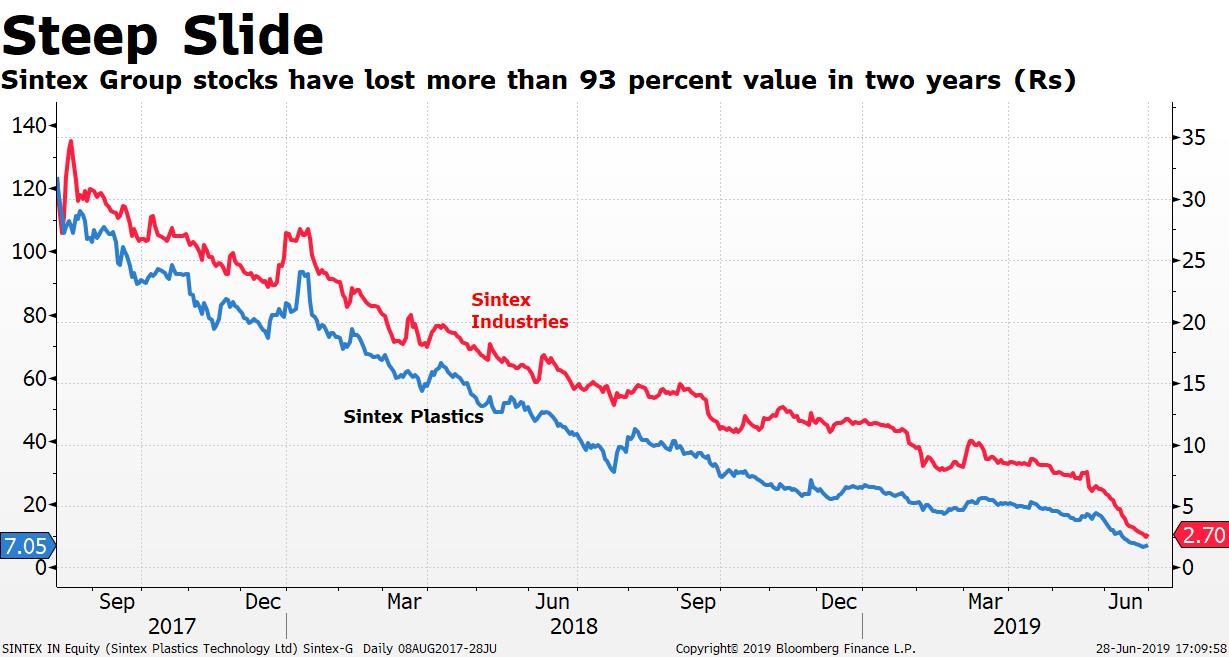
In September 2016, the group carved out its custom moulding and prefab unit to streamline operations, cut costs and ensure better management control. Sintex Industries remained a pure-play textile company, making yarn and fabric. Both segments ran into headwinds.
Sintex Industries
Although revenue increased, expenses almost doubled over the last two years as cost of cotton jumped twofold to Rs 1,769.3 crore in FY19, putting pressure on profit.
That came a year after its purchase cost of fabric nearly doubled to Rs 962 crore because of higher cotton prices and an increase in minimum support price of the crop in FY18. A stronger rupee only hurt the export-oriented sector.
In the last financial year, the demand for yarn remained sluggish largely because exports shrunk. According to India Brand Equity foundation, shipments were down 19.2 percent to $31.65 billion from April 2018 to January 2019.
Forecasts for the ongoing financial year don't offer any hope. Crisil estimates overall cotton yarn demand to grow at a slower pace of 4.5 percent in FY19 compared with 5.6 percent in the last fiscal.
That threatens to put more pressure on its already-stretched balance sheet.
Sintex Industries' debt rose during the period as the cost of infrastructure and automation increased despite its efforts to strengthen financials and deleverage the balance sheet.
In May 2016, the company had issued $110 million foreign currency convertible bonds due 2022. To pare debt and improve financial position, Sintex Industries converted this debt into equity. That brought down outstanding FCCBs to $13.5 million as of March this year.
The company had also issued Rs 500 crore worth of non-convertible debentures as of March. It missed interest and principal repayment worth Rs 88.87 crore due on June 11, according to its exchange filing. To add to its worries, the rest of the debentures are also due this fiscal.
After the default, CARE Ratings Ltd. downgraded the NCDs from ‘C' to ‘D' (issuer not cooperating) on June 12, citing that Sintex Industries failed to provide information for monitoring of the rating and had not paid the surveillance fees. In fact, the rating agency expects to be in default on maturity dates given the stressed liquidity position of the company, CARE said.
Falling Coverage
Debt coverage ratio declined as finance costs rose and earnings fell. Higher debt compared to its net worth further deteriorated return on common equity.
Key Numbers
Low Cash: Sintex Industries has Rs 84 crore worth of cash and investments as of March against Rs 5,314.6-crore debt. Debenture redemption reserve of Rs 111.03 crore will only cover a third of the NCDs falling due this fiscal.
Struggling Subsidiaries: And it can't expect help from its subsidiaries Sintex Prefab and Infra Ltd. and Sintex-BAPL Ltd. because of deterioration of their financial position.
- Sintex BAPL reported a loss of Rs 79 lakh in FY19 against profit of Rs 21.21 crore in the previous fiscal because of higher finance costs.
- Sintex Prefab & Infra reported a profit of Rs 6.28 crore in FY19 against Rs 52.2 crore in FY18.
No Room To Pledge More Shares: And with 84 percent of the promoter shares already pledged, ability to raise more debt against shares is low.
The only hope would have been improvement in business fundamentals. But given the seasonality of cotton availability and sluggish yarn demand, revenue may take a hit. Realisations have shrunk mainly on account of slowdown in the textile industry coupled with the U.S.-China trade war.
Already, inventory on hand has risen because of delayed sales. Stock stayed on its books for nearly 100 days compared with a little over 67 in FY18.
And that will increase working capital requirements even though the company is not in a position to borrow more. It plans to divest up to 24.99 percent stake by September in its trading arm M/s. BVM Overseas Ltd., which has a net worth of Rs 18.37 crore.
Sintex Plastics
While slowdown in demand from automakers has hurt its custom moulding business, according to the company's earnings statement, lower private spending and a liquidity crunch impacted growth of the prefabrication and infrastructure businesses.
The unit's revenue and profits have fallen for two straight years.
Its Rs 2,000-crore capital invested in the business in FY19 only returned Rs 27 crore.
It has been a challenging quarter as pre-election spending was skewed and the automotive segment remained sluggish, Amit Patel, managing director at Sintex Plastic, said in the earnings statement. The company plans to sell Sintex BAPL, a subsidiary of the auto division, assets to pare debt.
That, however, may be difficult amid slacking demand.
The company has Rs 383 crore worth of cash and investments against a Rs 3,096.2- crore debt as of March. And with 70.59 percent of the promoter stake pledged, the company's ability to raise funds might remain restricted like Sintex Industries.
The group has yet to respond to BloombergQuint's emailed queries on its plans to repay debt, poor financials and loss-making subsidiaries.
Phillip Capital, one of the few analysts that tracked the group's stocks, recently suspended coverage. Promoters' inability to further exercise their right of conversion of warrants manifests a lack of confidence in the business and turnaround, Vikram Suryavanshi, analyst at the brokerage said. Phillip Capital is not sanguine about the management's guidance of debt reduction and cash-flow management.

-
Why Amazon And Flipkart Are Struggling To Beat Meesho In India's Smaller Cities

With 274 million users and lowest-cost logistics, Meesho is defending its value commerce crown against giants like Amazon and Flipkart.
-
High US Salaries, No Green Card Certainty: The Financial Calculation Facing Indian H-1B Families
The suspension of PERM processing at eight technology employers does not cancel existing H-1B visas. What it does is force a question many Indian families have been avoiding: is the US salary worth tying your career and family plans to one employer?
-
Swiggy vs Eternal: Food Delivery's Two Rivals Are No Longer In The Same Race
Eternal is building a private AI assistant, dark.ai. Swiggy is still working out how to make Instamart pay, with an operating loss of Rs 895 crore in the July-September quarter while Blinkit stayed profitable.
-
Where You Live Shapes How You Get To Work | The Reason Why
Two-wheelers are the most popular way to get to work in India, accounting for nearly 43% of workplace commutes.
-
Unhedged Position: Can India See An Indonesia-Style Time Correction?
The Nifty is trading below levels it first clocked in 2024. Is there, then, as I have suggested in the headline, potential that the current time correction drags on painfully for the next three-five, even ten years?
-
Navigating Friction And Energy Realities: An Analysis Of Marco Rubio's October Visit To India
Occurring at a critical juncture marked by stalled trade negotiations and escalating geopolitical pressures over global energy supplies, the visit offers a profound window into modern US-India relations.
-
India Exports Capital. Why Not Export Trusteeship?
The big question, then, is whether India can build an institution that global borrowers, investors, banks, and lawyers can trust, even without an Indian connection.
-
France's Economy & Politics Are In Crisis | The Reason Why
Let's look at how the French economy and politics evolved under Nicolas Sarkozy, Franois Hollande and Emmanuel Macron.
-
You May Inherit The Business. You Must Earn Its Credibility.
Succession tests the founder's ability to share authority as much as it tests the next generation's readiness to assume it.
-
Signing Deals Is One Thing; Making Them Work Is Another | The Week In Whys
Sometimes, things don't turn out as planned. Indian companies have lost some bids to rivals, some projects won't produce until 2030.










