How Secret Derivatives Trading Led To The Fiasco At Archegos Capital Management

The forced liquidation of more than $20 billion in holdings linked to Bill Hwang's investment firm is drawing attention to the covert financial instruments he used to build large stakes in companies. Much of the leverage used by Hwang's Archegos Capital Management was provided by banks including Nomura Holdings Inc. and Credit Suisse Group AG through swaps or so-called contracts-for-difference, according to people with direct knowledge of the deals. It means Archegos may never actually have owned most of the underlying securities -- if any at all.
While investors who own a stake of more than 5 per cent in a U.S.-listed company usually have to disclose their holdings and subsequent transactions, that's not the case with positions built through the type of derivatives apparently used by Archegos. The products, which are transacted off exchanges, allow managers like Hwang to amass exposure to publicly-traded companies without having to declare it.
The swift unwinding of Archegos has reverberated across the globe, after banks such as Goldman Sachs Group Inc. and Morgan Stanley forced Hwang's firm to sell billions of dollars in investments accumulated through highly leveraged bets. The selloff roiled stocks from Baidu Inc. to ViacomCBS Inc., and prompted Nomura and Credit Suisse to disclose that they face potentially significant losses on their exposure.
One reason for the widening fallout is the borrowed funds that investors use to magnify their bets: a margin call occurs when the market goes against a large, leveraged position, forcing the hedge fund to deposit more cash or securities with its broker to cover any losses. Archegos was probably required to deposit only a small percentage of the total value of trades.
The chain of events set off by this massive unwinding is yet another reminder of the role that hedge funds play in the global capital markets. A hedge fund short squeeze during a Reddit-fueled frenzy for Gamestop Corporation shares earlier this year spurred a $6 billion loss for Gabe Plotkin's Melvin Capital and sparked scrutiny from U.S. regulators and politicians.
The idea that one firm can quietly amass outsized positions through the use of derivatives could set off another wave of criticism directed against loosely regulated firms that have the power to destabilize markets.
While the margin calls on Friday triggered losses of as much as 40 per cent in some shares, there was no sign of contagion in markets broadly on Monday. Contrast that with 2008, when Ireland's then-richest man used derivatives to build a position so large in Anglo Irish Bank Corporation. It eventually contributed to the country's international bailout. In 2015, New York-based FXCM Inc. needed rescuing because of losses at its U.K. affiliate resulting from the unexpected de-pegging of the Swiss franc.
Much about Hwang's trades remains unclear, but market participants estimate his assets had grown to anywhere from $5 billion to $10 billion in recent years and total positions may have topped $50 billion.
"This is a challenging time for the family office of Archegos Capital Management, our partners and employees," Karen Kessler, a spokesperson for Archegos, said late Monday in an emailed statement. "All plans are being discussed as Mr. Hwang and the team determine the best path forward."
CFDs and swaps are among bespoke derivatives that investors trade privately between themselves, or over-the-counter, instead of through public exchanges. Such opacity helped to worsen the 2008 financial crisis and regulators have introduced a vast new body of rules governing the assets since then.
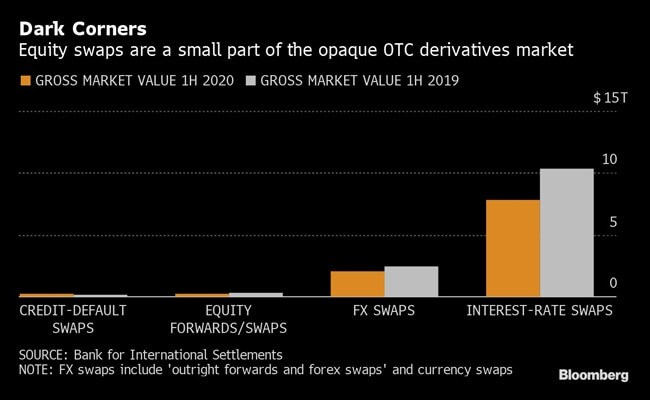
Over-the-counter equity derivatives occupy one of the smallest corners of this opaque market. Swaps and forwards linked to stocks had a gross market value of $282 billion at the end of June 2020, according to data from the Bank for International Settlements. That compared with $10.3 trillion for swaps linked to interest rates and $2.4 trillion for swaps and forwards linked to currencies.
Regulators have begun clamping down on CFDs in recent years because they're concerned the derivatives are too complex and too risky for retail investors, with the European Securities and Markets Authority in 2018 restricting the distribution to individuals and capping leverage. In the U.S., CFDs are largely banned for amateur traders.
Banks still favor them because they can make a large profit without needing to set aside as much capital versus trading actual securities, another consequence of regulation imposed in the aftermath of the global financial crisis. Among hedge funds, equity swaps and CFDs grew in popularity because they are exempt from stamp duty in high-tax jurisdictions such as the U.K.
(Except for the headline, this story has not been edited by NDTV staff and is published from a syndicated feed.)

-
Opinion | India at 38: From Innovation Overperformer to Innovation Powerhouse

India now has 453 VC-backed deep science startups, 18 of them late-stage, after 117 percent growth since 2020. Laurus Labs, at USD 9.3 billion, is the most valuable deep science company in any middle-income economy outside China.
-
Navigating Energy Crossroads: S Jaishankar's Call For Diversified Supply Chains At G20 Ministerial Meeting
As geopolitical fault lines continue to test maritime trade routes and commodity flows, Jaishankar's message remains pertinent: true economic resilience requires open markets, protected transit lines, and a genuine commitment to multilateral cooperation rather than coercion.
-
Indians Are Travelling, But Not Every Journey Is A Holiday | The Week In Whys
Pilgrims, patients and working women are the real travellers, and the system hasn't quite caught up with them.
-
Getting To Work Costs Women More | The Reason Why
It is not just about women paying more than men. It is about women paying much more in cities than in villages.
-
AI Bias In Investing Cannot Be Eliminated, But It Can Be Governed
Framing is a particularly important example as identical financial information presented in terms of gains rather than losses can lead an LLM to reach a different assessment.
-
Joining The Dots | Dark Skies, Steady Diya: Why Hope Holds This Diwali
With war, a weak rupee and foreign outflows weighing on sentiment, policymakers at the NDTV World Summit and market veterans at NDTV Profit Ignite: Diwali Edition offered the same advice: stay invested and filter out the noise.
-
The Curious Case of Equitas Small Finance Bank And A CEO Who Quit For Stock
PN Vasudevan believes persistent investor concerns over a perceived conflict of interest had become a governance overhang on Equitas Small Finance Bank's stock, even as the lender improved profitability and asset quality.
-
Talking Points This Week: AI Cash Burn, A Tiger Comeback And An India That Still Finds Its Own Path
India is not immune to higher oil or tighter global liquidity, yet its earnings base is broader, its domestic policy levers are still available.
-
Foreign Investors Own Half Of HDFC Bank and ICICI Bank. An LTCG Cut Could Matter Most Here
Foreign portfolio investors have US$115 billion parked in HDFC Bank, ICICI Bank. If the government cuts long-term capital gains tax, Jefferies says returning foreign money could land here first.










