How Mukesh Ambani Vs Jeff Bezos Is Playing Out In India
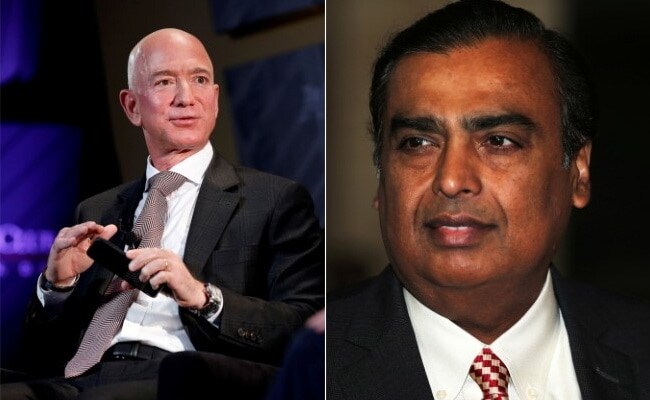
Jeff Bezos and Mukesh Ambani, two of the world's richest men, face a turning point in a battle for preeminence in India's booming, nearly trillion-dollar retail market.
The outcome of a legal dispute which has embroiled the billionaires' Amazon.com and Reliance Industries Ltd empires - where a court ruling is imminent - may shape India's retail landscape for years to come.
The winner in the fight for Future Retail Ltd, Amazon's estranged local partner, will get pole position in the race to meet the daily needs of more than a billion people.
Accusations of insider trading and contractual breaches, as well as nationalistic cries to keep the US giant at bay, mark the high-stakes fight, which has snowballed from what began as a dispute between Amazon and Future.
If Amazon succeeds, it may slow Reliance's plans to expand its e-commerce and brick-and-mortar operations. If Amazon loses, its hopes of expanding its interests in India's second-largest retailer and cashing in on its key grocery supply chain will be dashed, industry insiders say.
Amazon is trying to stop Reliance's $3.4 billion purchase of Future Group's retail assets. The US company, which won an injunction from an arbitrator to block the Reliance-Future deal, accuses its partner of breaching some pre-existing agreements, misleading the public and insider trading. Future denies the allegations.
Amazon, Reliance and Future did not respond to requests for comment.
Mr Bezos's behemoth is a formidable foe, but Mr Ambani has a history as a disrupter. He has shaken foreign telecom firms by offering dirt-cheap data. Industry executives see his e-commerce plans as a threat for Amazon and Walmart Inc's Flipkart.
"If Reliance moves faster and faster, obviously it'll become very difficult for anyone else to gain," said Himanshu Bajaj, head of consulting firm Kearney's India retail practice.
Reliance, seeking to expand its JioMart e-commerce business, this month completed a $6.4 billion fund-raising by selling a stake in its retail arm to such investors as Silver Lake Partners and KKR & Co.
Groceries, 'Big Brother' In America
India's retail market will grow 46 per cent over the next four years to an annual $1.3 trillion, reckons Forrester Research. The key battle is over groceries, expected to be worth around $740 billion a year by 2024.
Founded by Kishore Biyani, dubbed India's retail king, Future transformed the country's retailing in recent decades, before COVID-19 hit the business so hard this year that Mr Biyani was forced to find a new buyer.
Around 1,300 of Future's more than 1,700 retail outlets in 400 cities sell groceries. Its budget supermarkets cater to middle-class shoppers, while its upmarket stores offer products like imported cheese and fresh guacamole, relatively rare in India's retail landscape.
That makes Future a prized asset for both Reliance and Amazon.
Reliance and Future dominate the market, with the next competitor, Avenue Supermarts Ltd's DMart, having just 220 outlets in around 70 cities.
While Reliance boasts around 11,000 retail stores, just 800 of those offer food and groceries, UBS estimates. Future's retail assets would nearly triple Reliance's footprint in the grocery segment and boost its e-commerce plans, said Forrester analyst Satish Meena.
Amazon sees Future as a long-term play to optimise its supply chain for grocery delivery, an area where it has lagged, Mr Meena said.
"Grocery is the category in which you fight," he said, while losing Future to Reliance would "slow Amazon".
Amazon, Future and Reliance this month hired some of India's top lawyers, who argued at length before a judge. She is expected to decide soon whether to restrain Amazon from approaching regulators to block the Future-Reliance deal.
Amid heated legal arguments and patriotic appeals, Future's lawyer attacked Amazon as "Big Brother" in America, arguing Future faces bankruptcy if the Reliance deal fails.
"Please don't allow this American giant to kill Future," the lawyer urged the judge.

-
Navigating Friction And Energy Realities: An Analysis Of Marco Rubio's October Visit To India

Occurring at a critical juncture marked by stalled trade negotiations and escalating geopolitical pressures over global energy supplies, the visit offers a profound window into modern US-India relations.
-
India Exports Capital. Why Not Export Trusteeship?
The big question, then, is whether India can build an institution that global borrowers, investors, banks, and lawyers can trust, even without an Indian connection.
-
France's Economy & Politics Are In Crisis | The Reason Why
Let's look at how the French economy and politics evolved under Nicolas Sarkozy, Franois Hollande and Emmanuel Macron.
-
You May Inherit The Business. You Must Earn Its Credibility.
Succession tests the founder's ability to share authority as much as it tests the next generation's readiness to assume it.
-
Signing Deals Is One Thing; Making Them Work Is Another | The Week In Whys
Sometimes, things don't turn out as planned. Indian companies have lost some bids to rivals, some projects won't produce until 2030.
-
FOMC Wall, PERM Suspension, Hospital Stocks | Talking Points This Week
A PERM suspension would directly affect green-card sponsorship rather than H-1B visas, so the near-term earnings impact could remain relatively limited. The key question is whether this marks a new phase in US scrutiny of Indian IT.
-
Everything, Everywhere, All At Once: Dalal Street's Week To Forget | Joining The Dots
Visa curbs, a Starlink spat and cancer drug caps: what connects this week's shocks for Indian markets
-
India Is Going Abroad For Critical Minerals. But It May Take Years To Pay Off | The Reason Why
Although India's steps are in the right direction, they remain modest compared with India's growing dependence.
-
When Everyone Has AI, What Gives You An Edge?
India's young workforce is entering an uncertain world of work where powerful AI tools are becoming widely accessible. The advantage will belong to those who combine deep expertise with digital fluency, and the distinctly human capabilities that technology cannot manufacture.
-
Wrong Labels, High Pesticide Residues Holding Back Agri Exports | The Reason Why
India needs stronger domestic food-safety and labelling standards, with best practices becoming part of everyday business for farmers, traders and food companies.










