Hollywood Writers Are Going on Strike For First Time in 15 Years
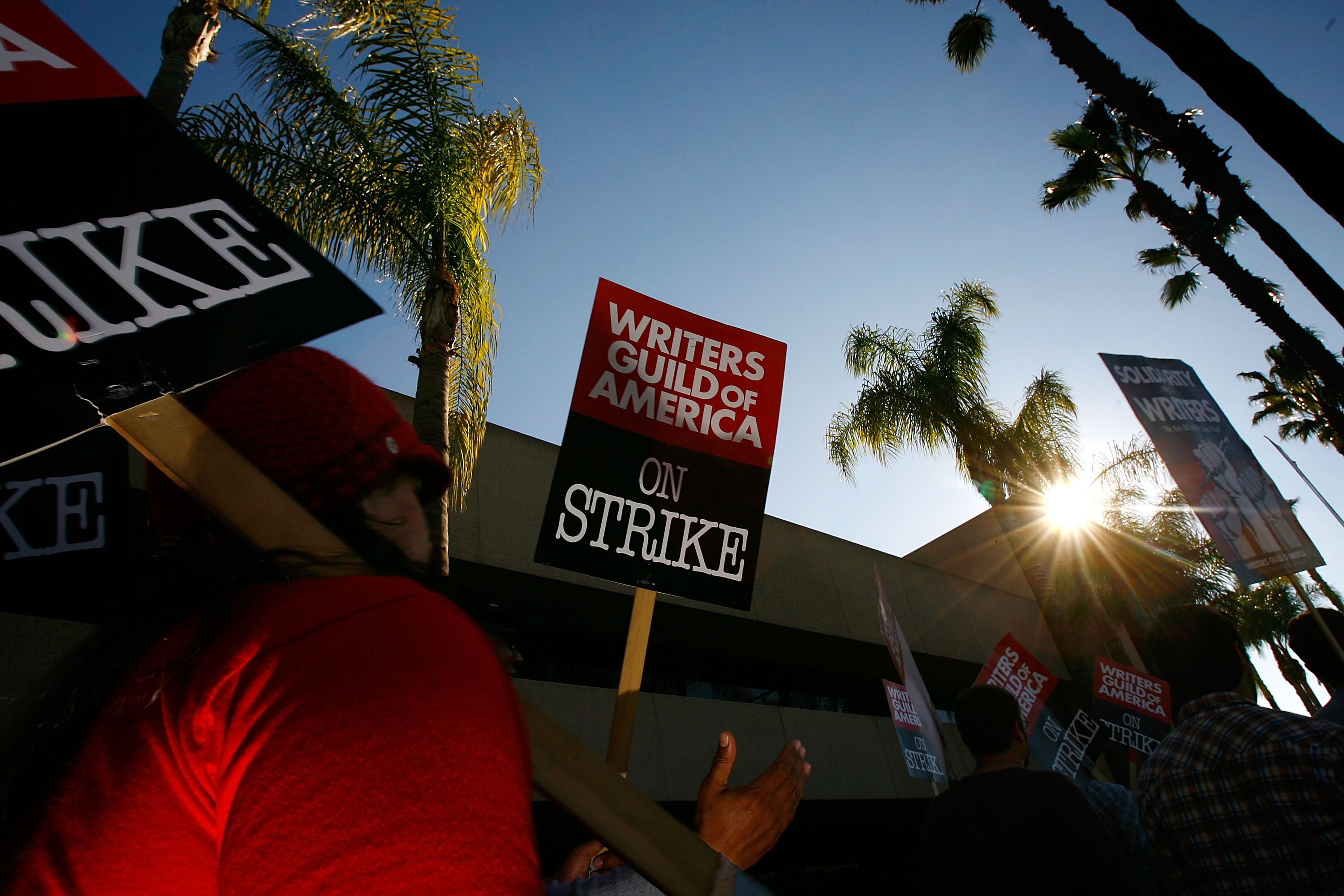
(Bloomberg) -- Writers for some of the most popular shows on television are walking off the job, striking for higher pay amid rapid changes in the way people watch their programs and films.
The Writers Guild of America, which represents more than 11,500 Hollywood scribes, said its strike is effective Tuesday morning Los Angeles time. Members voted overwhelmingly to authorize the walkout last month.
As a result, work on late night talk shows — such as and — and soap operas could halt immediately. Depending on how long the work stoppage lasts, consumers could miss episodes of their favorite shows this fall. Movie release schedules could be impacted. The walkout could also depress the economy of Los Angeles, the nation's second-largest city, which is already struggling with slower home sales and labor disruptions at its port.
In a statement Monday night, the union said the decision to strike was made after six weeks of negotiations and that the studios' responses have been “wholly insufficient given the existential crisis writers are facing.” The guild added that the studios have been “stonewalling” on issues such as the use of artificial intelligence in script production.
Writers are concerned that generative AI tools such as ChatGPT could be cut out of the creative process, and the union has called for regulation of the technology as part of its contract. Although the group doesn't oppose the use of AI, it says it shouldn't share writing credits, or get a chunk of the residuals.
“It is important to note that AI software does not create anything. It generates a regurgitation of what it's fed,” the Writers Guild wrote.
The last time the WGA walked out, in 2007, was the fifth strike in the union's 90-year history. The writers put down their pens for 100 days, costing the Los Angeles economy some $2.5 billion, the Los Angeles County Economic Development Corp. estimates. Dozens of popular shows, including , , , and had to run seasons with fewer episodes. and seasons were postponed, and and were canceled. The standoff led to a surge in reality-TV shows, which don't need screenplays.
Read more: Every US Movie and TV Show Risks Stopping as Strike Looms
If the current strike drags on, the stoppage could prevent broadcast networks, such as Walt Disney Co, which owns ABC, and Paramount Global, which owns CBS, from producing shows for the fall season. But it would likely have little immediate impact on the release of scripted TV or movies. Netflix Inc., for example, has a big pipeline of shows ready to go for the next several months so it would likely see little impact from a prolonged strike.
The Alliance of Motion Picture & Television Producers, which represents Hollywood studios, said in a separate statement Monday night that it presented “generous increases” in compensation to writers as well as improvements in residual payments for shows that are on streaming services. The studios said they were prepared to improve that offer, but were unwilling to do so because of the magnitude of other requests from the writers.
The key points of contention are mandatory staffing and duration of employment, with the studios arguing that the writers guild is seeking contracts for a minimum number of writers on shows regardless of whether they're needed, according to the alliance's statement.
The union says the studios that produce television shows and films have used the transition from traditional TV viewing to streaming to cut writers' pay. More writers are working at union minimums and for shorter periods, the union said.
In the heyday of network TV, writers often worked on 22-episode seasons that included pilot episodes written before the series was officially picked up. In the streaming era, seasons may consist of only six or eight episodes and programs are ordered directly without pilots.

With streaming services often picking up global rights to shows for multiple years, there's less opportunity for writers to earn huge paydays from recurring and international sales.
The strike is coming amid an overall contraction in entertainment spending following several boom years after Netflix, Disney and others spent heavily to create new programs for their streaming services. Disney is in the process of laying off 7,000 staffers, many of whom worked in the creation or marketing of shows.
Film and TV production in Los Angeles tumbled 24% in the first quarter, as measured by FilmLA, which administers permits for shoots. Among the hardest hit categories was TV dramas, a staple of streaming and cable TV, which fell 40%.
More stories like this are available on bloomberg.com
©2023 Bloomberg L.P.

-
Ten Things I Learnt This Samvat

Patience can be a trap. Cheap stocks can stay cheap. Leverage can wipe you out. What did Samvat 2082 teach us? Niraj Shah writes on 10 lessons from the year gone by.
-
Talking Points This Week: Tech Nerves, FII Buying, And A Faraway Banking Shock
The global markets are not shining this Diwali. The exception in the large markets is, India.
-
Midterm Rally Lasted A Day. The Hard Reality Of A Divided US May Last Two Years | Opinion
Between a contested AI boom, a debt ceiling that arrives in 2027 and a president with every incentive to act alone, the next two years may prove more volatile than the first day's rally suggests.
-
Blue Wave Will Derail the AI Trade but Won't Dismantle the AI Era | Unhedged Position
The Democrats' sweep of the US Congress will see politics collide with economic forces both over the long and short term.
-
It's Time To Take The GST Council's Bet On Trust Global
Payment records can prove India's services exports, and clear, proportionate rules can bring foreign digital sellers into the tax net.
-
Opinion | India at 38: From Innovation Overperformer to Innovation Powerhouse
India now has 453 VC-backed deep science startups, 18 of them late-stage, after 117 percent growth since 2020. Laurus Labs, at USD 9.3 billion, is the most valuable deep science company in any middle-income economy outside China.
-
Navigating Energy Crossroads: S Jaishankar's Call For Diversified Supply Chains At G20 Ministerial Meeting
As geopolitical fault lines continue to test maritime trade routes and commodity flows, Jaishankar's message remains pertinent: true economic resilience requires open markets, protected transit lines, and a genuine commitment to multilateral cooperation rather than coercion.
-
Indians Are Travelling, But Not Every Journey Is A Holiday | The Week In Whys
Pilgrims, patients and working women are the real travellers, and the system hasn't quite caught up with them.
-
Getting To Work Costs Women More | The Reason Why
It is not just about women paying more than men. It is about women paying much more in cities than in villages.









