Here’s What NITI Aayog Suggests To Make India $4 Trillion Economy By 2023
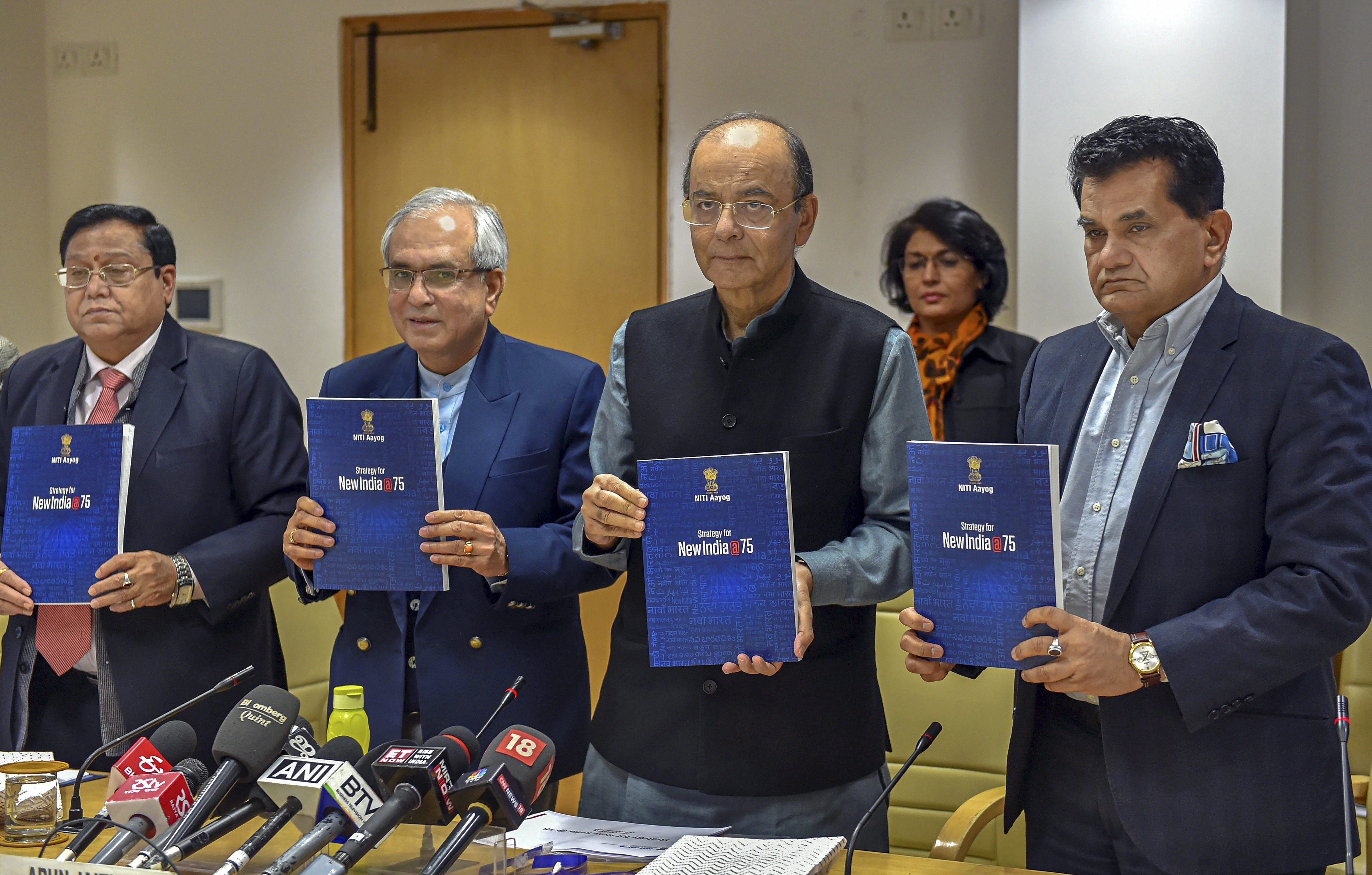
Niti Aayog said India should lower both personal and corporate tax rates as the nation's planning think tank suggested ways for the government to sustain an average GDP growth of 8 percent, raising the economy's size to $4 trillion in real terms.
Efforts will also be needed to rationalise direct taxes for both corporate tax and personal income tax, NITI Aayog said in its ‘Strategy for New India @ 75' document. The government will also have to ease the tax compliance burden and eliminate direct interface between taxpayers and tax officials using technology.
India should aim to increase its tax-GDP ratio to 22 percent of GDP by 2022-23. Two reforms undertaken by the government—demonetisation and the Goods and Service Tax—will contribute positively to this, it said.
India's tax-GDP ratio is around 17 percent, half of the average 35 percent for countries part of Organisation for Economic Co-operation and Development. It is also low compared to other emerging economies like Brazil's 34 percent, and 27 percent and 22 percent of South Africa and China, respectively.
States can also undertake greater mobilisation of their taxes such as property tax and take steps to improve administration of GST to better tax collections, the document said.
Focus On Housing, Infrastructure
NITI Aayog said besides having rapid growth, which reaches 9-10 per cent by 2022-23, it is also necessary to ensure that growth is inclusive, sustained, clean and formalised.
This can be done by increasing the investment rate in the country measured by Gross Fixed Capital Formation to 36 percent of the GDP by 2022 from 29 percent currently. A slew of measures will be required to boost both private and public investment, it said.
Two areas, according to the strategy document, in which higher public investment will be easily absorbed are housing and infrastructure. "Investment in housing, especially in urban areas, will create very large multiplier effects in the economy."
Investment in physical infrastructure will address long-standing deficiencies faced by the economy, it said.
Divestments
The document also said that the government should continue to exit public sector undertakings that are not strategic in nature. “Inefficient CPSEs surviving on government support distort entire sectors as they operate without any real budget constraints,” it said.
The government's exit will attract private investment and contribute to the exchequer, enabling higher public investment, it said.
The government should also offload its stake in larger PSUs with the aim to create widely-held companies where no single promoter has control. "This will both improve management efficiency and allow government to monetise its holdings with substantial contribution to public finances," the document said.
Private investment, on the other hand, needs be encouraged in infrastructure through a renewed public-private partnership mechanism.
Thrust On Exports, Manufacturing
An effort to make logistics sector more efficient, rationalisation of power tariffs to ensure global competitiveness of Indian industries, among others are some of the reforms needed to keep India globally competitive, particularly in the production and exports of manufactured goods, including processed agricultural goods.
Other reforms suggested by NITI Aayog that will help in improving the competitiveness are:
- Import tariffs that seek to promote indigenous industry should come with measures to raise productivity which will provide the ability to compete globally.
- Improve connectivity by accelerating completion of announced infrastructure projects. Enhancing physical connectivity will help reduce delivery times and improve global connectivity and the reach of our exporters.
- By 2022-23, India should complete projects that are already underway such as the Delhi-Mumbai Industrial Corridor and Dedicated Freight Corridors.
- Work with states to ease labour and land regulations. India should introduce flexibility in labour provisions across sectors. All state governments should speedily implement fixed-term employment that has now been extended to cover all sectors.
The document has been divided under four sections, namely Drivers, Infrastructure, Inclusion and Governance, and was prepared after consultations with over 800 stakeholders from within the government - central, state and district levels.
Other recommendations from the strategy document include:
- In agriculture, government should shift the emphasis on converting farmers to “agripreneurs” by further expanding e-National Agriculture Markets and replacing the Agricultural Produce Marketing Committee Act with the Agricultural Produce and Livestock Marketing Act.
- Give a strong push to “Zero Budget Natural Farming” techniques that reduce costs, improve land quality and increase farmers' incomes.
- To ensure maximum employment creation, complete codification of labour laws and a massive effort must be made to upscale and expand apprenticeships.
- Launch a mission “Explore in India” by revamping minerals exploration and licensing policy.
- Expedite establishment of the Rail Development Authority, which is already approved. RDA will advise or make informed decisions on an integrated, transparent and dynamic pricing mechanism for the railways.
- Double the share of freight transported by coastal shipping and inland waterways. Initially, viability gap funding will be provided until the infrastructure is fully developed. Develop an IT-enabled platform for integrating different modes of transport and promoting multi-modal and digitised mobility.
- Successfull implementation of Ayushman Bharat programme including the establishment of 150,000 health and wellness centres across the country, and rolling out the Pradhan Mantri Jan Arogya Abhiyaan.
- Set up a new autonomous body, the Arbitration Council of India, to grade arbitral institutions and accredit arbitrators to make the arbitration process cost effective and speedy, and to preempt the need for court intervention.
- Address backlog of pending cases and shift part of workload out of regular court system
- Expand scope of Swachh Bharat Mission to cover initiatives for landfills, plastic waste and municipal waste and generating wealth from waste.

-
Where You Live Shapes How You Get To Work | The Reason Why

Two-wheelers are the most popular way to get to work in India, accounting for nearly 43% of workplace commutes.
-
High US Salaries, No Green Card Certainty: The Financial Calculation Facing Indian H-1B Families
The suspension of PERM processing at eight technology employers does not cancel existing H-1B visas. What it does is force a question many Indian families have been avoiding: is the US salary worth tying your career and family plans to one employer?
-
Unhedged Position: Can India See An Indonesia-Style Time Correction?
The Nifty is trading below levels it first clocked in 2024. Is there, then, as I have suggested in the headline, potential that the current time correction drags on painfully for the next three-five, even ten years?
-
Navigating Friction And Energy Realities: An Analysis Of Marco Rubio's October Visit To India
Occurring at a critical juncture marked by stalled trade negotiations and escalating geopolitical pressures over global energy supplies, the visit offers a profound window into modern US-India relations.
-
India Exports Capital. Why Not Export Trusteeship?
The big question, then, is whether India can build an institution that global borrowers, investors, banks, and lawyers can trust, even without an Indian connection.
-
France's Economy & Politics Are In Crisis | The Reason Why
Let's look at how the French economy and politics evolved under Nicolas Sarkozy, Franois Hollande and Emmanuel Macron.
-
You May Inherit The Business. You Must Earn Its Credibility.
Succession tests the founder's ability to share authority as much as it tests the next generation's readiness to assume it.
-
Signing Deals Is One Thing; Making Them Work Is Another | The Week In Whys
Sometimes, things don't turn out as planned. Indian companies have lost some bids to rivals, some projects won't produce until 2030.
-
FOMC Wall, PERM Suspension, Hospital Stocks | Talking Points This Week
A PERM suspension would directly affect green-card sponsorship rather than H-1B visas, so the near-term earnings impact could remain relatively limited. The key question is whether this marks a new phase in US scrutiny of Indian IT.
-
Everything, Everywhere, All At Once: Dalal Street's Week To Forget | Joining The Dots
Visa curbs, a Starlink spat and cancer drug caps: what connects this week's shocks for Indian markets









