World Health Day: India’s Conflicting Stand on Healthcare Delivery

The past decade has been, what can at best be regarded as a mixed bag for Indian healthcare. We have witnessed a rise in the level of institutional deliveries, a full-immunisation coverage nudging 70 percent, and a promising decline in infant mortality rate and total fertility rate.
At the same time, however, we still remain at the rock bottom of public health expenditure, while nations such as Afghanistan, Nepal, and Maldives present much more respectable figures than we do.
About seven percent of our population is plunged into poverty every year due to catastrophic expenses on health. Nearly 20 percent of those below five years of age are wasted due to acute under-nutrition, and only about a fifth of our Primary Health Centers (PHC) are able to meet Indian Public Health Standards (IPHS).
As dismaying as these statistics are, equally disconcerting is the fact that a very fundamental question concerning our healthcare philosophy remains unanswered amid all this.
India's Fickle Philosophy on Healthcare Delivery
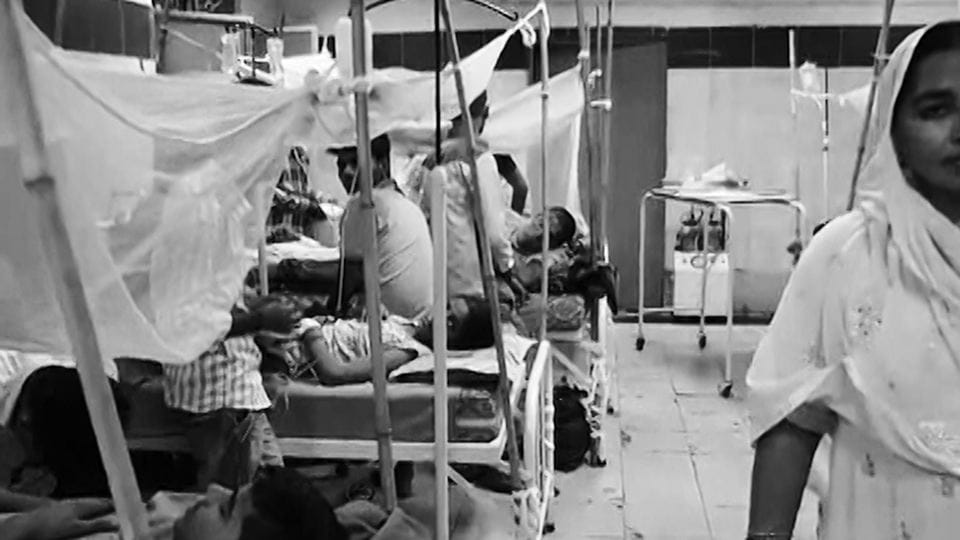
At the time of independence, the sovereign, socialist, democratic republic of India embraced the vision of healthcare being made available to all irrespective of the ability to pay, through a state-controlled system.
Subsequently, India has reaffirmed its commitment to safeguard the health of its citizens by the ratification of various human rights treaties which see health as an inalienable right, of which the right to healthcare is a critical entitlement.
However, the other side of things presents a version which is highly dissonant with this line of thought.
Building on an already established private health sector and in line with the stated policy, India has constantly presented a favorable environment for market forces to dominate it's healthcare provision for the last few decades – so much so that over two-thirds of our healthcare today is with the for-profit sector.
This reveals the fickleness of our very philosophy of healthcare provision.
National Health Policy (NHP), 2017
The National Health Policy (NHP) 2017, while explicitly citing a lack of ‘threshold levels of finances and infrastructure' as being the prime barrier towards realisation of a rights-based approach to healthcare, aspired to ‘create an enabling environment for realising healthcare as a right in the future'.
However, not much effort has been made to make the best use of the available finances and resources.
From the jostle for setting up of new AIIMS (All India Institute of Medical Sciences) to proposing to build renal dialysis centres in district hospitals with public-private partnership, lopsided priorities have resulted in costly end-point management taking precedence over the much cheaper entry level interventions, leaving a lot to be desired in terms of health outcomes at the same time.
Lopsided Priorities
In view of our perpetual failure to allocate a serious percentage of GDP to healthcare and the fact that many of the targets mentioned in the NHP 1983 (the year it was first adopted) still remain unfulfilled, such assurances, as that of creating an enabling environment for the right to health, appear to be little more than promises written on water.
On the other side, bolstering the for-profit health sector through generous subsidies and tax exemptions continues to evolve as a deliberate and conspicuous objective of our health related policies.
With Universal Health Coverage (UHC) as it's theme, the World Health Day 2018 makes a propitious occasion for us to ascertain and declare our philosophy of healthcare provision.
Countries such as the United Kingdom and Cuba have done this for themselves in the past and went on to build exemplary health systems.
Do we sincerely swear allegiance to the concept that health is a fundamental right, or do we believe that healthcare makes a lucrative business enterprise and should be traded for profit?
How to chart the way forward and what indicators and yardsticks to develop to measure progress will depend on the choice we make.
What Can Be Done?
Assuming that we shall restate our commitment to the right to health, the following could be suggested:
- A comprehensive paradigm for UHC provision with a well defined role and scope for every player involved (including for-profit/not-for-profit entities) must be worked out.
- The scope of UHC must go beyond economic accessibility and must include the other elements of the right to health viz availability; non-discriminatory, physical, and information accessibility; acceptability; and quality. With the nearest health center being 80 kilometres away on a rugged terrain, lacking a full time doctor and essential medicines, and having a precarious electricity supply – provision of free of cost healthcare doesn't make much sense.
- A trajectory shift from prioritising complex, end-point interventions to focusing on basic, entry level ones (including preventive care) is warranted as a means of achieving far more desirable outcomes at much lesser expenditures, thus paving the way to UHC with the limited resources available. Insurance on hospitalisation would be of little help when the out-of-pocket spending is greatest on basic medicines and diagnostics and least on inpatient treatment.
- Renewed efforts have to be made to reorient medical education, which currently does a little more than priming medical students to become specialists, towards community and primary care so as to manufacture a basic medical workforce having not only the skill, but also the alacrity and willingness to serve the primary care needs of the population.
(Dr Soham D Bhaduri is a doctor based in Mumbai. He is currently the Editor-in-chief of The Indian Practitioner (a foremost peer reviewed medical journal). He has written articles on healthcare in a number of publications including The Hindu, The Indian Express, The Wire, The British Medical Journal etc. He can be reached at soham.bhaduri@gmail.com)

-
High US Salaries, No Green Card Certainty: The Financial Calculation Facing Indian H-1B Families

The suspension of PERM processing at eight technology employers does not cancel existing H-1B visas. What it does is force a question many Indian families have been avoiding: is the US salary worth tying your career and family plans to one employer?
-
Unhedged Position: Can India See An Indonesia-Style Time Correction?
The Nifty is trading below levels it first clocked in 2024. Is there, then, as I have suggested in the headline, potential that the current time correction drags on painfully for the next three-five, even ten years?
-
Navigating Friction And Energy Realities: An Analysis Of Marco Rubio's October Visit To India
Occurring at a critical juncture marked by stalled trade negotiations and escalating geopolitical pressures over global energy supplies, the visit offers a profound window into modern US-India relations.
-
India Exports Capital. Why Not Export Trusteeship?
The big question, then, is whether India can build an institution that global borrowers, investors, banks, and lawyers can trust, even without an Indian connection.
-
France's Economy & Politics Are In Crisis | The Reason Why
Let's look at how the French economy and politics evolved under Nicolas Sarkozy, Franois Hollande and Emmanuel Macron.
-
You May Inherit The Business. You Must Earn Its Credibility.
Succession tests the founder's ability to share authority as much as it tests the next generation's readiness to assume it.
-
Signing Deals Is One Thing; Making Them Work Is Another | The Week In Whys
Sometimes, things don't turn out as planned. Indian companies have lost some bids to rivals, some projects won't produce until 2030.
-
FOMC Wall, PERM Suspension, Hospital Stocks | Talking Points This Week
A PERM suspension would directly affect green-card sponsorship rather than H-1B visas, so the near-term earnings impact could remain relatively limited. The key question is whether this marks a new phase in US scrutiny of Indian IT.
-
Everything, Everywhere, All At Once: Dalal Street's Week To Forget | Joining The Dots
Visa curbs, a Starlink spat and cancer drug caps: what connects this week's shocks for Indian markets
-
India Is Going Abroad For Critical Minerals. But It May Take Years To Pay Off | The Reason Why
Although India's steps are in the right direction, they remain modest compared with India's growing dependence.