GST Council To Discuss Tax Rate On COVID Essentials, Compensation To States
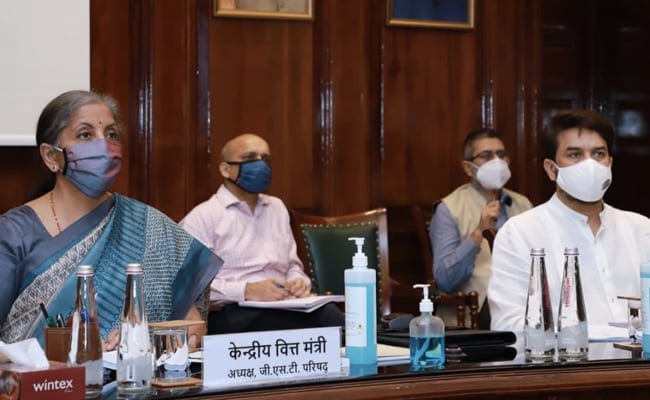
The GST Council is likely to discuss on Friday a reduction in the tax rate on Covid medicines, vaccines, and medical equipment, as well as means to make up for the shortfall in revenues, promised to states. Ahead of the first meeting of the top decision-making body, finance ministers of eight states ruled by non-BJP and like-minded parties -- Rajasthan, Punjab, Chhattisgarh, Tamil Nadu, Maharashtra, Jharkhand, Kerala, and West Bengal -- have devised a joint strategy to press for a zero tax rate on Covid essentials, sources said.
The Council, which is headed by Union Finance Minister Nirmala Sitharaman and includes representatives of all states and Union territories, is meeting for the first time in nearly eight months. Besides discussion on tax rates, the Council may also deliberate on the estimated Rs 2.69 lakh crore that states need to be provided as per the promise in 2017 to make good any loss in revenue they suffer because of giving up their right to levy VAT and other taxes.
Sources said the Fitment Committee on GST rates, comprising tax officers of Centre and states, has also given its report to the Council listing out the pros and cons of waiver and zero-rating of Covid vaccines, drugs and other equipment.
Exempting final products from GST would deny manufacturers the option to claim the benefit of the input tax credit on raw materials and hence not much benefit accrues to consumers. In 2018, the Council, following demands from various women's organisations, had exempted GST on sanitary napkins from an earlier rate of 12 per cent. However, not much of the rate cut benefits accrued to consumers as manufacturers could not claim the benefit of taxes paid along the supply chain.
Earlier this week, Punjab Finance Minister Manpreet Singh Badal, in a letter to Sitharaman, said that many goods, including protective garments, digital thermometers, laboratory sanitisers/disinfectants and paper bed sheets, which are needed to fight the Covid pandemic attract a basic customs duty of 20 per cent and a Goods and Services Tax (GST) of up to 18 per cent.
On top of that, a 10 per cent social welfare surcharge is levied on such items. As IGST is charged on taxable value, which includes import duties, the effective burden exceeds by another 2-3 per cent, Badal said. "It is baffling that despite the crisis our country currently finds itself in... taxes this high continue to apply on basic essentials needed to overcome this life-threatening disease...," Badal said in the letter.
Earlier this month, Sitharaman virtually ruled out exempting Covid vaccines, medicines and oxygen concentrators from GST, saying such an exemption will make the lifesaving items costlier for consumers as manufacturers will not be able to offset the taxes paid on inputs.
Currently, domestic supplies and commercial imports of vaccines attract a 5 per cent GST while COVID drugs and oxygen concentrators attract a 12 per cent levy. With regard to the issue of compensation payable to states, the Centre has estimated the shortfall at Rs 2.69 lakh crore.
The Centre expects to collect over Rs 1.11 lakh crore through cess on luxury, demerit and sin goods which will be given to the states to compensate them for the shortfall in revenue arising out of GST implementation. The remaining Rs 1.58 lakh crore would have to be borrowed to meet the promised compensation.
As per the agenda note shared with the states ahead of the GST council meeting on Friday, the Centre has estimated that although the GST revenues may see a recovery in the current financial year, there will still be a gap between the compensation need and the amount raised through cess. The 2021-22 Budget has assumed 17 per cent growth in GST revenues, translating into monthly gross GST revenue of Rs 1.1 lakh crore.
Based on this assumption, it has been estimated that for the period February 2021 to January 2022, the gap between projected revenue and the actual revenue after the release of the compensation would be around Rs 1.6 lakh crore. In the last fiscal, the Centre had borrowed on behalf of the states and released Rs 1.10 lakh crore to compensate for the GST revenue shortfall. Another Rs 68,700 crore was collected by way of levy of cess.
Under the GST law, states were guaranteed to be compensated bi-monthly for any loss of revenue in the first five years of the GST implementation from July 1, 2017. The shortfall is calculated assuming a 14 per cent annual growth in GST collections of states over the base year of 2015-16.
With states still continuing to face a shortfall in revenue as GST collections declined on account of slowing economic activity mainly due to Covid, the GST compensation cess would continue beyond the first five years of GST implementation.

-
Unhedged Position: Can India See An Indonesia-Style Time Correction?

The Nifty is trading below levels it first clocked in 2024. Is there, then, as I have suggested in the headline, potential that the current time correction drags on painfully for the next three-five, even ten years?
-
Navigating Friction And Energy Realities: An Analysis Of Marco Rubio's October Visit To India
Occurring at a critical juncture marked by stalled trade negotiations and escalating geopolitical pressures over global energy supplies, the visit offers a profound window into modern US-India relations.
-
India Exports Capital. Why Not Export Trusteeship?
The big question, then, is whether India can build an institution that global borrowers, investors, banks, and lawyers can trust, even without an Indian connection.
-
France's Economy & Politics Are In Crisis | The Reason Why
Let's look at how the French economy and politics evolved under Nicolas Sarkozy, Franois Hollande and Emmanuel Macron.
-
You May Inherit The Business. You Must Earn Its Credibility.
Succession tests the founder's ability to share authority as much as it tests the next generation's readiness to assume it.
-
Signing Deals Is One Thing; Making Them Work Is Another | The Week In Whys
Sometimes, things don't turn out as planned. Indian companies have lost some bids to rivals, some projects won't produce until 2030.
-
FOMC Wall, PERM Suspension, Hospital Stocks | Talking Points This Week
A PERM suspension would directly affect green-card sponsorship rather than H-1B visas, so the near-term earnings impact could remain relatively limited. The key question is whether this marks a new phase in US scrutiny of Indian IT.
-
Everything, Everywhere, All At Once: Dalal Street's Week To Forget | Joining The Dots
Visa curbs, a Starlink spat and cancer drug caps: what connects this week's shocks for Indian markets
-
India Is Going Abroad For Critical Minerals. But It May Take Years To Pay Off | The Reason Why
Although India's steps are in the right direction, they remain modest compared with India's growing dependence.
-
When Everyone Has AI, What Gives You An Edge?
India's young workforce is entering an uncertain world of work where powerful AI tools are becoming widely accessible. The advantage will belong to those who combine deep expertise with digital fluency, and the distinctly human capabilities that technology cannot manufacture.









