Government's Dependence On RBI Payout Leaves Budget Funding At Risk
The government is increasingly relying on one-time revenue measures to plug its budget gap, raising questions about how it will finance spending pledges further out.
Finance Minister Nirmala Sitharaman is counting on a record $24 billion windfall from the Reserve Bank of India and a budgeted Rs 1.05 lakh crore ($15 billion) income from asset sales to fund the fiscal deficit of 3.3 per cent of gross domestic product in the year through March 2020.
She'll need more revenue next year to narrow that gap to 3 per cent -- as mandated by law -- without compromising on spending. That may prove difficult since slower economic growth has made it harder for the government to improve tax collections and the boost from the central bank and assets sale program are unlikely to be repeated.
The RBI bonanza appears to be a "one-time" measure and does not necessarily bode well in the medium term from a fiscal stand point, said Madhavi Arora, an economist with Edelweiss Securities Pvt. in Mumbai. "It would be crucial for the government to meet or outdo divestment targets amid falling tax revenues."
The government's revenue was $24 billion short of its target last year.
While Ms Sitharaman has so far resisted calls for any significant fiscal stimulus to revive the economy, bond traders fear the weak economic print last Friday may force the government to give in. Speculation it may then push up its planned borrowing from a record Rs 7.1 lakh crore helped benchmark sovereign notes cap their worst performance in 16 months in August.
Ms Sitharaman has said she hasn't decided yet on how the RBI funds will be used. The cash is more than enough to pay income support to farmers and recapitalize troubled state banks this year.
Below Average
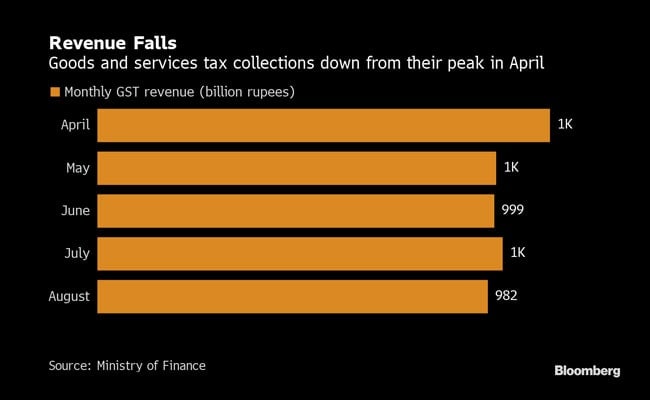
Countries traditionally fund their large expenditure programs from taxes. India's tax collection in the four months through July was only a fifth of the budget target of Rs 16.5 lakh crore. The shortfall last year forced the government to slash expenditure to meet the fiscal gap goal.
The country's tax-to-GDP ratio of about 11 per cent ranks lower than the global average and has fallen despite an amnesty program in 2016, which was followed by a surprise clampdown on cash to nab tax evaders.
The government is penciling in a 12 per cent increase in collections this year, based on economic expansion of 7 per cent. That may be over-optimistic, given that GDP growth in the June quarter slowed to 5 per cent.
In the run-up to elections earlier this year, Prime Minister Narendra Modi announced a flurry of ambitious programs to win over voters. Since returning to power with a bigger margin, he now has to find resources to fund recurring expenses for farm income, employment guarantees and health access.
The success of the assets sale program is also uncertain, given declining investor appetite and volatile financial markets.
The government will need to reduce its dependence on RBI transfers to bridge fiscal gaps and re-look at asset sales and improving tax compliance, said analysts led by Suvodeep Rakshit at Kotak Institutional Equities.

-
Where You Live Shapes How You Get To Work | The Reason Why

Two-wheelers are the most popular way to get to work in India, accounting for nearly 43% of workplace commutes.
-
High US Salaries, No Green Card Certainty: The Financial Calculation Facing Indian H-1B Families
The suspension of PERM processing at eight technology employers does not cancel existing H-1B visas. What it does is force a question many Indian families have been avoiding: is the US salary worth tying your career and family plans to one employer?
-
Unhedged Position: Can India See An Indonesia-Style Time Correction?
The Nifty is trading below levels it first clocked in 2024. Is there, then, as I have suggested in the headline, potential that the current time correction drags on painfully for the next three-five, even ten years?
-
Navigating Friction And Energy Realities: An Analysis Of Marco Rubio's October Visit To India
Occurring at a critical juncture marked by stalled trade negotiations and escalating geopolitical pressures over global energy supplies, the visit offers a profound window into modern US-India relations.
-
India Exports Capital. Why Not Export Trusteeship?
The big question, then, is whether India can build an institution that global borrowers, investors, banks, and lawyers can trust, even without an Indian connection.
-
France's Economy & Politics Are In Crisis | The Reason Why
Let's look at how the French economy and politics evolved under Nicolas Sarkozy, Franois Hollande and Emmanuel Macron.
-
You May Inherit The Business. You Must Earn Its Credibility.
Succession tests the founder's ability to share authority as much as it tests the next generation's readiness to assume it.
-
Signing Deals Is One Thing; Making Them Work Is Another | The Week In Whys
Sometimes, things don't turn out as planned. Indian companies have lost some bids to rivals, some projects won't produce until 2030.
-
FOMC Wall, PERM Suspension, Hospital Stocks | Talking Points This Week
A PERM suspension would directly affect green-card sponsorship rather than H-1B visas, so the near-term earnings impact could remain relatively limited. The key question is whether this marks a new phase in US scrutiny of Indian IT.
-
Everything, Everywhere, All At Once: Dalal Street's Week To Forget | Joining The Dots
Visa curbs, a Starlink spat and cancer drug caps: what connects this week's shocks for Indian markets