Government To Seek Legal View On Joining RIL Arbitration
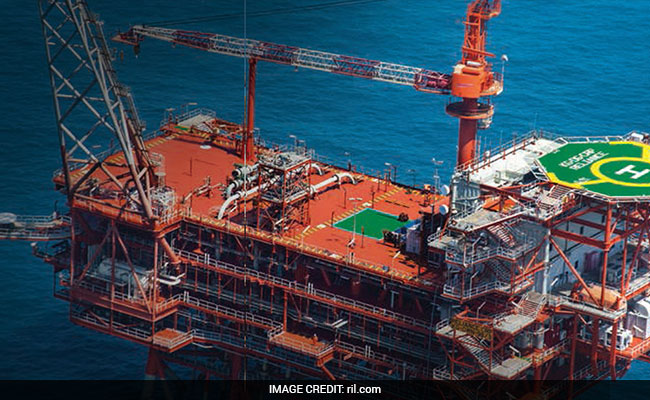
New Delhi: Government is considering joining the arbitration initiated by Reliance Industries and its partners against a $1.55 billion demand raised on them for "unfairly enriching" by producing natural gas belonging to ONGC.
RIL and its partners BP Plc of the UK and Canada's Niko Resources had on November 11 brought an arbitration notice against the government, disputing the $1.55 billion demand.
"We have received the notice and are studying it. We will take an opinion of the law ministry on joining the arbitration," a senior oil ministry official said.
Under the dispute resolution mechanism set out in the production sharing contract (PSC), an arbitration notice over a dispute has to be followed up within six months by naming arbitrators.
So, RIL and its partners have time till May 10 to name an arbitrator for the dispute. The government will thereafter name its arbitrator and the two will then decide on a presiding judge of the three-member arbitration panel.
Often, the two do not agree on the presiding arbitrator and the matter over such appointment lands either at the International Court of Justice or the Supreme Court.
"It is a long-drawn affair. If you are looking for a quick-fix solution, it won't come so easy," the official said.
The oil ministry had on November 3 issued a notice to RIL, Niko and UK's BP Plc seeking $1.47 billion for producing in the seven years ended March 31, 2016 about 338.332 million British thermal unit of gas that had seeped or migrated from the state-owned Oil and Natural Gas Corporation's (ONGC) blocks into their adjoining KG-D6 in the Bay of Bengal.
After deducting $71.71 million royalty paid on the gas produced and adding an interest at the rate of Libor plus 2 per cent, totalling $149.86 million, a total demand of $1.55 billion was made on RIL, BP and Niko.
RIL is the operator of the KG-D6 block with 60 per cent interest while BP holds 30 per cent. The remaining 10 per cent is with Niko Resources.
The Justice (retd) A P Shah Committee, in its August 28 report, concluded that there has been "unjust enrichment" to the contractor of the block KG-DWN-98/3 (KG-D6) due to production of the migrated gas from ONGC's blocks KG-DWN-98/2 and Godavari PML.
The government, the official said, has accepted the recommendations of the committee and consequently, it decided to claim restitution from RIL-BP-Niko for "the unjust benefit received and unfairly retained".
So, a notice was sent, he said, adding that the government is also pressing RIL to pay $174.9 million of additional profit petroleum after certain costs were disallowed because of KG-D6 output being lower than targets.
The cost recovery issue is also being arbitrated separately.
Originally, ONGC had sued RIL for producing gas that had migrated from its blocks KG-DWN-98/2 (KG-D5) and Godavari PML in the KG basin to adjoining KG-D6 block of RIL.
Under direction of the Delhi High Court, the government had appointed a one-man committee under retired Justice A P Shah to go into the issue.
(This story has not been edited by NDTV staff and is auto-generated from a syndicated feed.)

-
High US Salaries, No Green Card Certainty: The Financial Calculation Facing Indian H-1B Families

The suspension of PERM processing at eight technology employers does not cancel existing H-1B visas. What it does is force a question many Indian families have been avoiding: is the US salary worth tying your career and family plans to one employer?
-
Swiggy vs Eternal: Food Delivery's Two Rivals Are No Longer In The Same Race
Eternal is building a private AI assistant, dark.ai. Swiggy is still working out how to make Instamart pay, with an operating loss of Rs 895 crore in the July-September quarter while Blinkit stayed profitable.
-
Where You Live Shapes How You Get To Work | The Reason Why
Two-wheelers are the most popular way to get to work in India, accounting for nearly 43% of workplace commutes.
-
Unhedged Position: Can India See An Indonesia-Style Time Correction?
The Nifty is trading below levels it first clocked in 2024. Is there, then, as I have suggested in the headline, potential that the current time correction drags on painfully for the next three-five, even ten years?
-
Navigating Friction And Energy Realities: An Analysis Of Marco Rubio's October Visit To India
Occurring at a critical juncture marked by stalled trade negotiations and escalating geopolitical pressures over global energy supplies, the visit offers a profound window into modern US-India relations.
-
India Exports Capital. Why Not Export Trusteeship?
The big question, then, is whether India can build an institution that global borrowers, investors, banks, and lawyers can trust, even without an Indian connection.
-
France's Economy & Politics Are In Crisis | The Reason Why
Let's look at how the French economy and politics evolved under Nicolas Sarkozy, Franois Hollande and Emmanuel Macron.
-
You May Inherit The Business. You Must Earn Its Credibility.
Succession tests the founder's ability to share authority as much as it tests the next generation's readiness to assume it.
-
Signing Deals Is One Thing; Making Them Work Is Another | The Week In Whys
Sometimes, things don't turn out as planned. Indian companies have lost some bids to rivals, some projects won't produce until 2030.
-
FOMC Wall, PERM Suspension, Hospital Stocks | Talking Points This Week
A PERM suspension would directly affect green-card sponsorship rather than H-1B visas, so the near-term earnings impact could remain relatively limited. The key question is whether this marks a new phase in US scrutiny of Indian IT.









