Government to Decide on Diesel Deregulation After State Polls: Report
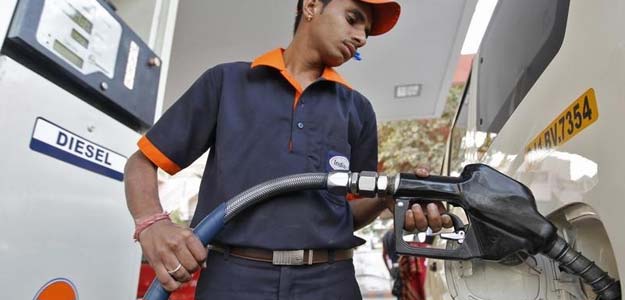
New Delhi: Government will decide on whether to end government control of diesel pricing after elections in two states next month, an oil ministry source said.
India currently controls prices with subsidies under a scheme originally intended to help the poor and rein in inflation, but local prices are now higher than global rates, making a case for a cut in retail prices.
"The diesel under-recovery (goal) has been wiped out and there is over-recovery of 0.35 rupees per litre (less than a cent) with effect from Sep. 16," a government statement said on Tuesday.
A rising subsidy bill and strained public finances in a sluggish economy forced the Cabinet in January 2013 to allow state retailers to marginally raise diesel prices each month.
"We tinker with diesel prices once a month...There is a case for a cut in diesel prices towards the end of the month but a decision is yet to be taken on that," the source with direct knowledge of the matter said. "Decision on diesel deregulation will be taken after state elections."
Reserve Bank of India Governor Raghuram Rajan on Monday said India should use this opportunity of easing global oil prices to eliminate diesel subsidies at the earliest.
Maharashtra and Haryana, will go to the polls on October 15. Under India's election rules the government cannot make any major policy decisions during an election campaign which may directly impact voters.
The oil ministry will have to seek a cabinet nod for deregulating diesel prices, two ministry sources said last month.
Government controls over pricing of liquefied petroleum gas, kerosene and diesel led to revenue losses at state fuel marketing companies - Indian Oil Corp, Bharat Petroleum Corp and Hindustan Petroleum Corp.
"For oil marketing companies, it is quite positive because 55 per cent of their sales are diesel and positive margins on diesel definitely helps their earnings," said Rohit Ahuja, Mumbai-based analyst at ICICI Securities.
State-run Oil and Natural Gas Corp, Oil India Ltd and GAIL (India) sell crude and related products at a hefty discount to partly compensate for losses of retailers, who also get some cash subsidies from the government.
Mr Ahuja said benefits for ONGC and Oil India would come with a lag as the government might look at easing their burden through a "subsidy sharing formula or a fixed number". Currently these companies' subsidy share varies from quarter to quarter.
Deregulation could bring the return of private firms such as Reliance Industries and Essar Oil to retail sales. Such companies do not receive government support for selling diesel at discounted rates and currently sell via state refiners despite having their own sales infrastructure.
Copyright: Thomson Reuters 2014

-
High US Salaries, No Green Card Certainty: The Financial Calculation Facing Indian H-1B Families

The suspension of PERM processing at eight technology employers does not cancel existing H-1B visas. What it does is force a question many Indian families have been avoiding: is the US salary worth tying your career and family plans to one employer?
-
Unhedged Position: Can India See An Indonesia-Style Time Correction?
The Nifty is trading below levels it first clocked in 2024. Is there, then, as I have suggested in the headline, potential that the current time correction drags on painfully for the next three-five, even ten years?
-
Navigating Friction And Energy Realities: An Analysis Of Marco Rubio's October Visit To India
Occurring at a critical juncture marked by stalled trade negotiations and escalating geopolitical pressures over global energy supplies, the visit offers a profound window into modern US-India relations.
-
India Exports Capital. Why Not Export Trusteeship?
The big question, then, is whether India can build an institution that global borrowers, investors, banks, and lawyers can trust, even without an Indian connection.
-
France's Economy & Politics Are In Crisis | The Reason Why
Let's look at how the French economy and politics evolved under Nicolas Sarkozy, Franois Hollande and Emmanuel Macron.
-
You May Inherit The Business. You Must Earn Its Credibility.
Succession tests the founder's ability to share authority as much as it tests the next generation's readiness to assume it.
-
Signing Deals Is One Thing; Making Them Work Is Another | The Week In Whys
Sometimes, things don't turn out as planned. Indian companies have lost some bids to rivals, some projects won't produce until 2030.
-
FOMC Wall, PERM Suspension, Hospital Stocks | Talking Points This Week
A PERM suspension would directly affect green-card sponsorship rather than H-1B visas, so the near-term earnings impact could remain relatively limited. The key question is whether this marks a new phase in US scrutiny of Indian IT.
-
Everything, Everywhere, All At Once: Dalal Street's Week To Forget | Joining The Dots
Visa curbs, a Starlink spat and cancer drug caps: what connects this week's shocks for Indian markets
-
India Is Going Abroad For Critical Minerals. But It May Take Years To Pay Off | The Reason Why
Although India's steps are in the right direction, they remain modest compared with India's growing dependence.









