Government Says Fertiliser Subsidy May Rise To Rs 2.5 Lakh Crore In 2022-23
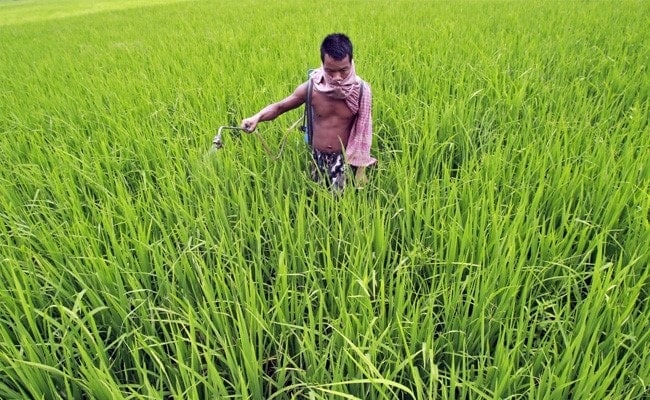
Government on Monday stressed that availability of fertilisers during the current Kharif (summer-sown) season is more than the estimated demand, adding that its subsidy for this fiscal might increase to around Rs 2.5 lakh crore to ensure that farmers get crop nutrients at highly subsidised rates.
It further said it will take strict action against hoarding of crop nutrients and asked states to monitor fertiliser movement. It also told states to provide accurate information to farmers for ensuring there is no panic buying.
Union Agriculture Minister Narendra Singh Tomar and Chemicals and Fertilisers Minister Mansukh Mandaviya jointly chaired a review meeting virtually on the situation of fertilisers with the agriculture ministers of states, according to an official statement.
Speaking on the occasion, Mr Mandaviya said, "With the government's proactive steps in pre-positioning urea, DAP and NPK and other fertilisers supply, currently, we have more stock for supply of fertilizers for this kharif season than the demand." He also advised states to keep providing farmers with adequate and accurate information regarding availability and not create either a panic situation or misinformation related to fertiliser stocks.
Despite the pandemic and rise in prices of raw materials at international level, Mr Mandaviya said the Centre has managed to keep fertiliser prices affordable by increasing subsidies so that farmers do not suffer.
"This year, around Rs 2.5 lakh crore subsidy will be given to farmers. We should make plans so that the fertilizers are utilized at a balanced level at ground level," he said.
The total fertiliser subsidy stood at around Rs 1.62 lakh crore last fiscal.
Recently, the Union Cabinet approved Nutrient Based Subsidy (NBS) rates for Phosphatic and Potassic (P&K) fertilisers for Kharif Season - 2022 (from April 1 to September 30). The subsidy approved by the Cabinet for the NBS Kharif-2022 was Rs 60,939.23 crore.
The minister further urged states to take note of how much fertilisers are available and needed at each district level, and keep an eye on how much stock each farmer has bought in order to avoid malpractices like black-marketing.
Stressing on the need to tackle malpractices like hoarding, black-marketing or diversion of fertilisers, Mr Mandaviya said the government will take strict action in case of such scenarios.
He also urged states to make farmers aware of recent trends in the fertilisers market and alternate fertilisers and agriculture practices like use of nano urea and organic farming.
Mr Mandaviya said the increase in the international prices of DAP and its raw materials have been primarily absorbed by the Union government. The Centre has decided to provide a subsidy of Rs 2,501 per bag on DAP instead of the existing subsidy of Rs 1,650 per bag, which is a 50 per cent increase over the last year's subsidy rates.

-
High US Salaries, No Green Card Certainty: The Financial Calculation Facing Indian H-1B Families

The suspension of PERM processing at eight technology employers does not cancel existing H-1B visas. What it does is force a question many Indian families have been avoiding: is the US salary worth tying your career and family plans to one employer?
-
Swiggy vs Eternal: Food Delivery's Two Rivals Are No Longer In The Same Race
Eternal is building a private AI assistant, dark.ai. Swiggy is still working out how to make Instamart pay, with an operating loss of Rs 895 crore in the July-September quarter while Blinkit stayed profitable.
-
Where You Live Shapes How You Get To Work | The Reason Why
Two-wheelers are the most popular way to get to work in India, accounting for nearly 43% of workplace commutes.
-
Unhedged Position: Can India See An Indonesia-Style Time Correction?
The Nifty is trading below levels it first clocked in 2024. Is there, then, as I have suggested in the headline, potential that the current time correction drags on painfully for the next three-five, even ten years?
-
Navigating Friction And Energy Realities: An Analysis Of Marco Rubio's October Visit To India
Occurring at a critical juncture marked by stalled trade negotiations and escalating geopolitical pressures over global energy supplies, the visit offers a profound window into modern US-India relations.
-
India Exports Capital. Why Not Export Trusteeship?
The big question, then, is whether India can build an institution that global borrowers, investors, banks, and lawyers can trust, even without an Indian connection.
-
France's Economy & Politics Are In Crisis | The Reason Why
Let's look at how the French economy and politics evolved under Nicolas Sarkozy, Franois Hollande and Emmanuel Macron.
-
You May Inherit The Business. You Must Earn Its Credibility.
Succession tests the founder's ability to share authority as much as it tests the next generation's readiness to assume it.
-
Signing Deals Is One Thing; Making Them Work Is Another | The Week In Whys
Sometimes, things don't turn out as planned. Indian companies have lost some bids to rivals, some projects won't produce until 2030.
-
FOMC Wall, PERM Suspension, Hospital Stocks | Talking Points This Week
A PERM suspension would directly affect green-card sponsorship rather than H-1B visas, so the near-term earnings impact could remain relatively limited. The key question is whether this marks a new phase in US scrutiny of Indian IT.









