Government 'Owed' Demonetisation To Nation, Says Nirmala Sitharaman
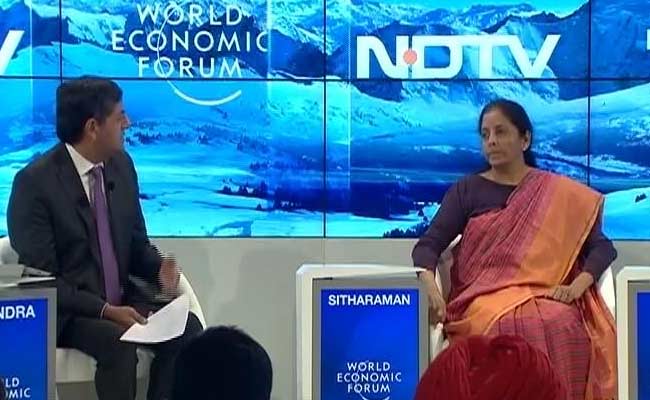
Davos, Switzerland: Prime Minister Narendra Modi's government "owed" demonetisation to the nation in its fight to eradicate black money and to bring hoarded cash back into the banking system, Union Commerce Minister Nirmala Sitharaman said at the World Economic Forum in Davos.
Participating in a panel discussion on "India's Time to Transform" which was moderated by NDTV's Vikram Chandra, the minister said, "Even if it sounds propagandist" one needs a strong leadership to take "such a bold step".
She said the ban on old high denomination notes was part of the "electoral promise we made to check the black money menace".
"Right after coming to power, we started with setting up the special investigation team, came out with scheme for declaration of undisclosed money, tightened tax treaties with different countries to check round tripping of money. We took all these steps."
"This step of demonetisation was absolutely necessary... 87 per cent of our economy was informal," the minister said, adding that only about 50 lakh people pay tax and all others who file the returns do not pay any tax.
"Can we survive if this kind of tax-to-GDP ratio continues? We had to do it, we owed it to the country and we do not regret it."
Also participating in the panel discussion was State Bank of India chief Arundhati Bhattacharya, who said "there were many small and medium businesses that were earning profit but were not paying tax".
"We need to convince them that they come into the tax net if they are earning enough for paying taxes," Ms Bhattacharya added.
Kenneth Rogoff, Professor of Economics and Public Policy at Harvard University, said the same step could have been done in a more systematic manner.
On why demonetiation could not have been taken with more public planning, Ms Sitharaman said Indians are "smart" and they would have "sensed" it and people could have stashed the money somewhere.
From 2006 and 2016, the portion of banknotes of high denomination rose considerably to 86 per cent, she added.
Ms Sitharaman said no part of the country faced any problem because the ministers and officials were moving around the country to take stock of situation and to take necessary measures throughout this 50-day period.
Argentina's central bank governor Federico Sturzenegger praised the Indian government for the bold step.
Speaking on the sudden move on old notes, Ms Sitharaman said it was a "one-time attack on the stock" and it worked.
"The moment the money has come into banks, it is no more anonymous and it has to be identified with somebody. In India, unaccounted cash or black money is a major issue," the minister said.
Carmen M Reinhart, Professor at Harvard Kennedy School of Government, said she concurred with the view that demonetisation was "short-run pain and long-run gain".
Ms Reinhart said India is also undertaking “another extremely bold initiative” of GST (Goods and Services Tax), adding, "I would have preferred the GST to be introduced before the currency conversion.”
On whether GST could have been done earlier, Ms Sitharaman said the new indirect tax regime is going through a process and the government is confident it will get through from July 1.
"There was no choosing between the two," she said.
About steps being taken to improve the ease of doing business, Ms Sitharaman said the government is "at it" and is an ongoing work.
Ms Bhattacharya of SBI said: "To say how much successful it (demonetisation) has been, it needs to be seen how things pan out. We are already seeing a huge surge in the quantum of card transactions. But the day the ATM limits were raised to Rs 10,000, the card transactions began to fall."
Ms Bhattacharya also said that studying all the accounts that could have been used to launder money was a humongous task.
NITI Aayog CEO Amitabh Kant said India is on the cusp of a major revolution as one would need just his or her thumb to transact and this has not happened anywhere in the world and would leave cards and PoS (point of sale) machines etc totally redundant.
Every single mobile will have a thumb and iris impressions that will make "each one of us a walking ATM", he said.

-
High US Salaries, No Green Card Certainty: The Financial Calculation Facing Indian H-1B Families

The suspension of PERM processing at eight technology employers does not cancel existing H-1B visas. What it does is force a question many Indian families have been avoiding: is the US salary worth tying your career and family plans to one employer?
-
Unhedged Position: Can India See An Indonesia-Style Time Correction?
The Nifty is trading below levels it first clocked in 2024. Is there, then, as I have suggested in the headline, potential that the current time correction drags on painfully for the next three-five, even ten years?
-
Navigating Friction And Energy Realities: An Analysis Of Marco Rubio's October Visit To India
Occurring at a critical juncture marked by stalled trade negotiations and escalating geopolitical pressures over global energy supplies, the visit offers a profound window into modern US-India relations.
-
India Exports Capital. Why Not Export Trusteeship?
The big question, then, is whether India can build an institution that global borrowers, investors, banks, and lawyers can trust, even without an Indian connection.
-
France's Economy & Politics Are In Crisis | The Reason Why
Let's look at how the French economy and politics evolved under Nicolas Sarkozy, Franois Hollande and Emmanuel Macron.
-
You May Inherit The Business. You Must Earn Its Credibility.
Succession tests the founder's ability to share authority as much as it tests the next generation's readiness to assume it.
-
Signing Deals Is One Thing; Making Them Work Is Another | The Week In Whys
Sometimes, things don't turn out as planned. Indian companies have lost some bids to rivals, some projects won't produce until 2030.
-
FOMC Wall, PERM Suspension, Hospital Stocks | Talking Points This Week
A PERM suspension would directly affect green-card sponsorship rather than H-1B visas, so the near-term earnings impact could remain relatively limited. The key question is whether this marks a new phase in US scrutiny of Indian IT.
-
Everything, Everywhere, All At Once: Dalal Street's Week To Forget | Joining The Dots
Visa curbs, a Starlink spat and cancer drug caps: what connects this week's shocks for Indian markets
-
India Is Going Abroad For Critical Minerals. But It May Take Years To Pay Off | The Reason Why
Although India's steps are in the right direction, they remain modest compared with India's growing dependence.









