Global Diamond Business Roiled As Cash Crunch Hits Indian Stone Cutting
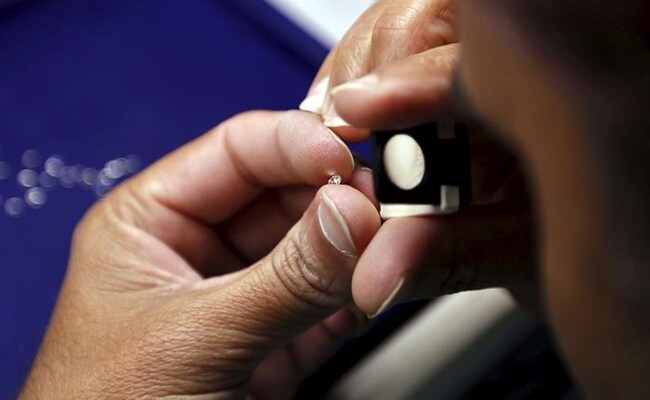
Surat: The global diamond industry is facing disruption that could stretch through the first few months of next year, including Valentine's Day in February, as a result of Prime Minister Narendra Modi's radical move to abolish most of the country's cash overnight.
In Surat, craftsmen usually spend 10-12 hours a day in small mills or grimy sheds cutting and polishing 80 per cent of the world's diamonds but the business is based on cash and the demonetisation of the high-value banknotes from November 8 has prevented many from operating. Thousands of diamond brokers in the area's narrow lanes are also doing little business.
The lack of cash is not the only problem for an industry that employs 1 million people in India, most of them in this city. PM Modi's shock treatment is intended to make it much more difficult for those laundering ill-gotten gains or evading taxes, and that means diamond buyers are demanding proof of tax payments that are often not available, the traders said.
Top diamond miners, such as Anglo American-owned De Beers and smaller Canadian producers such as Stornoway Diamond and Dominion Diamond are seeing weaker demand and prices for cheaper stones used in lower-priced jewellery.
The picture for retailers and consumers of diamonds is less clear. The cash crunch has also badly hurt consumer demand for diamond jewellery in India, the world's third-biggest market.
That means there are more of the cheaper finished stones to export, helping to create a temporary glut and lower prices at wholesaler and store level. However, that may not last if the cutters and polishers of India can't get back to work soon.
But the luxury buyer doesn't have to worry. Much of the higher-value jewellery business, with the highest grade one-carat stones usually costing more than $14,500, is protected because cutting and polishing is also done in Israel, Belgium and by bigger Indian companies that rely on bank transactions.
"The knock-on effect of Indian demonetisation has meant a reduction in the prices of lower quality diamonds," said Tobias Kormind, managing director of 77 Diamonds, an online jewellery retailer based in London. "As a result, we've seen an increase in demand for those kinds of diamonds as our clients have snapped up these favourable deals."
In India, jewellery demand typically climbs in the winter months' wedding season. But this year sales are plunging as nearly two-thirds of jewellery is usually purchased with cash, which is in short-supply.
Ishu Datwani, owner of Mumbai-based Anmol Jewellers, says his sales are down nearly 70 per cent since the government scrapped the high-value notes.
The demand is unlikely to revive any time soon as India struggles to dispense enough new notes, industry officials say.
"During the cash crunch, diamonds are one of the last things people want to buy. At least for the next six months demand will remain weak," says Praveenshankar Pandya, head of India's Gem & Jewellery Export Promotion Council (GJEPC).
The crisis hit at a time when there were plenty of stones in the retail pipeline or being processed. India's rough diamond imports between April and November jumped 30.5 per cent, while exports of cut and polished diamonds during the period rose 12.2 per cent, GJEPC data shows.
Diamond processors bought rough diamonds aggressively, expecting a jump in exports and rising Indian demand, but now they are struggling, said trader Dharmesh Navadiya.
In trading hubs like Hong Kong, many retailers are stuck holding diamonds they bought three years back at higher prices expecting robust demand from China that didn't materialise.
"There has been no supply crunch as the market is already flooded, especially the low carat diamond," said Jonathan Rotbart, a distributor of gems in Hong Kong.
'Shock to the market'
"The market is frozen. We don't have cash to buy diamonds," said Kalpesh Savaliya, a trader for 25 years who was sitting cross-legged on a mattress behind a low wooden desk in Surat.
As small operators close, India's rough diamond imports could decline by up to 25 per cent between December and March, said Mehul Choksi, chairman of Gitanjali Gems, India's biggest diamond jeweller.
Miners are already feeling the pain with some lower-quality stones being discounted by more than 25 per cent from prices before demonetisation, said Panmure Gordon analyst Kieron Hodgson, in a recent note to clients.
In its final 2016 tender, De Beers said sales were affected by a slowdown in lower-value rough stones, a trend Hodgson expects to see repeated for at least the next three months.
Dominion Diamond, with stakes in two Canadian mines, expects its sales in its fourth quarter ending Jan. 31 will be hurt by the Indian cash crisis, and sees weaker demand for small stones extending to its fiscal first quarter. Demonetisation was a "shock to the market", said chief executive Brendan Bell.
Stornoway, which this year finished building Quebec's first diamond mine, withdrew smaller, lower-quality stones from its first-ever tender in November due to poor demand and prices.
But Mountain Province Diamonds, which owns 49 per cent of Canada's newest diamond mine, Gahcho Kue, indicated it isn't overly worried. "Small diamonds are roughly 80 per cent of your production and 20 per cent of your revenue - and the demand for the large diamonds remains robust," said CEO Patrick Evans.
"The diamond market is fine. Average prices are up 7 to 9 percent this year, but small diamonds are down about 50 per cent."

-
High US Salaries, No Green Card Certainty: The Financial Calculation Facing Indian H-1B Families

The suspension of PERM processing at eight technology employers does not cancel existing H-1B visas. What it does is force a question many Indian families have been avoiding: is the US salary worth tying your career and family plans to one employer?
-
Unhedged Position: Can India See An Indonesia-Style Time Correction?
The Nifty is trading below levels it first clocked in 2024. Is there, then, as I have suggested in the headline, potential that the current time correction drags on painfully for the next three-five, even ten years?
-
Navigating Friction And Energy Realities: An Analysis Of Marco Rubio's October Visit To India
Occurring at a critical juncture marked by stalled trade negotiations and escalating geopolitical pressures over global energy supplies, the visit offers a profound window into modern US-India relations.
-
India Exports Capital. Why Not Export Trusteeship?
The big question, then, is whether India can build an institution that global borrowers, investors, banks, and lawyers can trust, even without an Indian connection.
-
France's Economy & Politics Are In Crisis | The Reason Why
Let's look at how the French economy and politics evolved under Nicolas Sarkozy, Franois Hollande and Emmanuel Macron.
-
You May Inherit The Business. You Must Earn Its Credibility.
Succession tests the founder's ability to share authority as much as it tests the next generation's readiness to assume it.
-
Signing Deals Is One Thing; Making Them Work Is Another | The Week In Whys
Sometimes, things don't turn out as planned. Indian companies have lost some bids to rivals, some projects won't produce until 2030.
-
FOMC Wall, PERM Suspension, Hospital Stocks | Talking Points This Week
A PERM suspension would directly affect green-card sponsorship rather than H-1B visas, so the near-term earnings impact could remain relatively limited. The key question is whether this marks a new phase in US scrutiny of Indian IT.
-
Everything, Everywhere, All At Once: Dalal Street's Week To Forget | Joining The Dots
Visa curbs, a Starlink spat and cancer drug caps: what connects this week's shocks for Indian markets
-
India Is Going Abroad For Critical Minerals. But It May Take Years To Pay Off | The Reason Why
Although India's steps are in the right direction, they remain modest compared with India's growing dependence.









