Global Auto Component Makers Gear Up for China's Tougher Emission Rules
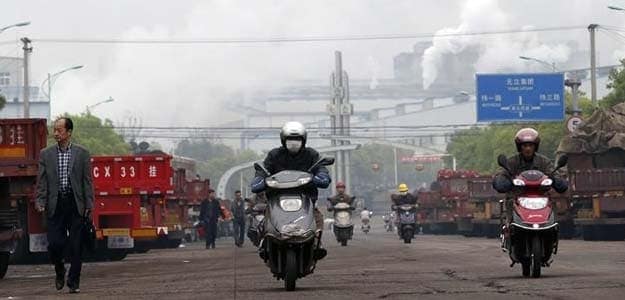
Global companies that specialise in making vehicle emissions cleaner are rushing to take advantage of Beijing's war on pollution, as Chinese automakers look to comply with tougher regulations in the world's biggest auto market.
Firms from Bill Gates-backed start-up EcoMotors Inc to Faurecia SA, a parts supplier controlled by French giant Peugeot SA, are jostling to help automakers meet new diesel emission rules taking effect in January, despite concerns the standards may not be strictly enforced.
"Generally speaking, we will benefit from higher emission standards in China as they will further spur our business growth," said Liu Xiaoxing, China vice president of Cummins Inc, a US diesel engine maker that partners with Faurecia and counts China as its biggest and fastest-growing market.
Pollution has reached crisis levels in China after decades of growth-at-all-costs, contributing to hundreds of thousands of deaths a year and sowing the seeds of social unrest. Automobiles are chiefly responsible for China's foul air, according to the country's environment watchdog.
Among other measures to tackle the problem, from next year China will adopt a new set of diesel emissions regulations aimed at eliminating mainly trucks and lorries that produce high levels of harmful substances such as nitrogen oxides, carbon monoxide and particulate matter.
The country will also take six million high-emission cars off the road this year, and is drafting regulations aimed at slashing fuel consumption by passenger vehicles.
"Foreign component makers will benefit most from the stricter emissions standards over the long term, as they have more advanced technology than Chinese suppliers," said Li Jia, an analyst at consultancy IHS Automotive.
Leading component suppliers that can help Chinese automakers cut emissions include Continental AG, Robert Bosch GmbH, Denso Corp, Tenneco Inc and Faurecia, Swiss private bank Bank J Safra Sarasin Ltd said in a report on June 3.
The technologies they bring to the table include exhaust treatment systems, turbo chargers, direct injection mechanisms and powertrain controls.
Clearing The Air
The World Health Organization says about 2 million people die every year from air pollution, mostly in developing nations. Beijing is among the world's most polluted cities, it says.
Concentrations of fine atmospheric particles known as PM2.5 averaged 89.5 micrograms per cubic meter daily in the Chinese capital last year. That was 156 per cent higher than national standards.
From January 1, 2015, China will adopt the long-delayed national stage 4 emission standard (NS4) - the equivalent of Euro 4 standards - on diesel vehicles, meaning automakers will be allowed to sell only trucks and lorries that puff out lower levels of pollutants than they do currently.
China also aims to reduce average fuel consumption by passenger vehicles to 6.9 litres (1.8 gallons) per 100 kilometres (62 miles) in 2015, from 7.38 litres currently.
Mathias Miedreich, Asia president of Faurecia's emission control technologies unit FECT, whose clients include makers of both diesel and gasoline-propelled vehicles, said annual sales stood to grow 40 per cent faster than the broader auto industry's growth rate over the remainder of the decade.
The company forecasts FECT's China revenue will double to 2 billion euros ($2.72 billion) by 2020. FECT recently invested several million euros in a plant in Beijing to expand capacity for NS4-compliant exhaust systems.
"China represents the highest growth market ... We believe our products will give us significant advantage," Miedreich said.
Other players are also boosting investment. EcoMotors struck a deal in March with a unit of state-owned China FAW Group Corp, one of China's biggest producers of commercial vehicles, to jointly build a $200 million engine plant in China.
EcoMotors President Amit Soman said many Chinese automakers were looking to skip straight to the latest technology in fuel efficiency rather than "just do small changes in conventional engines".
German automotive supplier Eberspaecher Group is also getting in on the act, setting up a joint venture in December with Shaanxi Automobile Group Co Ltd to make exhaust systems for the China market.
Faurecia's Miedreich said the risk that the tougher emission standards would not be enforced, exposing companies that invest in the technology to potential losses, was worth taking.
"The risk is, basically, we spend money and have no return," he said. "Our decision is and will be - we will take the risk."
Copyright: Thomson Reuters 2014

-
Opinion | India at 38: From Innovation Overperformer to Innovation Powerhouse

India now has 453 VC-backed deep science startups, 18 of them late-stage, after 117 percent growth since 2020. Laurus Labs, at USD 9.3 billion, is the most valuable deep science company in any middle-income economy outside China.
-
Navigating Energy Crossroads: S Jaishankar's Call For Diversified Supply Chains At G20 Ministerial Meeting
As geopolitical fault lines continue to test maritime trade routes and commodity flows, Jaishankar's message remains pertinent: true economic resilience requires open markets, protected transit lines, and a genuine commitment to multilateral cooperation rather than coercion.
-
Indians Are Travelling, But Not Every Journey Is A Holiday | The Week In Whys
Pilgrims, patients and working women are the real travellers, and the system hasn't quite caught up with them.
-
Getting To Work Costs Women More | The Reason Why
It is not just about women paying more than men. It is about women paying much more in cities than in villages.
-
AI Bias In Investing Cannot Be Eliminated, But It Can Be Governed
Framing is a particularly important example as identical financial information presented in terms of gains rather than losses can lead an LLM to reach a different assessment.
-
Joining The Dots | Dark Skies, Steady Diya: Why Hope Holds This Diwali
With war, a weak rupee and foreign outflows weighing on sentiment, policymakers at the NDTV World Summit and market veterans at NDTV Profit Ignite: Diwali Edition offered the same advice: stay invested and filter out the noise.
-
The Curious Case of Equitas Small Finance Bank And A CEO Who Quit For Stock
PN Vasudevan believes persistent investor concerns over a perceived conflict of interest had become a governance overhang on Equitas Small Finance Bank's stock, even as the lender improved profitability and asset quality.
-
Talking Points This Week: AI Cash Burn, A Tiger Comeback And An India That Still Finds Its Own Path
India is not immune to higher oil or tighter global liquidity, yet its earnings base is broader, its domestic policy levers are still available.
-
Foreign Investors Own Half Of HDFC Bank and ICICI Bank. An LTCG Cut Could Matter Most Here
Foreign portfolio investors have US$115 billion parked in HDFC Bank, ICICI Bank. If the government cuts long-term capital gains tax, Jefferies says returning foreign money could land here first.










