Ghosn's Jail Time May Stretch to Months in Japan's Legal System
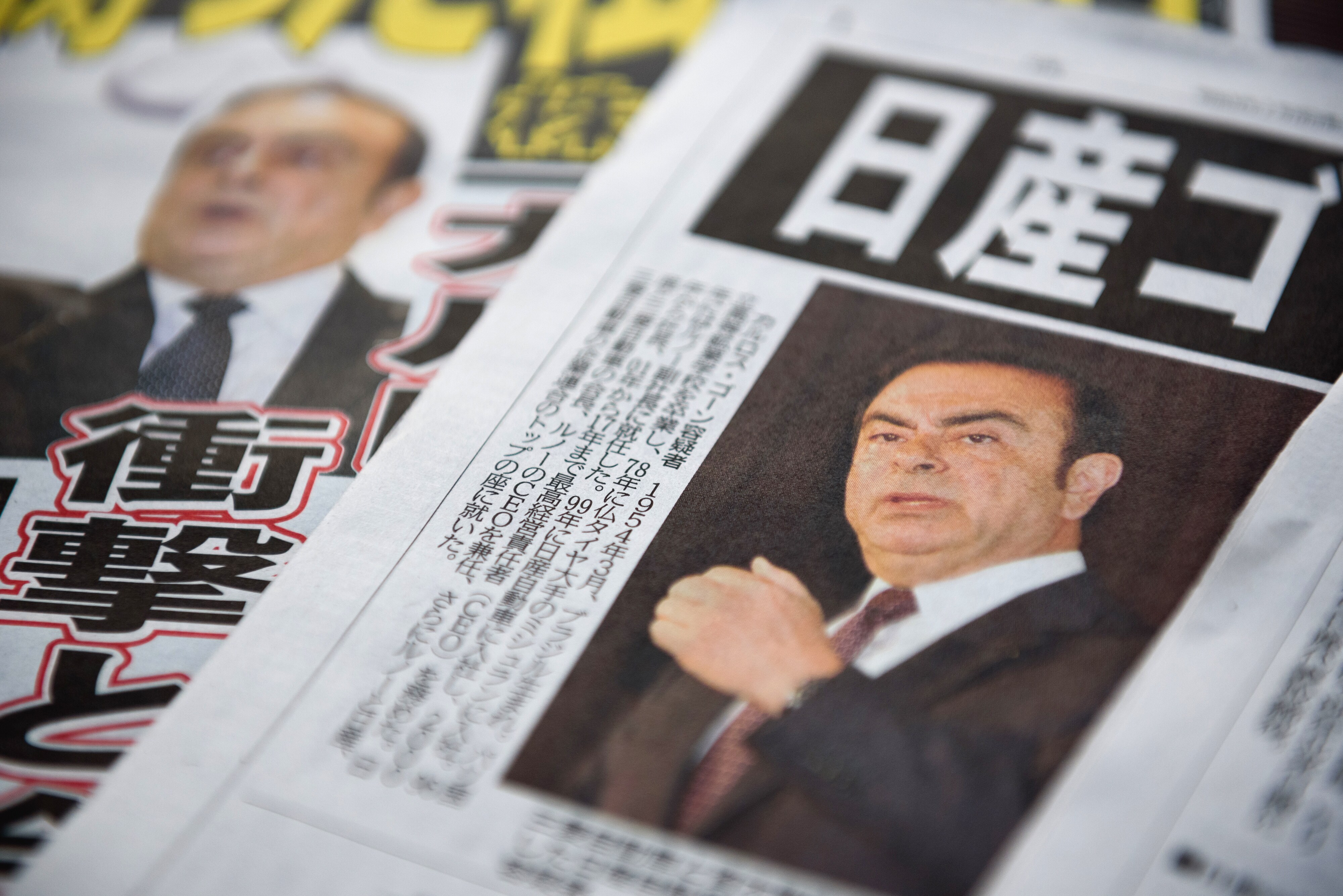
(Bloomberg) -- Carlos Ghosn has already been detained without charges in Japan longer than would be permitted in the U.K. for a suspected terrorist.
Since being arrested last month on suspicion of under-reporting his income, he has been held for 15 days. In the U.K., police can hold suspects without charge for up to 96 hours for serious crimes such as murder, and up to 14 days under the Terrorism Act.
The powers given to police and prosecutors to incarcerate suspects during an investigation without charging them are unique in the developed world, according to the Japan Federation of Bar Associations. The group has called for drastic changes to the nation's criminal justice system. Amnesty International and the UN Committee against Torture have condemned the practice, which has resulted in false confessions.
The globe-trotting former chairman of Nissan, a household name in Japan, may still have a long time to wait for his freedom -- pre-trial detention of more than a year isn't unusual in Japan, according to Issei Sakamoto, a lawyer with Nakamura International Criminal Defense in Tokyo.
Ghosn has denied through his lawyers reports that he passed on trading losses to Nissan. He also has denied under-reporting income, according to Kyodo News. He is being held in Katsushika in northern Tokyo, in a complex that also houses convicted prisoners.
When the 20 days allotted for questioning following his initial Nov. 19 arrest expire on Dec. 10, prosecutors will seek permission from a judge to re-arrest him on suspicion of a similar offense relating to the period from April 2016, according to the Sankei newspaper, which cited people familiar with the matter. That would start the clock on what could be another 10 or 20 days of questioning.
“It is a fairly common practice to arrest suspects on an initial charge and then interrogate them until they confirm what the prosecutors suspect, implicate others or otherwise provide information of more serious crimes,” said Colin Jones, a professor at Doshisha Law School in Kyoto and author of a book on the Japanese legal system.
No Limit
There's no limit to the number of times a suspect can be re-arrested, as long as a separate crime is cited in each case, Sakamoto said. Also, there's no limit on how long a suspect can be held after indictment, though time spent in custody is considered in sentencing, he said.
Those in powerful positions are hardly exempt from pre-verdict detention -- one well-known case being that of Muneo Suzuki, a lower-house lawmaker arrested in 2002 on suspicion of bribery who was held for 437 days before being granted bail and eventually found guilty. Senior bureaucrat Atsuko Muraki was awarded damages after being detained for five months in 2009 in connection with fraud charges that turned out to have been fabricated.
Suspects in Japan can't apply for bail until they are indicted, and they often are refused, especially in cases where they are considered likely to flee or to tamper with evidence. Those who don't confess to a crime are less likely to be released on bail. The website of the U.S. Embassy in Japan says bail is almost unheard-of for foreigners.
Bail's Significance
“Bail is extremely important in creating the environment for a fair trial,” said Noriyuki Saio of the Japan Bail Support Association. Failure to allow it risks weakening the position of the accused, resulting in too severe a punishment, he added. “It would be particularly significant in this case,” he said.
In the U.S., bail is often accessible to wealthy suspects, while the less affluent remain in custody because they lack the necessary funds, according to Human Rights Watch.
While Ghosn is likely preoccupied for the moment with questioning and meetings with his lawyer, his everyday life could change considerably if he is charged and remains in detention. Muraki said her biggest problem while remaining in jail for a lengthy period was filling her time.
“It's a weird situation,” she said in a 2013 interview with Bloomberg. “You don't have to work. You don't have to do housework. They give you three meals a day and do your laundry.” With no TV available, she used her time in the lock-up to read 150 books.
To contact the reporter on this story: Isabel Reynolds in Tokyo at ireynolds1@bloomberg.net
To contact the editors responsible for this story: Brendan Scott at bscott66@bloomberg.net, Jodi Schneider, Colin Keatinge
©2018 Bloomberg L.P.

-
High US Salaries, No Green Card Certainty: The Financial Calculation Facing Indian H-1B Families

The suspension of PERM processing at eight technology employers does not cancel existing H-1B visas. What it does is force a question many Indian families have been avoiding: is the US salary worth tying your career and family plans to one employer?
-
Swiggy vs Eternal: Food Delivery's Two Rivals Are No Longer In The Same Race
Eternal is building a private AI assistant, dark.ai. Swiggy is still working out how to make Instamart pay, with an operating loss of Rs 895 crore in the July-September quarter while Blinkit stayed profitable.
-
Where You Live Shapes How You Get To Work | The Reason Why
Two-wheelers are the most popular way to get to work in India, accounting for nearly 43% of workplace commutes.
-
Unhedged Position: Can India See An Indonesia-Style Time Correction?
The Nifty is trading below levels it first clocked in 2024. Is there, then, as I have suggested in the headline, potential that the current time correction drags on painfully for the next three-five, even ten years?
-
Navigating Friction And Energy Realities: An Analysis Of Marco Rubio's October Visit To India
Occurring at a critical juncture marked by stalled trade negotiations and escalating geopolitical pressures over global energy supplies, the visit offers a profound window into modern US-India relations.
-
India Exports Capital. Why Not Export Trusteeship?
The big question, then, is whether India can build an institution that global borrowers, investors, banks, and lawyers can trust, even without an Indian connection.
-
France's Economy & Politics Are In Crisis | The Reason Why
Let's look at how the French economy and politics evolved under Nicolas Sarkozy, Franois Hollande and Emmanuel Macron.
-
You May Inherit The Business. You Must Earn Its Credibility.
Succession tests the founder's ability to share authority as much as it tests the next generation's readiness to assume it.
-
Signing Deals Is One Thing; Making Them Work Is Another | The Week In Whys
Sometimes, things don't turn out as planned. Indian companies have lost some bids to rivals, some projects won't produce until 2030.
-
FOMC Wall, PERM Suspension, Hospital Stocks | Talking Points This Week
A PERM suspension would directly affect green-card sponsorship rather than H-1B visas, so the near-term earnings impact could remain relatively limited. The key question is whether this marks a new phase in US scrutiny of Indian IT.









