General Motors' Cruise Recalls Cars, Revises Self-Driving Software After Crash
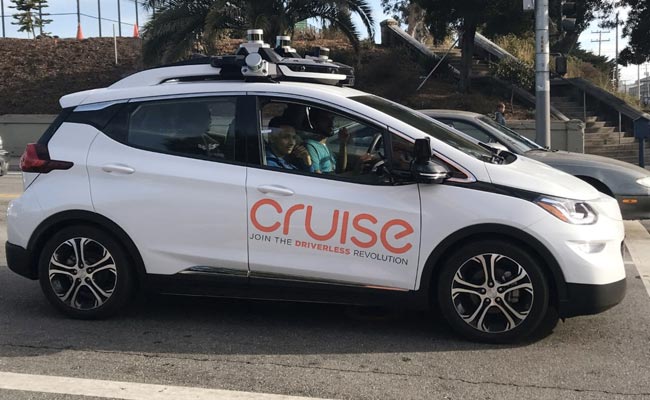
General Motors' startup unit Cruise LLC said Thursday it had recalled and updated software in 80 self-driving vehicles after a June crash in San Francisco that left two people injured.
Federal regulators said the recalled software could "incorrectly predict" an oncoming vehicle's path. Cruise said it had determined this unusual scenario would not recur after the software update.
The National Highway Traffic Safety Administration (NHTSA) said the recalled software could "in certain circumstances when making an unprotected left, cause the (autonomous driving system) to incorrectly predict another vehicle's path or be insufficiently reactive to the sudden path change of a road user."
Cruise disclosed Thursday that after the June 3 crash in San Francisco, it temporarily prevented its vehicles from making unprotected left turns and reduced the area in which its vehicles could operate.
After the software update on July 6, Cruise said it had gradually reintroduced unprotected left turns, which refers to turning left at an intersection with a solid green light that directs all traffic, rather than a designated green arrow just for turning vehicles.
Cruise emphasized in a statement Thursday all vehicles had software updates and the recall "does not impact or change our current on-road operations."
The company added "Cruise AVs are even better equipped to prevent this singular, exceptional event."
NHTSA said "an improper (Automated Driving Systems) response can increase the risk of a crash."
NHTSA said last month it opened a special investigation into the Cruise crash.
Cruise said NHTSA "suggested that the appropriate mechanism for disseminating this information" about the update was for Cruise to file a recall notice.
In rare circumstances, Cruise said the software caused the autonomous vehicle to hard brake while performing an unprotected left turn that it deemed necessary to avoid a severe front-end collision.
The self-driving vehicle "had to decide between two different risk scenarios and chose the one with the least potential for a serious collision at the time, before the oncoming vehicle's sudden change of direction," Cruise said.
Cruise also noted a police report found the party most at fault for the June crash was the other vehicle, which was traveling at 40 miles per hour in a 25-mile zone.
In March, startup technology firm Pony.ai agreed to recall some versions of its autonomous driving system software, after an October crash in California, that had been used in three vehicles.
NHTSA said at the time it was the "first recall of an automated driving system."
In June, Cruise said it had started charging fares for driverless rides in San Francisco, after it became the first company to secure a permit to charge for self-driving car rides in the U.S. city, having overcome objections by local officials.
(Except for the headline, this story has not been edited by NDTV staff and is published from a syndicated feed.)

-
Unhedged Position: Can India See An Indonesia-Style Time Correction?

The Nifty is trading below levels it first clocked in 2024. Is there, then, as I have suggested in the headline, potential that the current time correction drags on painfully for the next three-five, even ten years?
-
Navigating Friction And Energy Realities: An Analysis Of Marco Rubio's October Visit To India
Occurring at a critical juncture marked by stalled trade negotiations and escalating geopolitical pressures over global energy supplies, the visit offers a profound window into modern US-India relations.
-
India Exports Capital. Why Not Export Trusteeship?
The big question, then, is whether India can build an institution that global borrowers, investors, banks, and lawyers can trust, even without an Indian connection.
-
France's Economy & Politics Are In Crisis | The Reason Why
Let's look at how the French economy and politics evolved under Nicolas Sarkozy, Franois Hollande and Emmanuel Macron.
-
You May Inherit The Business. You Must Earn Its Credibility.
Succession tests the founder's ability to share authority as much as it tests the next generation's readiness to assume it.
-
Signing Deals Is One Thing; Making Them Work Is Another | The Week In Whys
Sometimes, things don't turn out as planned. Indian companies have lost some bids to rivals, some projects won't produce until 2030.
-
FOMC Wall, PERM Suspension, Hospital Stocks | Talking Points This Week
A PERM suspension would directly affect green-card sponsorship rather than H-1B visas, so the near-term earnings impact could remain relatively limited. The key question is whether this marks a new phase in US scrutiny of Indian IT.
-
Everything, Everywhere, All At Once: Dalal Street's Week To Forget | Joining The Dots
Visa curbs, a Starlink spat and cancer drug caps: what connects this week's shocks for Indian markets
-
India Is Going Abroad For Critical Minerals. But It May Take Years To Pay Off | The Reason Why
Although India's steps are in the right direction, they remain modest compared with India's growing dependence.
-
When Everyone Has AI, What Gives You An Edge?
India's young workforce is entering an uncertain world of work where powerful AI tools are becoming widely accessible. The advantage will belong to those who combine deep expertise with digital fluency, and the distinctly human capabilities that technology cannot manufacture.









