Geithner may have alerted BofA, other banks on rate cut: US Fed official
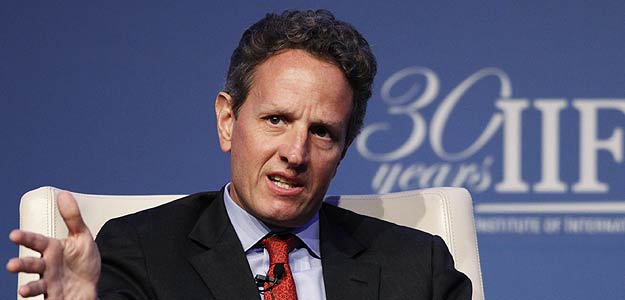
In the summer of 2007, as storm clouds gathered over the world's financial system, then-New York Federal Reserve President Timothy Geithner allegedly informed the Bank of America and other banks about the possibility the US central bank would lower one of its critical interest rates, according to a senior Fed official.
Jeffrey Lacker, the head of the Richmond Fed, originally raised the allegation during a Fed conference call in August 2007, and he stuck to his 5-year-old claim against the current US treasury secretary in a statement provided to Reuters on Friday.
"From conversations I had prior to the video conference call on August 16, 2007, I was aware of discussions among a few large banks about borrowing from their discount windows to support the asset backed commercial paper market," Lacker said in the statement. "My understanding was that (New York Fed) President Geithner had discussed a reduction in the discount rate with these banks in connection with these initiatives."
According to transcripts of the call released by the Fed on Friday, Geithner at the time denied that banks knew the Fed was considering cutting the discount rate. The Fed regularly releases transcripts of its policy meetings with a five-year lag.
"We don't have any comment beyond the transcript," said Treasury spokesman Anthony Coley. The Treasury declined to make Geithner available to comment.
Information about any planned interest rate move by the Fed is among the most sensitive as it can have a huge impact on a range of financial markets worldwide. That was particularly the case in the summer of 2007 when there were growing concerns about financial stability as a crisis that would reach fever pitch just more than a year later began to build.
Private disclosure of confidential, market-sensitive information by the central bank would be highly unusual, but it was not immediately clear if it would be illegal. It also was not clear if strict Fed internal rules governing confidential information would have been breached, or whether any internal or external investigation was mounted. Lacker made no suggestion of wrongdoing by the banks as a result of getting hold of any information.
The central bank delivered a surprise cut in the discount rate, which governs direct loans it makes to banks, the day after the call. The action spurred a big stock market rally, with the Standard & Poor's 500 Index enjoying its best gain in 4-1/2 years.
In his statement to Reuters, Lacker did not say which banks may have been privy to the information, although in the transcript of the August 16, 2007, call he said he had discussed the matter with Bank of America's then CEO, Ken Lewis, earlier that day. The Richmond Fed supervises the Charlotte, North Carolina-based bank.
Spokesmen for the Federal Reserve Board in Washington, the New York Fed and Bank of America all declined to comment, as did Lewis.
FIRST IN SERIES OF RATE CUTS
The unusually large half-point cut in the discount rate to 5.75 percent that the Fed delivered on August 17 was the first in a long series and came just days after French bank BNP Paribas froze three investment funds that were facing heavy redemptions. A month later, the Fed would also cut the overnight federal funds rate, its primary lever to influence the economy.
During the Fed's August 16, 2007, conference call, Geithner said that banks had started to ask about borrowing from the Fed earlier in the month after the central bank had released a statement saying it stood ready to provide liquidity to credit markets.
Geithner said banks "obviously don't have any idea that we're contemplating a change in policy" - a statement that Lacker then questioned.
"Did you say that they are unaware of what we're considering or what we might be doing with the discount rate?" Lacker asked, according to the transcript.
Geithner said yes, and Lacker followed up: "I spoke with Ken Lewis, president and CEO of Bank of America, this afternoon, and he said that he appreciated what Tim Geithner was arranging by way of changes in the discount facility. So my information is different from that."
Geithner responded, "I cannot speak for Ken Lewis, but I think they have sought to see whether they could understand a little more clearly the scope of their rights and our current policy with respect to the (discount lending) window."
"The only thing I've done is to try to help them understand ... what the scope of that is," he said.
Geithner, who is stepping down from his Treasury post next Friday, was an advocate of aggressive action to stem the crisis, and the steps the central bank took are widely credited with helping to calm the financial storm. Lacker was less inclined to intervene in the markets.
Copyright @ Thomson Reuters 2012

-
High US Salaries, No Green Card Certainty: The Financial Calculation Facing Indian H-1B Families

The suspension of PERM processing at eight technology employers does not cancel existing H-1B visas. What it does is force a question many Indian families have been avoiding: is the US salary worth tying your career and family plans to one employer?
-
Swiggy vs Eternal: Food Delivery's Two Rivals Are No Longer In The Same Race
Eternal is building a private AI assistant, dark.ai. Swiggy is still working out how to make Instamart pay, with an operating loss of Rs 895 crore in the July-September quarter while Blinkit stayed profitable.
-
Where You Live Shapes How You Get To Work | The Reason Why
Two-wheelers are the most popular way to get to work in India, accounting for nearly 43% of workplace commutes.
-
Unhedged Position: Can India See An Indonesia-Style Time Correction?
The Nifty is trading below levels it first clocked in 2024. Is there, then, as I have suggested in the headline, potential that the current time correction drags on painfully for the next three-five, even ten years?
-
Navigating Friction And Energy Realities: An Analysis Of Marco Rubio's October Visit To India
Occurring at a critical juncture marked by stalled trade negotiations and escalating geopolitical pressures over global energy supplies, the visit offers a profound window into modern US-India relations.
-
India Exports Capital. Why Not Export Trusteeship?
The big question, then, is whether India can build an institution that global borrowers, investors, banks, and lawyers can trust, even without an Indian connection.
-
France's Economy & Politics Are In Crisis | The Reason Why
Let's look at how the French economy and politics evolved under Nicolas Sarkozy, Franois Hollande and Emmanuel Macron.
-
You May Inherit The Business. You Must Earn Its Credibility.
Succession tests the founder's ability to share authority as much as it tests the next generation's readiness to assume it.
-
Signing Deals Is One Thing; Making Them Work Is Another | The Week In Whys
Sometimes, things don't turn out as planned. Indian companies have lost some bids to rivals, some projects won't produce until 2030.
-
FOMC Wall, PERM Suspension, Hospital Stocks | Talking Points This Week
A PERM suspension would directly affect green-card sponsorship rather than H-1B visas, so the near-term earnings impact could remain relatively limited. The key question is whether this marks a new phase in US scrutiny of Indian IT.









