GDP Report Will Highlight Impact Of PM Modi's Shock Cash Ban
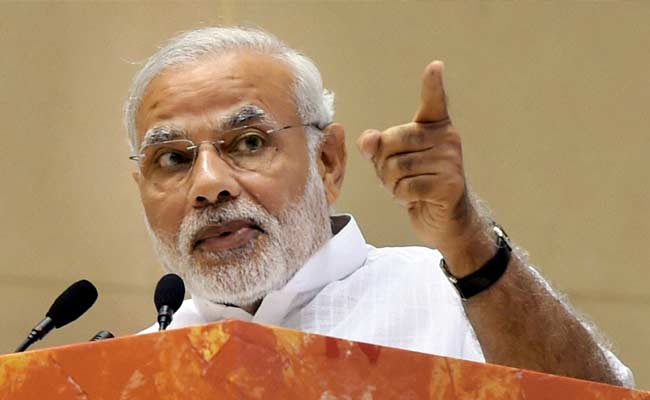
Rather than highlighting how far India's economy has come under Prime Minister Narendra Modi's pro-growth administration, Wednesday's gross domestic product report will underscore just how much there is to lose from his shock clampdown on cash.
Expansion probably accelerated to 7.5 percent in July-September, according to the median of 25 estimates in a Bloomberg survey of economists. However, analysts are cutting forecasts for growth to 7.4 percent from 7.7 percent for the year through March as Modi's Nov. 8 move to invalidate 86 percent of currency in circulation dents demand in an economy where 98 percent of consumer payments are in cash.
"Attention has shifted to the impact of the demonetization initiative on the real economy," Radhika Rao, an economist at DBS Bank Ltd. in Singapore, wrote in a report on Monday. Growth in October-December could dip below 6 percent, she said.
Such a slowdown would imperil India's position as the world's fastest-growing major economy. A bigger concern, though, is how soon the $2 trillion market can fully rebound from the effects of Modi's measure.
"Macroeconomic effects of the cash crunch include a temporary delay of consumption and investment, disrupted supply chains, farmers being unable to buy inputs, and some loss in productivity due to time lost to deal with cash issues," said Thomas Rookmaaker, director in Fitch Ratings's Asia-Pacific Sovereigns Group. "The impact on GDP growth is clearly going to be negative in the short run and depends to a large extent on how long the cash crunch is going to take."
By some estimates, Modi may need until May to replace the 23 billion bank notes he's sucked out. Others, such as Morgan Stanley's Chetan Ahya, estimate that about 98 percent of cash required for transactions will be in the system by mid-December. That means consumption -- which accounts for 60 percent of GDP -- will recover from the April-June quarter though private investment will take time to improve, he said.
India's GDP will grow 7.4 percent in the current fiscal year through March, according to the median of 15 estimates in a Bloomberg survey conducted after Modi announced the cash clampdown. A separate survey comprising five economists predicts October-December expansion at 6.6 percent and January-March at 7.6 percent.
Central Bank Review
Following Wednesday's GDP data, which is due at 5:30 p.m. in New Delhi, attention will shift to a purchasing managers' index due Thursday that will offer a first assessment of the impact on manufacturing. Services PMI is due Dec. 5 and the central bank will review interest rates Dec. 7.
Governor Urjit Patel will probably reduce the benchmark repurchase rate to 6 percent from 6.25 percent to arrest negative spillovers from the shock, according to Citigroup Inc. A private index compiled by BSE Ltd. and the Centre for Monitoring Indian Economy signaled a sharp surge in urban unemployment this month, as reports poured in of construction supervisors unable to pay their daily-wage laborers.
The Reserve Bank of India's decision will be a "close call," Citigroup economists Samiran Chakraborty and Anurag Jha wrote in a report on Sunday. "In an uncertain economic environment since the demonetization exercise, the December monetary policy has to focus on a prudent risk management approach rather than a simple growth-inflation trade-off."
(Except for the headline, this story has not been edited by NDTV staff and is published from a syndicated feed.)

-
High US Salaries, No Green Card Certainty: The Financial Calculation Facing Indian H-1B Families

The suspension of PERM processing at eight technology employers does not cancel existing H-1B visas. What it does is force a question many Indian families have been avoiding: is the US salary worth tying your career and family plans to one employer?
-
Unhedged Position: Can India See An Indonesia-Style Time Correction?
The Nifty is trading below levels it first clocked in 2024. Is there, then, as I have suggested in the headline, potential that the current time correction drags on painfully for the next three-five, even ten years?
-
Navigating Friction And Energy Realities: An Analysis Of Marco Rubio's October Visit To India
Occurring at a critical juncture marked by stalled trade negotiations and escalating geopolitical pressures over global energy supplies, the visit offers a profound window into modern US-India relations.
-
India Exports Capital. Why Not Export Trusteeship?
The big question, then, is whether India can build an institution that global borrowers, investors, banks, and lawyers can trust, even without an Indian connection.
-
France's Economy & Politics Are In Crisis | The Reason Why
Let's look at how the French economy and politics evolved under Nicolas Sarkozy, Franois Hollande and Emmanuel Macron.
-
You May Inherit The Business. You Must Earn Its Credibility.
Succession tests the founder's ability to share authority as much as it tests the next generation's readiness to assume it.
-
Signing Deals Is One Thing; Making Them Work Is Another | The Week In Whys
Sometimes, things don't turn out as planned. Indian companies have lost some bids to rivals, some projects won't produce until 2030.
-
FOMC Wall, PERM Suspension, Hospital Stocks | Talking Points This Week
A PERM suspension would directly affect green-card sponsorship rather than H-1B visas, so the near-term earnings impact could remain relatively limited. The key question is whether this marks a new phase in US scrutiny of Indian IT.
-
Everything, Everywhere, All At Once: Dalal Street's Week To Forget | Joining The Dots
Visa curbs, a Starlink spat and cancer drug caps: what connects this week's shocks for Indian markets
-
India Is Going Abroad For Critical Minerals. But It May Take Years To Pay Off | The Reason Why
Although India's steps are in the right direction, they remain modest compared with India's growing dependence.









