Infosys Founder Narayana Murthy Fears Of GDP Growth Hitting Lowest Since 1947
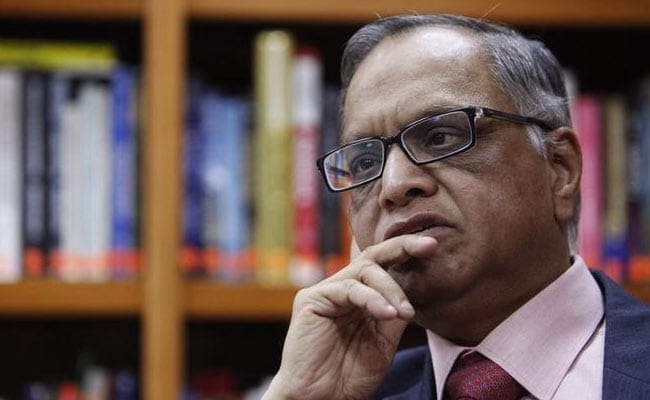
Flagging fears that the country's GDP growth may even touch its lowest since independence in the backdrop of coronavirus pandemic, Infosys founder NR Narayana Murthy on Monday said the economy should be brought back on track and people should be prepared to live with the pathogen.
He also pitched for developing a new system that should allow every player in every sector of the country's economy to operate at full steam with suitable precautions.
"India's GDP is expected to shrink by at least five per cent. There is a fear that we may even reach the lowest GDP (growth) since independence, since 1947," Mr Murthy said. The software icon was participating in a discussion on ''Leading India's Digital Revolution'' during the 16th edition of Institute of Engineering and Technology's India Digital Conversations held virtually.
"The global GDP has gone down. Global trade has shrunk, global travel has almost disappeared. The global GDP is likely to shrink between 5 per cent and 10 per cent," he said.
Mr Murthy said that right from the first day of the national lockdown on March 24 his view had been that people have to be prepared to live with the virus for three reasons -- there is no vaccine, no cure for coronavirus and the economy cannot be brought to a halt.
The earliest possible vaccine was from Oxford University, which may be available in the country anywhere from six to nine months, he said.
"But even if we are able to vaccinate 10 million people a day, it is going to take 140 days to vaccinate all the Indians. That is a long period to prevent the spread of the disease," Mr Murthy said.
"...We cannot make the economy come to a halt. Over 140 million workers have been affected by this virus. So the smartness is in defining a new normal. This normal should allow our economy to grow while moving on the earth and fighting the virus," the tech leader said.
Stressing on developing a new system to deal with the current situation, he also laid emphasis on creating a health infrastructure for vaccinating everybody once a vaccine was available and working towards a cure for the new virus.
"India has traditionally not invested sufficiently in public health. We have severe shortage both in talent and in material for a robust public health system. The state of our Institute of Public Health is a good data point," said Mr Murthy.
In the given system, Mr Murthy said, social distancing, and use of masks were the best way to combat the virus. He, however, lauded the country for having done a decent job under the present circumstances. To bring the economy back on track, the Infosys founder suggested getting back the 140 million migrant workers who have gone back to their villages to their workplaces, mostly in urban India.
His second advice was increasing the number of hospital beds and adding equipment for testing and taking care of the projected number of COVID-19 patients for three months and six months from now.
"Even today there is a severe shortage of COVID-19 care facilities in second tier and third tier towns," said Mr Murthy lamenting the demise of one of his relatives due to coronavirus in Hubballi, a north Karnataka tier-2 city and district headquarters.
The 74-year-old tech leader also favoured amending laws and providing infrastructural facilities for companies which cannot use the work-from-home paradigm and increasing the public transport and public safety facilities for businesses and the public to operate 24 hours.

-
High US Salaries, No Green Card Certainty: The Financial Calculation Facing Indian H-1B Families

The suspension of PERM processing at eight technology employers does not cancel existing H-1B visas. What it does is force a question many Indian families have been avoiding: is the US salary worth tying your career and family plans to one employer?
-
Swiggy vs Eternal: Food Delivery's Two Rivals Are No Longer In The Same Race
Eternal is building a private AI assistant, dark.ai. Swiggy is still working out how to make Instamart pay, with an operating loss of Rs 895 crore in the July-September quarter while Blinkit stayed profitable.
-
Where You Live Shapes How You Get To Work | The Reason Why
Two-wheelers are the most popular way to get to work in India, accounting for nearly 43% of workplace commutes.
-
Unhedged Position: Can India See An Indonesia-Style Time Correction?
The Nifty is trading below levels it first clocked in 2024. Is there, then, as I have suggested in the headline, potential that the current time correction drags on painfully for the next three-five, even ten years?
-
Navigating Friction And Energy Realities: An Analysis Of Marco Rubio's October Visit To India
Occurring at a critical juncture marked by stalled trade negotiations and escalating geopolitical pressures over global energy supplies, the visit offers a profound window into modern US-India relations.
-
India Exports Capital. Why Not Export Trusteeship?
The big question, then, is whether India can build an institution that global borrowers, investors, banks, and lawyers can trust, even without an Indian connection.
-
France's Economy & Politics Are In Crisis | The Reason Why
Let's look at how the French economy and politics evolved under Nicolas Sarkozy, Franois Hollande and Emmanuel Macron.
-
You May Inherit The Business. You Must Earn Its Credibility.
Succession tests the founder's ability to share authority as much as it tests the next generation's readiness to assume it.
-
Signing Deals Is One Thing; Making Them Work Is Another | The Week In Whys
Sometimes, things don't turn out as planned. Indian companies have lost some bids to rivals, some projects won't produce until 2030.
-
FOMC Wall, PERM Suspension, Hospital Stocks | Talking Points This Week
A PERM suspension would directly affect green-card sponsorship rather than H-1B visas, so the near-term earnings impact could remain relatively limited. The key question is whether this marks a new phase in US scrutiny of Indian IT.









