GDP Growth At 6.6% In December Quarter, Slowest In Over A Year
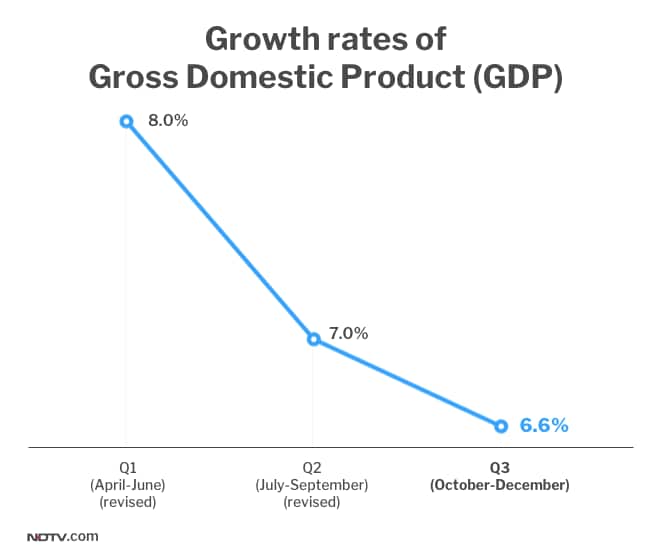
India's GDP or gross domestic product growth stood at 6.6 per cent in the quarter ended December 31, 2018, government data showed on Thursday. That marked the slowest rate of GDP expansion recorded since the quarter ended September 2017, and lower than economists' estimate. According to a poll by news agency Reuters, the median forecast from more than 55 economists polled on February 19-25 was for a GDP growth of 6.9 per cent.
The economic growth for the previous quarter (July-September) was revised down to 7.0 per cent from 7.1 per cent, according to the official statement. The growth rate in the third quarter of current financial year also marked a significant drop from 8.0 per cent in April-June 2018.
The growth in GDP during 2018-19 is estimated at 7.0 per cent as compared to the growth rate of 7.2 per cent in 2017-18, the Ministry of Statistics said in its statement.
Economists said the slowdown may lead to another rate cut by the central bank in its April policy review.
"I had expected the overall GDP growth for FY19 to get revised downwards, as the farm sector had suffered due to extremely uneven rainfall, depleted water reservoir levels in key agrarian states and their impact on sowing of food grains…The GDP data has correctly captured these events,” said Rupa Rege Nitsure, group chief economist, L&T Finance Holdings. (What economists say)
The Central Statistics Office (CSO) has projected GDP growth to average at 7.2 per cent in the current financial year (2018-19).
The Reserve Bank of India, however, has estimated GDP growth at 7.4 per cent in 2018-19. A slowdown in GDP growth momentum supported the central bank's dovish turn earlier this month when it cut key interest rates and changed its policy stance to "neutral" to boost expansion after a sharp fall in inflation.
“In retrospect, the RBI's policy actions on February 7 get strongly vindicated," Ms Nitsure added.
For the next financial year, the RBI has projected GDP growth to be in the range of 7.2-7.4 per cent in the first half, and 7.5 per cent in the third quarter.
(With agency inputs)

-
India Exports Capital. Why Not Export Trusteeship?

The big question, then, is whether India can build an institution that global borrowers, investors, banks, and lawyers can trust, even without an Indian connection.
-
France's Economy & Politics Are In Crisis | The Reason Why
Let's look at how the French economy and politics evolved under Nicolas Sarkozy, Franois Hollande and Emmanuel Macron.
-
You May Inherit The Business. You Must Earn Its Credibility.
Succession tests the founder's ability to share authority as much as it tests the next generation's readiness to assume it.
-
Signing Deals Is One Thing; Making Them Work Is Another | The Week In Whys
Sometimes, things don't turn out as planned. Indian companies have lost some bids to rivals, some projects won't produce until 2030.
-
FOMC Wall, PERM Suspension, Hospital Stocks | Talking Points This Week
A PERM suspension would directly affect green-card sponsorship rather than H-1B visas, so the near-term earnings impact could remain relatively limited. The key question is whether this marks a new phase in US scrutiny of Indian IT.
-
Everything, Everywhere, All At Once: Dalal Street's Week To Forget | Joining The Dots
Visa curbs, a Starlink spat and cancer drug caps: what connects this week's shocks for Indian markets
-
India Is Going Abroad For Critical Minerals. But It May Take Years To Pay Off | The Reason Why
Although India's steps are in the right direction, they remain modest compared with India's growing dependence.
-
When Everyone Has AI, What Gives You An Edge?
India's young workforce is entering an uncertain world of work where powerful AI tools are becoming widely accessible. The advantage will belong to those who combine deep expertise with digital fluency, and the distinctly human capabilities that technology cannot manufacture.
-
Wrong Labels, High Pesticide Residues Holding Back Agri Exports | The Reason Why
India needs stronger domestic food-safety and labelling standards, with best practices becoming part of everyday business for farmers, traders and food companies.
-
India Is Easy To Enter, Harder To Attract | The Week In Whys
The question is no longer just whether India can attract companies and capital. It is how much value they create here, how deeply they invest, and whether India remains relatively attractive when they have plenty of other options.










