G7 Summit Kicks Off Under Shadow Of Ukraine War, Stagflation Risk
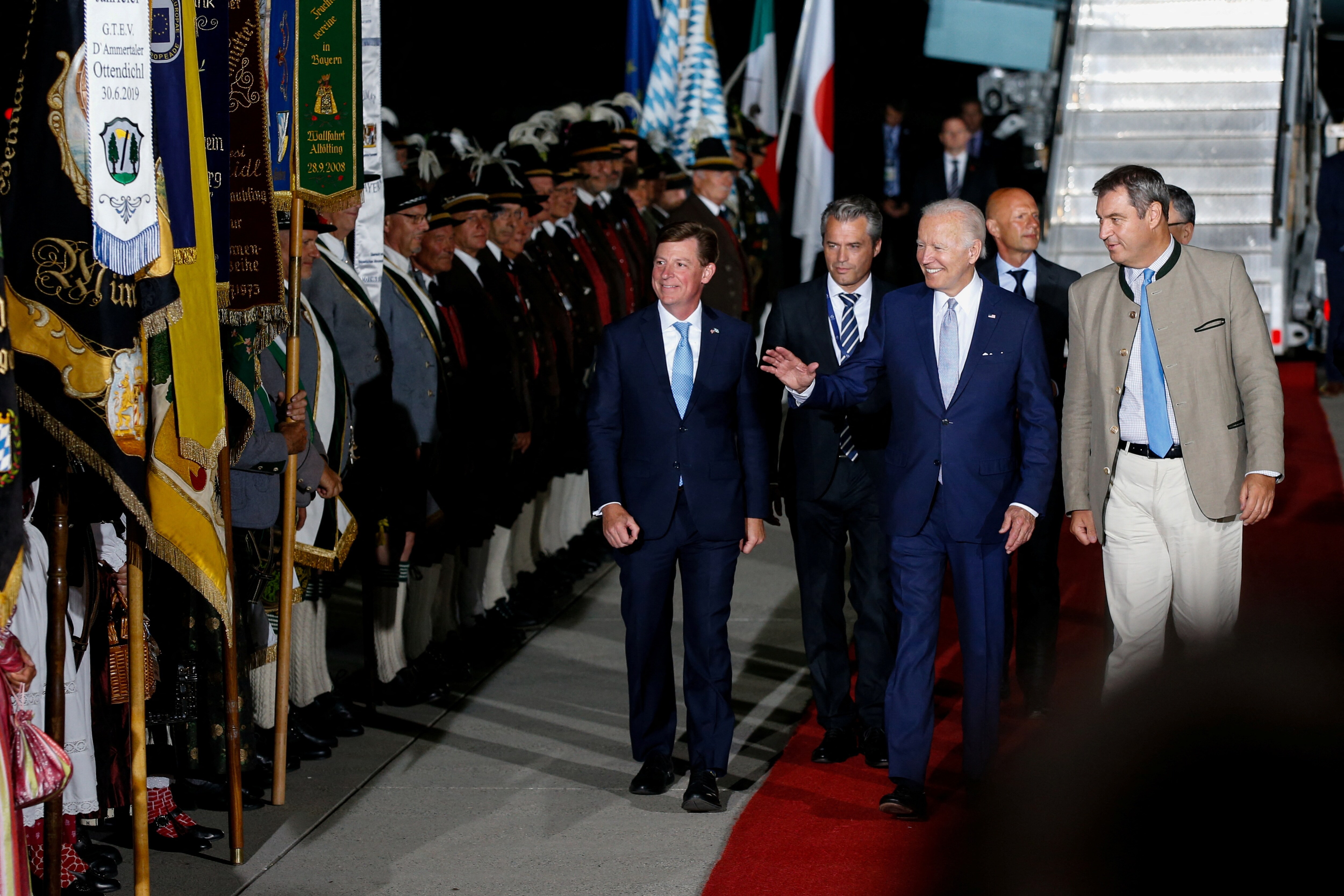
German Chancellor Olaf Scholz welcomes leaders of the Group of Seven rich democracies on Sunday to a three-day summit in the Bavarian Alps overshadowed by the war in Ukraine and its far-reaching consequences, from energy shortages to a food crisis.
The summit takes place against a darker backdrop than last year when the British, Canadian, French, German, Italian, Japanese and U.S. leaders met for the first time since before the COVID-19 pandemic and vowed to build back better.
Soaring global energy and food prices are hitting economic growth in the wake of Russia's invasion of Ukraine.
The United Nations warned on Friday of an "unprecedented global hunger crisis".
Climate change, an increasingly assertive China and the rise of authoritarianism are also set to be on the agenda.
The G7 leaders are expected to seek to show a united front on supporting Ukraine for as long as necessary and cranking up pressure on the Kremlin - although they will want to avoid sanctions that could stoke inflation and exacerbate the cost-of-living crisis affecting their own people.
"The main message from the G7 will be unity and coordination of action... That's the main message, that even through difficult times... we stick to our alliance," an EU official said.
The G7 partners are set to agree to ban imports of gold from Russia, a source familiar with the matter told Reuters. A German government source later said that leaders were having "really constructive" conversations on a possible price cap on Russian oil imports.
The G7 leaders are also expected to discuss options for tackling rising energy prices and replacing Russian oil and gas imports.
The summit takes place at the castle resort of Schloss Elmau at the foot of Germany's highest mountain, the Zugspitze - the same venue as when the country last hosted the G7 annual meet-up in 2015. Then too, Russian aggression against Ukraine dominated the agenda a year after Moscow's invasion of Crimea.
The summit is also a chance for Scholz to capitalise on being the host by displaying more assertive leadership on the Ukraine crisis.
The chancellor vowed a revolution in German foreign and defence policy after Russia's invasion in February, promising to bolster the military with a 100 billion euro fund and send weapons to Ukraine.
But critics have since charged him with foot-dragging and sending mixed messages by warning that Russia might perceive NATO as a war party and highlighting the risk of nuclear war.
The G7 was founded in 1975 as a forum for the richest nations to discuss crises such as the OPEC oil embargo.
It became the G8 after Russia was admitted six years after the fall of the Soviet Union. But Moscow was suspended in 2014 after it annexed Crimea from Ukraine.
Global Partners
This year, Scholz has invited as partner countries Senegal, currently chairing the African Union, Argentina, currently heading the Community of Latin American and Caribbean States, as well as Indonesia and India, the current and next hosts of the G20 group of large industrial nations, as well as South Africa.
"The summit must send not only the message that NATO and the G7 are more united than ever, but also that the democracies of the world stand together against Putin's imperialism just as they do in the fight against hunger and poverty," Scholz told the German parliament this week.
Many countries of the global south are concerned about the collateral damage from western sanctions.
An EU official said G7 countries would impress upon the partner countries that food price spikes hitting them were the result of Russia's actions and that there were no sanctions targeting food. It was also a mistake to think of the Ukraine war as a local matter.
"It's more than this. It's questioning the order, the post Second World War order," the official said.

-
Unhedged Position: Can India See An Indonesia-Style Time Correction?

The Nifty is trading below levels it first clocked in 2024. Is there, then, as I have suggested in the headline, potential that the current time correction drags on painfully for the next three-five, even ten years?
-
Navigating Friction And Energy Realities: An Analysis Of Marco Rubio's October Visit To India
Occurring at a critical juncture marked by stalled trade negotiations and escalating geopolitical pressures over global energy supplies, the visit offers a profound window into modern US-India relations.
-
India Exports Capital. Why Not Export Trusteeship?
The big question, then, is whether India can build an institution that global borrowers, investors, banks, and lawyers can trust, even without an Indian connection.
-
France's Economy & Politics Are In Crisis | The Reason Why
Let's look at how the French economy and politics evolved under Nicolas Sarkozy, Franois Hollande and Emmanuel Macron.
-
You May Inherit The Business. You Must Earn Its Credibility.
Succession tests the founder's ability to share authority as much as it tests the next generation's readiness to assume it.
-
Signing Deals Is One Thing; Making Them Work Is Another | The Week In Whys
Sometimes, things don't turn out as planned. Indian companies have lost some bids to rivals, some projects won't produce until 2030.
-
FOMC Wall, PERM Suspension, Hospital Stocks | Talking Points This Week
A PERM suspension would directly affect green-card sponsorship rather than H-1B visas, so the near-term earnings impact could remain relatively limited. The key question is whether this marks a new phase in US scrutiny of Indian IT.
-
Everything, Everywhere, All At Once: Dalal Street's Week To Forget | Joining The Dots
Visa curbs, a Starlink spat and cancer drug caps: what connects this week's shocks for Indian markets
-
India Is Going Abroad For Critical Minerals. But It May Take Years To Pay Off | The Reason Why
Although India's steps are in the right direction, they remain modest compared with India's growing dependence.
-
When Everyone Has AI, What Gives You An Edge?
India's young workforce is entering an uncertain world of work where powerful AI tools are becoming widely accessible. The advantage will belong to those who combine deep expertise with digital fluency, and the distinctly human capabilities that technology cannot manufacture.









