How FX Intervention Lost Its Taboo in Asia
(Bloomberg Opinion) -- You know the dollar is brawny when intervention isn't whispered or inferred, but spoken plainly. That's now the case in parts of Asia, where, despite the fashionable chatter about decoupling, the greenback's vigor is proving uncomfortable.
Interest-rate increases are a tried, though painful, method of stemming the retreat in regional currencies that's caused by the Federal Reserve's hawkishness. The yen lost 3.4% last quarter and closed in on the level that prompted the Ministry of Finance to wade into the market almost a year ago, while Indonesia is trying to attract foreign money into the rupiah. The Philippines isn't disguising an aversion to the peso weakening much beyond 57 per dollar.
While Fed officials have expressed no real conviction about a further hike, they are emphasizing borrowing costs will be tight for longer. This isn'tgreat for Asian bankers, who would prefer an approach to managing the local fallout that doesn't smother growth. The global economy is cooling and policymakers are wary of overdoing the tightening. That leaves wading into the market as a risky but plausible alternative. Once a fairly standard response to displeasing exchange-rate developments, the practice fell from favor prior to the pandemic. State transactions aimed at influencing the exchange rate's direction have subsequently lost some of their taboo.
It's often asserted that intervention is bound to fail. There are, however, circumstances where it can be useful. The key to a good outcome is about more than knowing when to buy. Goals must be clear, and broader economic policy aligned. Without the latter, a satisfactory denouement can be elusive.
If the objective is to turn a pronounced exchange-rate decline into a sustained rally, intercession isn't ideal. If the aim is slow things down and make bears think twice about their bets, then a tactical win by the government is possible. Even then, Asian authorities will probably need help from a friend called Jerome Powell. The Fed should make crystal clear that it's done with hikes and repeat that message until enough people understand. New York Fed President John Williams took a crack during prepared remarks on Friday, but the point deserves amplification.
It's worth looking at the case of the Philippines. Manila's actions around a year ago, when the dollar was on a tear, are instructive. Rarely does a nation whose currency is under siege spell out a specific level that's a no-go zone. But that is what Manila did, drawing a line at 60 pesos per greenback. The specificity was surprising; not even big economic powers with reserve currencies like the eurozone, the UK, Japan or even China, are so blunt.
The peso wasn't alone in having a rough time. Japan bought yen for the first time in a generation, Switzerland abandoned an experiment in negative interest rates, while a collapse in the British pound destroyed a prime minister. The 60 peso line held. Was the Philippines particularly astute or did the archipelago just get lucky? An under-rated speech by then-Fed Vice Chair Lael Brainard on Sept. 30, 2022, may have been crucial. Brainard, now the top economic adviser to President Joe Biden, acknowledged the risks of financial instability. She reiterated the Fed house view that inflation was too high and more hikes were needed, but emphasized “proceeding deliberately.” She foreshadowed the Fed's switch from half-point and three-quarter-point increases to 25-basis point increments. The dollar calmed down, and 2023 was forecast to be relatively quiet.
But it hasn't worked out that way. What is the Philippines response? Officials are signaling purchases of the peso at around 57 per dollar. The central bank isn't dismissing the chance of an out-of-cycle rate hike. This might not eventuate, but holding out the prospect isn't harmful to constraining the currency.
That's why the yen was undercut when Bank of Japan Governor Kazuo Ueda spent his Sept. 22 press conference walking back remarks he made to the Yomiuri newspaper in early September. The interview was interpreted as an effort to support the currency by suggesting an end to negative rates as soon as December.
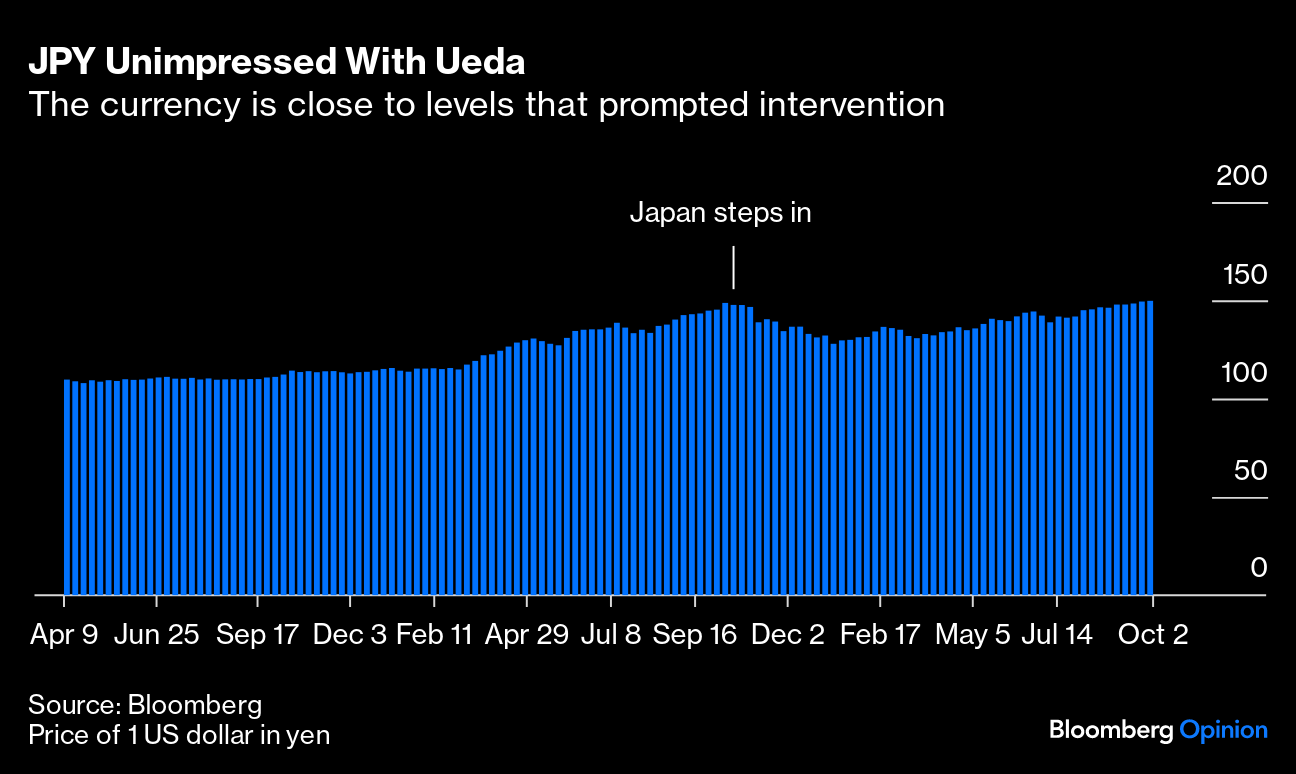
Japan is mostly out of the FX business these days after being active in the 1990s and early 2000s. There's no surer sign that the “I” word is in the air than the appearance of Eisuke Sakakibara, the former top international bureaucrat at the Ministry of Finance. He earned the nickname “Mr. Yen” for MOF's willingness to intervene on his watch. Sakakibara told Paul Jackson of Bloomberg News that authorities will probably try to tough out this moment, provided the yen doesn't slip to, say, 155 to the dollar.
The most interesting part of the interview was his view of what would turn the situation around. You guessed it: A shift in the Fed's stance after the Federal Open Market Committee's meeting in December, coupled with a possible rise in Japanese rates next year. That combination would open the door to a rally toward 130.
Until then, it's the Fed's rate and everyone else must bear it. The grin is optional.
More From Bloomberg Opinion:
- The Yuan's Slide Doesn't Have to End in Tears: Daniel Moss
- Food Inflation Is a Hardship Outside Fed's Control: Claudia Sahm
- Rates Are Like Mountains. It's About Getting Down: John Authers
This column does not necessarily reflect the opinion of the editorial board or Bloomberg LP and its owners.
Daniel Moss is a Bloomberg Opinion columnist covering Asian economies. Previously, he was executive editor for economics at Bloomberg News.
More stories like this are available on bloomberg.com/opinion
©2023 Bloomberg L.P.

-
Ten Things I Learnt This Samvat

Patience can be a trap. Cheap stocks can stay cheap. Leverage can wipe you out. What did Samvat 2082 teach us? Niraj Shah writes on 10 lessons from the year gone by.
-
Talking Points This Week: Tech Nerves, FII Buying, And A Faraway Banking Shock
The global markets are not shining this Diwali. The exception in the large markets is, India.
-
Midterm Rally Lasted A Day. The Hard Reality Of A Divided US May Last Two Years | Opinion
Between a contested AI boom, a debt ceiling that arrives in 2027 and a president with every incentive to act alone, the next two years may prove more volatile than the first day's rally suggests.
-
Blue Wave Will Derail the AI Trade but Won't Dismantle the AI Era | Unhedged Position
The Democrats' sweep of the US Congress will see politics collide with economic forces both over the long and short term.
-
It's Time To Take The GST Council's Bet On Trust Global
Payment records can prove India's services exports, and clear, proportionate rules can bring foreign digital sellers into the tax net.
-
Opinion | India at 38: From Innovation Overperformer to Innovation Powerhouse
India now has 453 VC-backed deep science startups, 18 of them late-stage, after 117 percent growth since 2020. Laurus Labs, at USD 9.3 billion, is the most valuable deep science company in any middle-income economy outside China.
-
Navigating Energy Crossroads: S Jaishankar's Call For Diversified Supply Chains At G20 Ministerial Meeting
As geopolitical fault lines continue to test maritime trade routes and commodity flows, Jaishankar's message remains pertinent: true economic resilience requires open markets, protected transit lines, and a genuine commitment to multilateral cooperation rather than coercion.
-
Indians Are Travelling, But Not Every Journey Is A Holiday | The Week In Whys
Pilgrims, patients and working women are the real travellers, and the system hasn't quite caught up with them.
-
Getting To Work Costs Women More | The Reason Why
It is not just about women paying more than men. It is about women paying much more in cities than in villages.









