Fuel Retailers Staring At Under-Recoveries, Says Petroleum Minister
With fuel prices remaining unchanged for almost two months despite a rise in cost, oil companies have started detailing under-recoveries or losses, which are as high as Rs 17.1 per litre on petrol and Rs 20.4 on diesel.
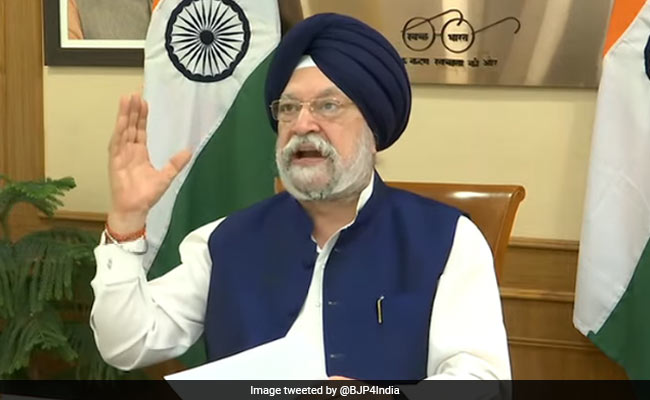
Oil Minister Hardeep Singh Puri said fuel retailers have knocked on the doors of the government seeking 'relief' but hastened to add that pricing is their decision.
While refusing to comment on reports of private oil refiners making a killing on importing Russian crude oil at deep discounts and exporting refined petroleum products to the US, the minister said the finance ministry was the appropriate authority to decide on the levy of a windfall tax on high gains the oil and gas producers are making due to surge in international energy prices.
"All our corporate citizens have a sense of responsibility," he told a news conference here. "These actions (revision in fuel prices) are taken by companies." Oil firms, he said, do not come to him for consultations on revising fuel prices.
Local pump rates are benchmarked to around $85 per barrel crude oil price while Brent is currently trading at $113. This has resulted in a gap between cost and selling price, referred to as under-recovery or loss. As of June 2, the industry was losing Rs 17.1 a litre on petrol and Rs 20.4 on diesel.
"They (oil companies) are talking under-recoveries. They are talking about that. As I said, they are responsible corporate citizens and they will take whatever decision they have to," Mr Puri said.
"Yes they come to us, it is an open secret. They come to us and say we need relief here, we need relief there but ultimately it (pricing) is their decision," the minister added.
He did not elaborate on the relief that oil firms have sought.
Despite a surge in oil prices, state-owned Indian Oil Corporation (IOC), Hindustan Petroleum Corporation Ltd (HPCL) and Bharat Petroleum Corporation Ltd (BPCL) first froze petrol and diesel rates for a record 137 days beginning in early November 2021 when five states including Uttar Pradesh went to the polls and then went into a hiatus again in April that is now 57 days old.
The Government last month cut excise duty on petrol by Rs 8 per litre and by Rs 6 on diesel. This reduction was passed on to the consumers and not adjusted against the under-recovery or losses oil firms make on selling petrol and diesel.
While state-owned oil marketing companies (OMCs) have maintained retail operations despite losses, private sector retailers like Reliance-BP and Nayara Energy have curtailed operations to cut losses.
This curtailment has met with criticism in some sections, which say the two firms are exporting at profit rather than selling to the domestic market.
While Reliance BP Mobility Ltd -- a joint venture of Reliance and UK's BP -- is a standalone fuel marketing company which has 1,459 petrol pumps in the country, Reliance Industries Ltd owns twin oil refineries at Jamnagar in Gujarat, with one of them being licensed only to export.
Rosneft-backed Nayara Energy too has an oil refinery at Vadinar in Gujarat.
Asked to comment on reports of the private sector refiners making a killing on importing Russian crude available at deep discounts and then exporting the finished products to the US and other countries, Puri said it is very hard to say crude oil from which country went into a giant refinery for processing and the product exported is from which crude oil.
"Is Russian crude coming into a private refinery and going to the US (as finished product), I would never be able to find. There is no possibility," he said.
However, private refiners not selling in the domestic market was "a legitimate question" to ask but he would not comment on the issue or advise them through the press, Mr Puri said.
"My primary responsibility as line minister is to make sure petrol and diesel are made available," he said.
"Many of our entities are both producers, importers and exporters. That is a thing you must realise."
On the issue of imposing a windfall tax like what the UK did last week, the minister said the issue falls in the domain of the Finance Ministry.
"It is Finance Ministry issue. But I would think that our present focus is on ensuring that we get access to energy at secure and affordable prices. That is main thing," Mr Puri said.
Exports, he said, will take place. "We import crude from one country, to the same country we export high speed diesel. These are process which go on. Rest is all speculative."

-
Navigating Energy Crossroads: S Jaishankar's Call For Diversified Supply Chains At G20 Ministerial Meeting

As geopolitical fault lines continue to test maritime trade routes and commodity flows, Jaishankar's message remains pertinent: true economic resilience requires open markets, protected transit lines, and a genuine commitment to multilateral cooperation rather than coercion.
-
Indians Are Travelling, But Not Every Journey Is A Holiday | The Week In Whys
Pilgrims, patients and working women are the real travellers, and the system hasn't quite caught up with them.
-
Getting To Work Costs Women More | The Reason Why
It is not just about women paying more than men. It is about women paying much more in cities than in villages.
-
AI Bias In Investing Cannot Be Eliminated, But It Can Be Governed
Framing is a particularly important example as identical financial information presented in terms of gains rather than losses can lead an LLM to reach a different assessment.
-
Joining The Dots | Dark Skies, Steady Diya: Why Hope Holds This Diwali
With war, a weak rupee and foreign outflows weighing on sentiment, policymakers at the NDTV World Summit and market veterans at NDTV Profit Ignite: Diwali Edition offered the same advice: stay invested and filter out the noise.
-
The Curious Case of Equitas Small Finance Bank And A CEO Who Quit For Stock
PN Vasudevan believes persistent investor concerns over a perceived conflict of interest had become a governance overhang on Equitas Small Finance Bank's stock, even as the lender improved profitability and asset quality.
-
Talking Points This Week: AI Cash Burn, A Tiger Comeback And An India That Still Finds Its Own Path
India is not immune to higher oil or tighter global liquidity, yet its earnings base is broader, its domestic policy levers are still available.
-
Foreign Investors Own Half Of HDFC Bank and ICICI Bank. An LTCG Cut Could Matter Most Here
Foreign portfolio investors have US$115 billion parked in HDFC Bank, ICICI Bank. If the government cuts long-term capital gains tax, Jefferies says returning foreign money could land here first.
-
'Never Seen This Level Of Negativity': Sandeep Tandon Says The Next Rally May Be Closer Than You Think
Veteran investor Sandeep Tandon says foreign selling is easing, large-caps are due a comeback and mid-caps are crowded, while he turns positive on gold, power and pharma this Diwali.










