Fuel Demand Declined In April, COVID-19 Wave Clouds Outlook
The country's April fuel demand slipped from the previous month as the world's third-largest oil consumer bore the brunt of raging coronavirus infections, with the prospect of further restrictions weighing on the outlook. Consumption of fuel, a proxy for oil demand, fell 9.4 per cent to 17.01 million tonnes from March, data from the Petroleum Planning and Analysis Cell (PPAC) of the Ministry of Petroleum & Natural Gas showed on Tuesday.
On a yearly basis, demand surged 81.5 per cent from April 2020 lows, when consumption plunged to the lowest since 2006 as coronavirus restrictions during India's first wave battered the economy. This represents the biggest year-on-year increase since data going back to about 1999. "India's second wave of virus infections and varying containment measures provides an uncertain outlook for the fuel demand," Edward Moya, senior market analyst at OANDA said.
India is nearing 400,000 infections a day and the second surge has increased calls for a nationwide lockdown and forced many states to impose tougher restrictions. Prime Minister Narendra Modi's resistance to a full lockdown has supported consumption in the short-term, Moya said.
Fuel demand had reached pre-pandemic levels of around 18.8 million tonnes in March, the highest level since end-2019.
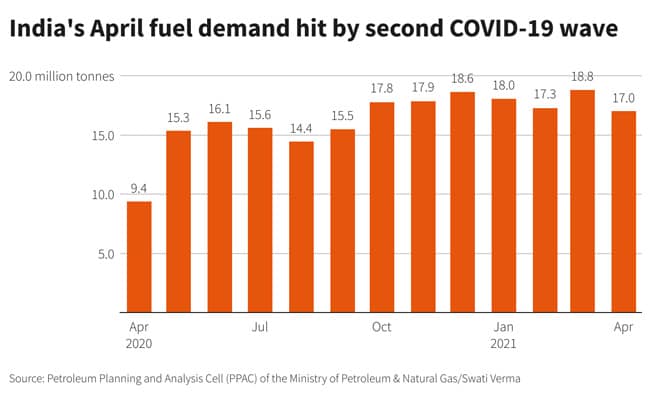
April fuel demand hit by second COVID-19 wave
Photo Credit: Reuters
However, the pandemic has led the country's top state oil refiners to reduce processing runs and crude imports, company officials told Reuters on Tuesday.
This trend is likely to extend into May as Indian refineries are reducing their refinery runs, UBS analyst Giovanni Staunovo said, adding that once mobility restrictions were lifted, demand should recovery swiftly.
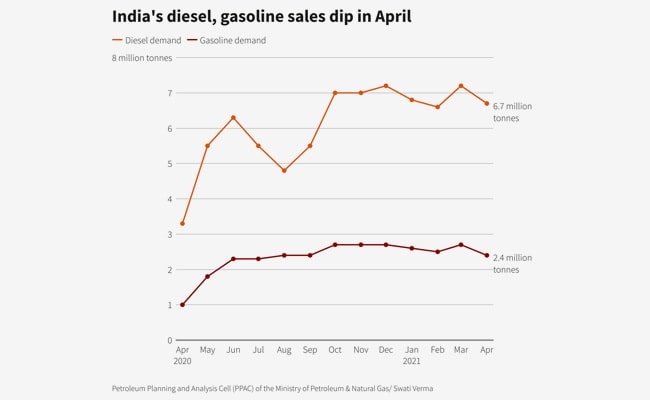
Diesel, gasoline sales dip in April
Photo Credit: Reuters
Diesel consumption, a key parameter linked to economic growth in India, fell 7.5 per cent to 6.68 million tonnes from the previous month but surged 105.5 per cent year-on-year. Gasoline, or petrol, sales fell 13.1 per cent to 2.38 million tonnes in April- the lowest level since August 2020, and were 145 per cent higher compared with same period a year ago.

-
A New Samvat Wishlist: Inclusive Prosperity And Human Development

India has strengthened its economic foundations through infrastructure, digital access and enterprise. Its next growth chapter must deepen productivity, create better livelihoods and widen participation in prosperity.
-
Love, Sex Aur Dhokha: The Audacious Plot To Spy On Jensen Huang
A Taipei dinner, a Singapore chip buyer and a suspected Chinese asset: inside the alleged spy operation that got close to NVIDIA's Jensen Huang.
-
Ten Things I Learnt This Samvat
Patience can be a trap. Cheap stocks can stay cheap. Leverage can wipe you out. What did Samvat 2082 teach us? Niraj Shah writes on 10 lessons from the year gone by.
-
Talking Points This Week: Tech Nerves, FII Buying, And A Faraway Banking Shock
The global markets are not shining this Diwali. The exception in the large markets is, India.
-
Midterm Rally Lasted A Day. The Hard Reality Of A Divided US May Last Two Years | Opinion
Between a contested AI boom, a debt ceiling that arrives in 2027 and a president with every incentive to act alone, the next two years may prove more volatile than the first day's rally suggests.
-
Blue Wave Will Derail the AI Trade but Won't Dismantle the AI Era | Unhedged Position
The Democrats' sweep of the US Congress will see politics collide with economic forces both over the long and short term.
-
It's Time To Take The GST Council's Bet On Trust Global
Payment records can prove India's services exports, and clear, proportionate rules can bring foreign digital sellers into the tax net.
-
Opinion | India at 38: From Innovation Overperformer to Innovation Powerhouse
India now has 453 VC-backed deep science startups, 18 of them late-stage, after 117 percent growth since 2020. Laurus Labs, at USD 9.3 billion, is the most valuable deep science company in any middle-income economy outside China.
-
Navigating Energy Crossroads: S Jaishankar's Call For Diversified Supply Chains At G20 Ministerial Meeting
As geopolitical fault lines continue to test maritime trade routes and commodity flows, Jaishankar's message remains pertinent: true economic resilience requires open markets, protected transit lines, and a genuine commitment to multilateral cooperation rather than coercion.









