FRBM Committee Recommends Glide Path To Bring Fiscal Deficit Down To 2.5%
A committee set up to review the fiscal framework for the Indian economy recommended that the central government's fiscal deficit be brought down to 2.5 percent over the next six financial years and that revenue deficit be contained at levels under 1 percent by then. The committee also recommended a target for government debt with separate ceilings for central and state government debt.
The committee headed by former Revenue Secretary NK Singh submitted its report to the government ahead of the Union Budget 2017-18 in February. The report of the committee was made public on Wednesday. Committee members included Reserve Bank of India Governor Urjit Patel, Chief Economic Adviser Arvind Subramanian, Sumit Bose and Rathin Roy. Subramanian submitted a dissent note and advocated a looser fiscal policy to suit India's growth needs.
The key recommendations of the committee revolve around bringing down government debt to 60 percent of GDP by fiscal 2023. To do this, the fiscal deficit should be adopted as the key operational target, said the committee.
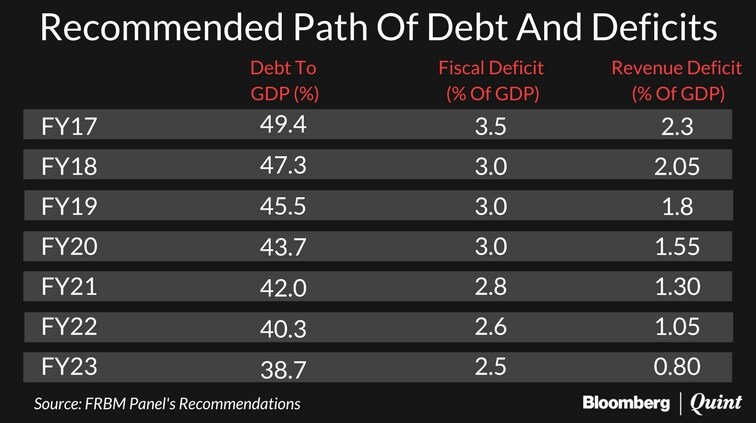
The committee suggests that the fiscal deficit be held steady at 3 percent between fiscal 2018 and fiscal 2020. From here on, a steady reduction to 2.5 percent by fiscal 2023 has been suggested. The government is yet to say whether the committee's recommendations will be accepted or not. However, for the current fiscal, the government is targeting a fiscal deficit of 3.2 percent – higher than the 3 percent recommended by the committee.
A large part of the fiscal deficit contraction should come from the revenue deficit, suggested the committee. In keeping with that philosophy, a steeper contraction in the revenue deficit is being proposed. The government should bring down the revenue deficit to 0.8 percent of GDP by fiscal 2023 from 2.3 percent in fiscal 2017, the committee said.
The proposed decline in revenue and fiscal deficit should help bring down central government debt to 38.7 percent of GDP over this time period. The overall cap for government debt has been set at 60 percent of GDP, with 20 percent being earmarked for states.
The Fiscal Responsibility And Budget Management (FRBM) Act would need to be repealed, should the government choose to accept these targets.
The Escape Clause
Along with the glide path to reduce government debt and deficit, the committee has suggested an ‘escape clause' that the government can invoke in times of economic stress. If this escape clause is invoked, the government can exceed the stipulated deficit for the year by up to 0.5 percentage points. RBI Governor Urjit Patel disagreed with the committee on the quantum of the escape clause and suggested a lower deviation of 0.3 percentage points.
The clause can be invoked in the following circumstances:
- Over-riding consideration of national security, acts of war; calamities of national proportion and collapse of agriculture severely affecting farm output and incomes.
- Far-reaching structural reforms in the economy with unanticipated fiscal implications.
- Sharp decline in real output growth of at least 3 percentage points below the average for the previous four quarters.
On the flip side, if growth is stronger than expected, the government is expected to bring its fiscal deficit down to below the stipulated levels. This is to ensure that a government used good times to strengthen its fiscal position.
If there is a sharp increase in real output growth of at least 3 percentage points above the average forthe previous four quarters, fiscal deficit must fall by at least 0.5 percentage points below the target.Similar to the escape clause, this buoyancy clause can be invoked by the government, after formalconsultations and advice of the Fiscal Council.FRBM Review Committee Report
The committee has also recommended that a fiscal council be set up. The three-member council would entirely consist of government appointed members. It's main task would be to “provide an independent assessment of the central government's fiscal performance and compliance with targets” set under the revised Act.
The government would also be expected to consult with the fiscal council before invoking the escape clause.
If the government were to accept the committee's recommendations, it could potentially invoke the escape clause for fiscal 2018 since reform measures, such as the Goods and Services Tax (GST) could be considered ‘structural reforms' which will impact government finances. However, Finance Minister Arun Jaitley, while presenting his Budget speech, had said that the escape clause has not yet been invoked.
Subramanian's Dissent Note
The committee's report includes a dissent note from Chief Economic Adviser Arvind Subramanian, who has called for looser fiscal policy for some time now. In his note, Subramanian calls the targets set by the committee as “arbitrary.”
A 60 percent debt-GDP rule cannot command broad consensus. Nor can a revenue deficit target of 0.8 percent of GDP. And the medium term fiscal deficit target of 2.5 percent of GDP is based on a conceptual framework that is unrelated to the debt objective and based on calculations that are hard to justify.Arvind Subramanian, Chief Economic Adviser
Instead, Subramanian proposes one target – to eliminate the general government primary deficit over a five-year period. This would ensure a declining trajectory for government debt, which would reassure investors and ensure that India's debt remains sustainable. The primary deficit is defined as fiscal deficit minus interest payments.

-
Navigating Energy Crossroads: S Jaishankar's Call For Diversified Supply Chains At G20 Ministerial Meeting

As geopolitical fault lines continue to test maritime trade routes and commodity flows, Jaishankar's message remains pertinent: true economic resilience requires open markets, protected transit lines, and a genuine commitment to multilateral cooperation rather than coercion.
-
Indians Are Travelling, But Not Every Journey Is A Holiday | The Week In Whys
Pilgrims, patients and working women are the real travellers, and the system hasn't quite caught up with them.
-
Getting To Work Costs Women More | The Reason Why
It is not just about women paying more than men. It is about women paying much more in cities than in villages.
-
AI Bias In Investing Cannot Be Eliminated, But It Can Be Governed
Framing is a particularly important example as identical financial information presented in terms of gains rather than losses can lead an LLM to reach a different assessment.
-
Joining The Dots | Dark Skies, Steady Diya: Why Hope Holds This Diwali
With war, a weak rupee and foreign outflows weighing on sentiment, policymakers at the NDTV World Summit and market veterans at NDTV Profit Ignite: Diwali Edition offered the same advice: stay invested and filter out the noise.
-
The Curious Case of Equitas Small Finance Bank And A CEO Who Quit For Stock
PN Vasudevan believes persistent investor concerns over a perceived conflict of interest had become a governance overhang on Equitas Small Finance Bank's stock, even as the lender improved profitability and asset quality.
-
Talking Points This Week: AI Cash Burn, A Tiger Comeback And An India That Still Finds Its Own Path
India is not immune to higher oil or tighter global liquidity, yet its earnings base is broader, its domestic policy levers are still available.
-
Foreign Investors Own Half Of HDFC Bank and ICICI Bank. An LTCG Cut Could Matter Most Here
Foreign portfolio investors have US$115 billion parked in HDFC Bank, ICICI Bank. If the government cuts long-term capital gains tax, Jefferies says returning foreign money could land here first.
-
'Never Seen This Level Of Negativity': Sandeep Tandon Says The Next Rally May Be Closer Than You Think
Veteran investor Sandeep Tandon says foreign selling is easing, large-caps are due a comeback and mid-caps are crowded, while he turns positive on gold, power and pharma this Diwali.
-
Indians Stay With Family, Not In Hotels | The Reason Why
India still lacks enough clean, reliable and affordable hotels for budget-conscious travellers.










