Four Years On, Did RBI’s IBC Gamble With 40 Large Defaulters Work?

On June 13, 2017, the Reserve Bank of India made a surprising move — it broke convention, which says that a banking regulator must not get involved in commercial decisions of banks, and told the country's lenders to refer 12 large stressed accounts for insolvency resolution proceedings. Many of these accounts belonged to the who's who of Indian industry.
A few months later, a second list of 28 accounts followed. Again, banks were directed to take these accounts to insolvency resolution.
Together, these 40 accounts owed lenders Rs 4.65 lakh crore and made up a little less than half of bad debt held by Indian banks as of FY18. These were all accounts that were believed to have gone through many rounds of evergreening as banks tried to keep their non-performing assets in check.
With banks stretching out resolution, as a last resort, the RBI directed lenders to initiate proceedings against these accounts under the Insolvency and Bankruptcy Code.
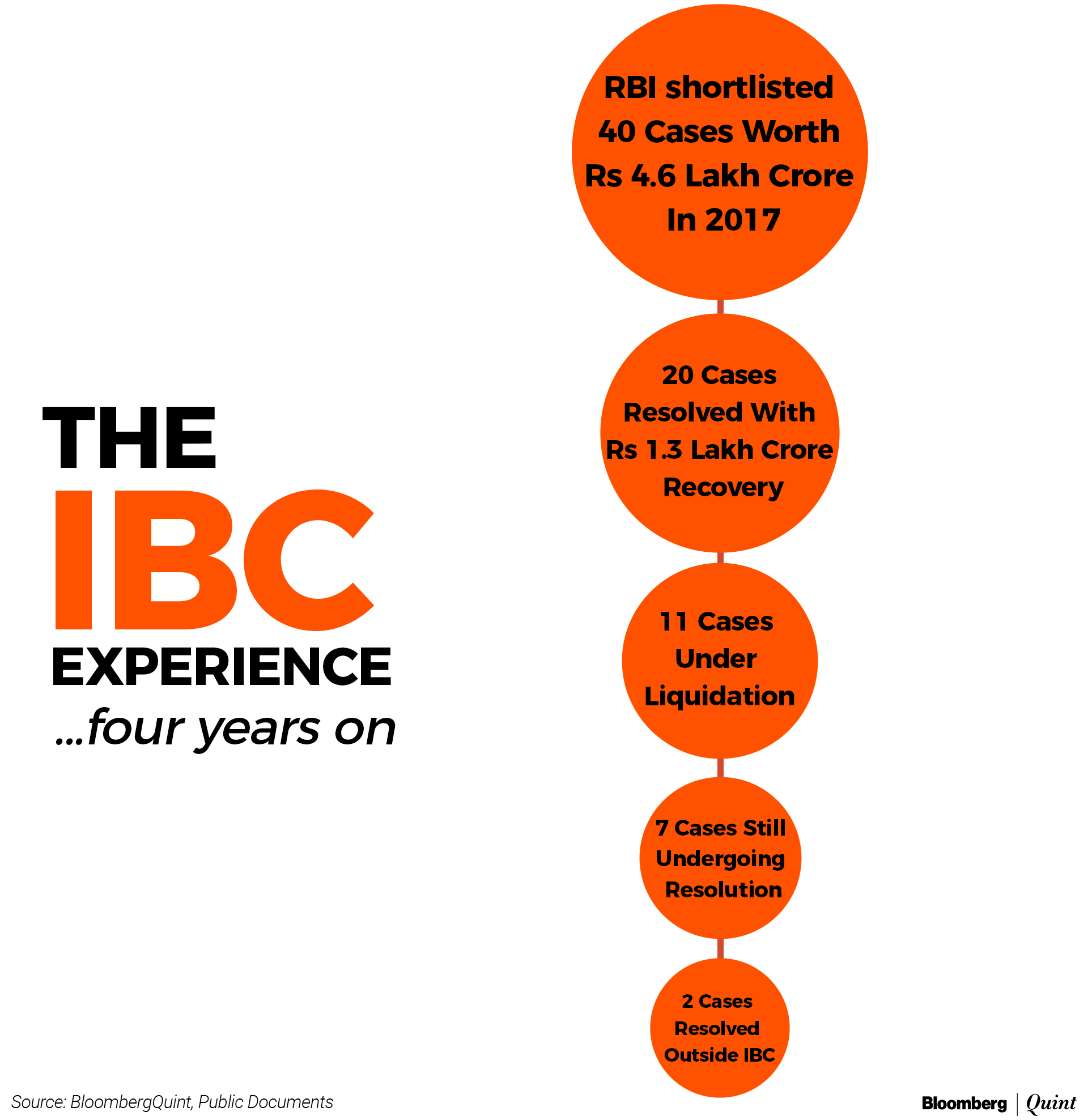
Four years on, only half of these 40 accounts have been resolved successfully. Among the other half, 11 are undergoing liquidation, seven are still pending resolution, while two are being resolved outside the courts.
Of the Rs 4.65 lakh crore worth debt which the RBI had shortlisted for IBC proceedings, banks have managed to recover 28%, or Rs 1.3 lakh crore, over the last four years. As a share of the outstanding debt of the 20 accounts where resolution was achieved, the recovery stands at 40% of outstanding debt.
The recovery experience across these 40 accounts is not very different from what has been seen more broadly under the four-year-old IBC.
As of March 31, there were 4,300 cases that were admitted under the IBC. Of these, only 8% have seen resolution, 30% have gone into liquidation, while 40% are still pending resolution.
The time taken for resolution is well beyond the 180-270 days initially prescribed under the IBC but even longer than the extended 330-day period now permitted.
“...the actual experience reveals that, for both liquidations, as well as resolutions of cases, the time required has been more than 400 days, which is worrying, as recovery values get affected due to such delays,” Macquarie Research said in a report on June 7.
While the experience in resolving both the 40 large accounts and other cases has been short of ideal, it was the only option at the time, said VG Kannan, who was the chief executive at the Indian Banks Association at the time these decisions were made.
“It's only because of this that banks have been forced to recognise the level of excessive lending and the underlying value of the account,” Kannan said. “Through this process, the banks had to make the necessary provisions and recover whatever they could.”
Besides, other resolution routes such as the Debt Recovery Tribunals and the Board for Industrial and Financial Reconstruction would have taken much longer to arrive at any recovery, he said.
The Standout Cases: Good With The Bad
Each large insolvency case brought with it its own quirks. Some earned lenders good recoveries. Others led creditors into a tangle of litigation.
Strong Recoveries: Essar Steel, Bhushan Power & Steel
The highest recovery was in the case of Essar Steel, where lenders managed to recover 92% of the outstanding dues of Rs 49,000 crore. This hotly contested case, which went all the way to Supreme Court, saw the Ruia family eventually yield control of the group's flagship to ArcelorMittal.
The resolution process took 850 days to be completed.
Recoveries were high for lenders of Bhushan Power & Steel Ltd., too, where they recovered about 41% of dues. The case, however, saw delays due to fraud proceedings against promoter Sanjay Singal. In March 2021, JSW Steel proceeded to implement the resolution plan and take over Bhushan Power & Steel, with lenders receiving Rs 19,350 crore against dues of Rs 47,000 crore.
Lowest Recoveries: Ushdev International
The lowest recoveries made by banks among these 40 cases were in Ushdev International Ltd, a power generation and trading company. Against outstanding dues of Rs 7,700 crore, banks approved a resolution plan by Singapore's Taguda Pte. Ltd. worth Rs 200 crore. The committee of creditors had originally rejected Taguda's resolution plan, as the liquidation value of Ushdev International stood at Rs 900 crore. The NCLT, however, intervened and noted that the rejection was based on the assumption of value by the creditors.
Group Insolvency: Videocon Industries
Videocon Industries has been among the most complex cases to be resolved, as banks were forced to first merge 13 group companies with Videocon Industries. These companies are responsible for businesses including financial investments, real estate, electronics, consumer appliances and telecommunication. Owing to the complex financial arrangements between these entities, a consolidated insolvency proceeding was the best way forward, the NCLT had noted in its judgement when it approved the merger.
A resolution plan by Anil Agarwal's Twin Star Technologies was approved by the NCLT this month, where Videocon's lenders would receive Rs 3,000 crore against dues worth Rs 31,000 crore, implying a recovery rate of less than 10%.
Largest Likely Liquidation: ABG Shipyard
Among the 11 companies which are currently under liquidation, ABG Shipyard with outstanding dues of Rs 15,500 crore is the largest. The company was part of the original 12 firms shortlisted by the RBI in June 2017. Liquidation was ordered in May 2019. While the liquidator has held multiple rounds of auctions, buyers have not been forthcoming. In December 2020, the NCLT allowed for private sale of ABG Shipyard's assets, instead of open auctions, for quicker resolution.
Endless Twists & Turns: Jaypee Infratech
The insolvency proceedings against the Noida-based Jaypee Infratech were initiated in August 2017, after it was identified as part of the RBI's first list. Over the years, the resolution process has seen multiple turns. Problems with the resolution have included judicial delays, the question of homebuyers being made part of the committee of creditors, legal challenges by the Uttar Pradesh state government and even a settlement plan by Manoj Gaur, the promoter.
A fourth-round of bidding for Jaypee Infratech is underway and resolution plans by NBCC Ltd and Suraksha Asset Reconstruction Company are being put to vote on June 14.
IBC: Still The Best Option?
With the prolonged resolution process and lower recoveries, are bankers now reluctant to use the IBC route for resolution?
Rajnish Kumar, former chairman, State Bank of India, doesn't think so.
“It would be unfair to judge the success of the IBC on the recovery rates in chronic cases. That is bound to be low,” he said. “The true success of the bankruptcy law is that it has led to better quality negotiations with promoters.”
According to Kumar, to step up the success of the IBC mechanism, the system should look for ways to minimise judicial delays, as that leads to value destruction and eventually lower recoveries.

-
Navigating Energy Crossroads: S Jaishankar's Call For Diversified Supply Chains At G20 Ministerial Meeting

As geopolitical fault lines continue to test maritime trade routes and commodity flows, Jaishankar's message remains pertinent: true economic resilience requires open markets, protected transit lines, and a genuine commitment to multilateral cooperation rather than coercion.
-
Indians Are Travelling, But Not Every Journey Is A Holiday | The Week In Whys
Pilgrims, patients and working women are the real travellers, and the system hasn't quite caught up with them.
-
Getting To Work Costs Women More | The Reason Why
It is not just about women paying more than men. It is about women paying much more in cities than in villages.
-
AI Bias In Investing Cannot Be Eliminated, But It Can Be Governed
Framing is a particularly important example as identical financial information presented in terms of gains rather than losses can lead an LLM to reach a different assessment.
-
Joining The Dots | Dark Skies, Steady Diya: Why Hope Holds This Diwali
With war, a weak rupee and foreign outflows weighing on sentiment, policymakers at the NDTV World Summit and market veterans at NDTV Profit Ignite: Diwali Edition offered the same advice: stay invested and filter out the noise.
-
The Curious Case of Equitas Small Finance Bank And A CEO Who Quit For Stock
PN Vasudevan believes persistent investor concerns over a perceived conflict of interest had become a governance overhang on Equitas Small Finance Bank's stock, even as the lender improved profitability and asset quality.
-
Talking Points This Week: AI Cash Burn, A Tiger Comeback And An India That Still Finds Its Own Path
India is not immune to higher oil or tighter global liquidity, yet its earnings base is broader, its domestic policy levers are still available.
-
Foreign Investors Own Half Of HDFC Bank and ICICI Bank. An LTCG Cut Could Matter Most Here
Foreign portfolio investors have US$115 billion parked in HDFC Bank, ICICI Bank. If the government cuts long-term capital gains tax, Jefferies says returning foreign money could land here first.
-
'Never Seen This Level Of Negativity': Sandeep Tandon Says The Next Rally May Be Closer Than You Think
Veteran investor Sandeep Tandon says foreign selling is easing, large-caps are due a comeback and mid-caps are crowded, while he turns positive on gold, power and pharma this Diwali.
-
Indians Stay With Family, Not In Hotels | The Reason Why
India still lacks enough clean, reliable and affordable hotels for budget-conscious travellers.










