Forty Days That Prompted Indian Companies To Write-Off A Quarter
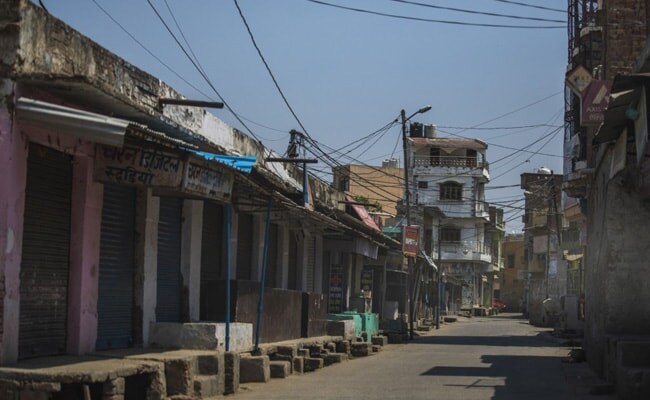
M.S. Unnikrishnan's main focus nowadays is to get his 10 factories in India up and running as the nation slowly starts to exit the world's strictest stay-at-home restrictions. Unnikrishnan, managing director of Thermax Ltd., a maker of energy efficient cooling equipment, is still awaiting permission to reopen three more. From Thermax to Kalyani Steel Limited, companies are slowly being allowed to resume operations from Monday even though the lockdown has been extended for two weeks.
Resumption of activity after almost 40 days won't help salvage economic growth this quarter -- or even the fiscal year-- as the lockdown decimated consumption, the main driver of Asia's third-largest economy. The majority of chief executive officers in a survey by the Confederation of Indian Industry expect domestic demand to take six to 12 months to return, while 45 per cent see economic normalcy to take more than a year after the lockdown ends.
"This quarter would be a write-off for entire India. By second quarter, we will learn to live with the disease," Unnikrishnan said in a phone interview on Sunday. "How fast can we restart the economy engine is the question right now."
It may not be fast enough. Factories that have opened are operating at about a third of their capacity and others are seeing demand for their products have evaporated. Star Cement, the most profitable maker of the construction material in India, saw demand fall 80 per cent at a factory it recently reopened.
Meanwhile top carmakers, that couldn't ship a single vehicle to dealers in April, are still not sure when they will be able to resume production.
The complete shutdown may result in a rare contraction in growth, according to economists. Mr Unnikrishnan said he expects localized lockdowns to happen more frequently.
India reported the biggest single-day spike in infections on May 3, recording more than 2,800 new cases, according to data from Johns Hopkins University. Those numbers now stand almost at 42,500 infections and almost 1,400 deaths.
"Covid-19 has had an unprecedented impact. It's the biggest risk as we look into the future," said Srinivas Phatak, Hindustan Unilever's chief financial officer in a post-earnings call with reporters last week. "It's difficult to estimate the pace of recovery. There's still a lot of disruption and business is not back to normal."
Rules Eased
ITC, the country's largest cigarette maker, that also makes instant noodles, soaps and incense sticks, said it will work with local administrations to resume operations where possible with the stipulated precautions.
"The company is in a state of readiness for different scenarios," a spokesperson said in a text message. "It remains imperative that progressively the entire value chain from sourcing to manufacture to distribution functions optimally to scale up economic activity and generate the critical livelihood opportunities."
Industrial establishments in urban areas, including special economic zones, will be allowed to operate. That includes manufacturing units for essential goods, including drugs, pharmaceuticals and medical devices and IT hardware production, the Ministry of Home Affairs said in a statement on May 1.
About 50 kilometers (31 miles) north of Chennai, Niraj Shah, who runs a fabrication unit, wants to clear his inventory so he can restart his cash flow. Meanwhile his vendors want payment quickly. Shah is hoping the government will help small firms like his.
"It's a catch-22 situation," Mr Shah said.

-
Unhedged Position: Can India See An Indonesia-Style Time Correction?

The Nifty is trading below levels it first clocked in 2024. Is there, then, as I have suggested in the headline, potential that the current time correction drags on painfully for the next three-five, even ten years?
-
Navigating Friction And Energy Realities: An Analysis Of Marco Rubio's October Visit To India
Occurring at a critical juncture marked by stalled trade negotiations and escalating geopolitical pressures over global energy supplies, the visit offers a profound window into modern US-India relations.
-
India Exports Capital. Why Not Export Trusteeship?
The big question, then, is whether India can build an institution that global borrowers, investors, banks, and lawyers can trust, even without an Indian connection.
-
France's Economy & Politics Are In Crisis | The Reason Why
Let's look at how the French economy and politics evolved under Nicolas Sarkozy, Franois Hollande and Emmanuel Macron.
-
You May Inherit The Business. You Must Earn Its Credibility.
Succession tests the founder's ability to share authority as much as it tests the next generation's readiness to assume it.
-
Signing Deals Is One Thing; Making Them Work Is Another | The Week In Whys
Sometimes, things don't turn out as planned. Indian companies have lost some bids to rivals, some projects won't produce until 2030.
-
FOMC Wall, PERM Suspension, Hospital Stocks | Talking Points This Week
A PERM suspension would directly affect green-card sponsorship rather than H-1B visas, so the near-term earnings impact could remain relatively limited. The key question is whether this marks a new phase in US scrutiny of Indian IT.
-
Everything, Everywhere, All At Once: Dalal Street's Week To Forget | Joining The Dots
Visa curbs, a Starlink spat and cancer drug caps: what connects this week's shocks for Indian markets
-
India Is Going Abroad For Critical Minerals. But It May Take Years To Pay Off | The Reason Why
Although India's steps are in the right direction, they remain modest compared with India's growing dependence.
-
When Everyone Has AI, What Gives You An Edge?
India's young workforce is entering an uncertain world of work where powerful AI tools are becoming widely accessible. The advantage will belong to those who combine deep expertise with digital fluency, and the distinctly human capabilities that technology cannot manufacture.









