Former Fed Boss Ben Bernanke Denied Mortgage Refinance
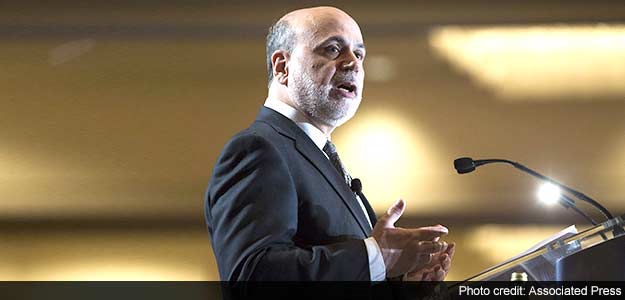
Imagine Reserve Bank Governor Raghuram Rajan being turned down for a home loan once he retires. Yet, that is exactly what happened to former Federal Reserve Chairman Ben Bernanke, who was till February 2014, the most powerful central banker in the world.
At a conference in Chicago on Thursday, Mr Bernanke said he was unsuccessful in refinancing his mortgage, Bloomberg News reported. Refinancing means replacing an existing loan with a new loan offering lower interest rate or more flexible tenure.
According to reports, Mr Bernanke wanted to refinance the mortgage on his Capitol Hill house, which he and his wife had bought for $839,000 (nearly Rs 5 crore at 1 dollar=60 rupee) in 2004.
Mr Bernanke, who has not taken up a regular job after two terms at the Federal Reserve, reportedly charges $250,000 (Rs 1.5 crore) for giving a speech and has also signed a book contract, which is expected to fetch him millions of dollars.
According to analysts, his application for refinance was rejected on grounds that he recently changed his job, a criteria that makes getting credit difficult even in India.
Mr Bernanke's revelation led to many hilarious tweets,
Binyamin Appelbaum@BCAppelbaum
Name: Ben Bernanke. Job? None. Other sources of income? I'm writing a book. And giving speeches. #DENIED
Money.com@MONEY
Don't feel bad if you can't refinance your mortgage: Even Ben Bernanke can't get a loan
zerohedge@zerohedge
Going forward instead of getting paid at a rate of $250,000 per hour, Ben Bernanke would prefer a mortgage refi LOI instead
The episode highlights the tight credit situation in the US property market, economists say. It also shows how rigid lending rules have become post the subprime mortgage crisis that triggered the global recession in 2008.
The subprime crisis resulted from banks extending mortgages to risky buyers on high interest rates. Large investment firms then bought such loans as mortgage-backed securities (MBSs). A number of such loans became delinquent starting in 2007, triggering bankruptcy across many banks in the US. The fallout was a major contributor to the global recession that followed.

-
Opinion | India at 38: From Innovation Overperformer to Innovation Powerhouse

India now has 453 VC-backed deep science startups, 18 of them late-stage, after 117 percent growth since 2020. Laurus Labs, at USD 9.3 billion, is the most valuable deep science company in any middle-income economy outside China.
-
Navigating Energy Crossroads: S Jaishankar's Call For Diversified Supply Chains At G20 Ministerial Meeting
As geopolitical fault lines continue to test maritime trade routes and commodity flows, Jaishankar's message remains pertinent: true economic resilience requires open markets, protected transit lines, and a genuine commitment to multilateral cooperation rather than coercion.
-
Indians Are Travelling, But Not Every Journey Is A Holiday | The Week In Whys
Pilgrims, patients and working women are the real travellers, and the system hasn't quite caught up with them.
-
Getting To Work Costs Women More | The Reason Why
It is not just about women paying more than men. It is about women paying much more in cities than in villages.
-
AI Bias In Investing Cannot Be Eliminated, But It Can Be Governed
Framing is a particularly important example as identical financial information presented in terms of gains rather than losses can lead an LLM to reach a different assessment.
-
Joining The Dots | Dark Skies, Steady Diya: Why Hope Holds This Diwali
With war, a weak rupee and foreign outflows weighing on sentiment, policymakers at the NDTV World Summit and market veterans at NDTV Profit Ignite: Diwali Edition offered the same advice: stay invested and filter out the noise.
-
The Curious Case of Equitas Small Finance Bank And A CEO Who Quit For Stock
PN Vasudevan believes persistent investor concerns over a perceived conflict of interest had become a governance overhang on Equitas Small Finance Bank's stock, even as the lender improved profitability and asset quality.
-
Talking Points This Week: AI Cash Burn, A Tiger Comeback And An India That Still Finds Its Own Path
India is not immune to higher oil or tighter global liquidity, yet its earnings base is broader, its domestic policy levers are still available.
-
Foreign Investors Own Half Of HDFC Bank and ICICI Bank. An LTCG Cut Could Matter Most Here
Foreign portfolio investors have US$115 billion parked in HDFC Bank, ICICI Bank. If the government cuts long-term capital gains tax, Jefferies says returning foreign money could land here first.










