FinTech Tracker: In A World Of BHIM And UPI, MSwipe Is Betting On Tiny Card Swipe Machines
When the government announced the sudden withdrawal of Rs 500 and Rs 1000 notes, merchants and banks rushed to try and acquire point of sale (PoS) machines so that they could continue to transact.
They hit upon two hurdles - the unavailability of these PoS machines in India and their cost. Since then the government (through the Union Budget) has tried to incentivize local production of such machines. Meanwhile the RBI has suggested a cut in fee or merchant discount rates (MDR) to draw more merchants towards non-cash payments.
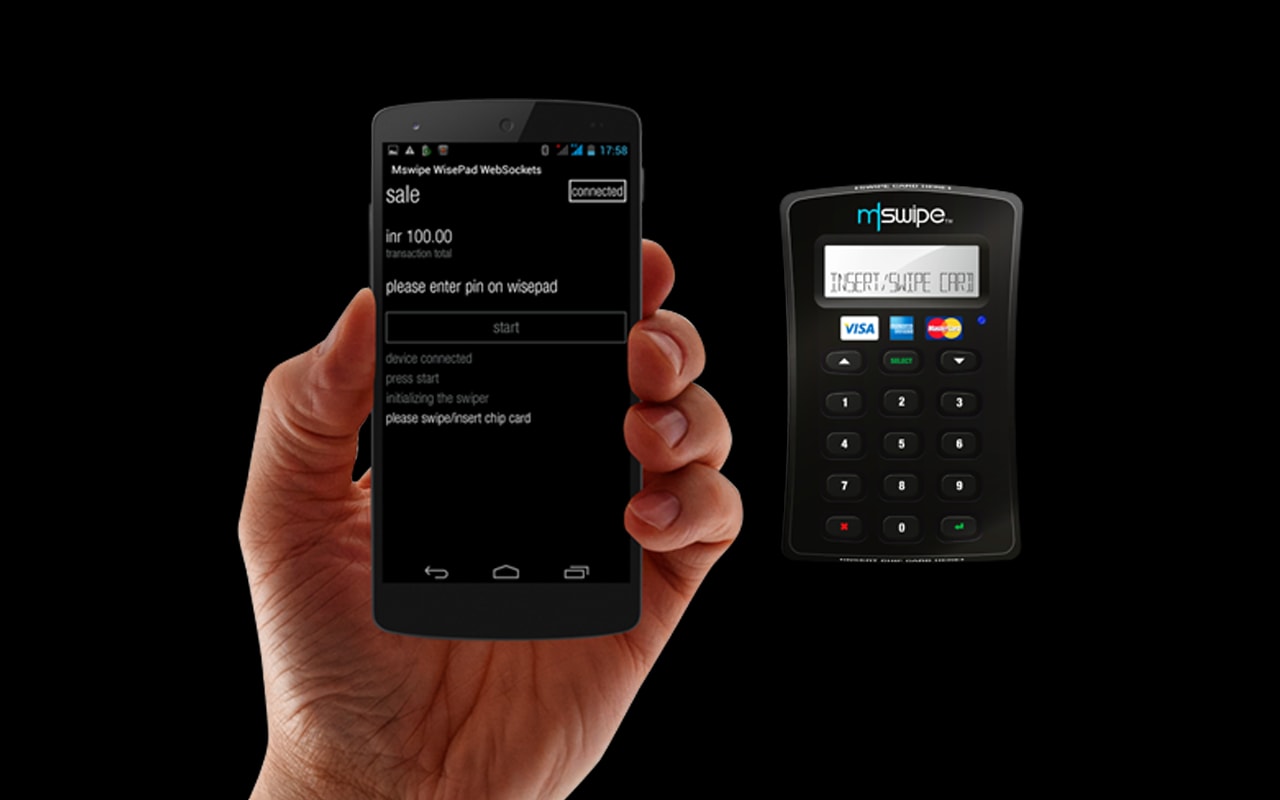
MSwipe, a Mumbai-based hardware startup, says another solution is to popularize mobile PoS in India. MSwipe, which manufactures hardware devices that can convert any phone into a PoS terminal, claims this will reduce the cost of accepting payments through cards.
An Unlikely Beginning
MSwipe was started in 2012 by Manish Patel, a doctor by training. He chose not to practice medicine and instead went into wine retailing. There, he spent about 15 years before founding MSwipe. While supplying wine to retail stores, Patel had noticed the need for PoS machines but had found it tough to acquire one. From there emerged the idea of a different kind of PoS business.
“I figured that there were only four large banks who had monopolized the business. I looked around and found out that banks were deploying antiquated terminals and it got me thinking about newer ways to approach the problem. We set up to become a bank agnostic merchant acquirer,” he told BloombergQuint.
On launch, the company brought out a nifty card swiping machine. All you had to do was plug it into the audio jack of any phone and begin accepting card payments.
Despite having a very high card issuance base, our acquiring base is faltering. This is because acquirers never found it viable to provide terminals to small merchants who are doing business of, say, Rs 30,000 a month. And that is the clear mandate that Mswipe has.Manish Patel, Co-Founder & CEO, Mswipe
.png)
With 1,70,000 terminals, Patel claims Mswipe is the fifth largest deployer of card machines in the country. Since inception the company has raised $32 million, with the last round of funding coming in July 2015.
The machines offered by Mswipe are built for the Indian market, said Patel. They are possibly the only ones with a SIM card slot and work on Wi-Fi, he added. It's focus is on acquiring small and medium sized merchants in tier 2 and tier 3 cities. This means that the average ticket size for transactions at MSwipe machines is slightly lower at about Rs 1700 per transaction compared to Rs 1800 - Rs 3000 per transaction on regular PoS machines.
To sign up with Mswipe, a merchant needs to shell out upto Rs 3,000 as a one-time fee which goes towards delivering and setting up the terminal. From thereon, the charges are set at Rs 350 per month for unlimited transactions with no minimum transaction cap. In comparison, a regular PoS machine will cost atleast Rs 20,000 to buy along with regular overhead costs.
The Demonetisation Factor
Like other digital payment options, Mswipe, too, benefited from the shortage of currency in the country since November. Till then, the company was deploying machines at the pace of 10,000 devices per month. This shot up to 25,000 a month after demonetisation. Since then, demand has moderated.
“I think we will end February with 15,000 deployments which is still a high number compared to other acquirers,” Patel said.
While demonetisation was initially a boon for MSwipe, it could equally prove to be a bane.
The government is doing all it can to promote digital payment means such as the Unified Payment Interface (UPI) based BHIM app. BharatQR, a QR code based payment mechanism, has also been launched. As some of these become popular, some, including NITI Aayog chief Amitabh Kant, are of the view that PoS machines will become redundant.
India is in the midst of huge disruption in the world of both financial technology and in terms of social innovation. (There is) huge innovation and this disruption will enable India to leapfrog. And, by 2020, my view is that in the next two-and-a-half years, India will make all its debit cards, credit cards, all ATM machines, all POS machines, totally irrelevant.Amitabh Kant, CEO, NITI Aayog (January 7, 2017)
Patel acknowledges that the payment world is changing rapidly but said that newer ways to pay have a long way to go before they can compete with the penetration of cards.
It's a wish that physical PoS will be eliminated but I don't think that's going to happen. You have got 700 million card holders and they all have to be online to do a transaction through all the new-fangled UPI and AEPS (Aadhaar enabled payment system) etc. It is a struggle for us to make sure that just 1.6 lakh merchants are online at all times. Most failures are due to bad connectivity at the time of firing the transaction. It's a utopian dream at best.Manish Patel, Co-founder & CEO, Mswipe
There is another challenge on the horizon.
The government and the RBI want all payment acceptance infrastructure to be biometric enabled to allow for the use of Aadhaar. The deadline for this has been set at June 30 by the RBI. Patel doesn't believe the industry is prepared. One, the costs will rise. Two, companies like MSwipe are not sure how to link biometric readers with PoS devices in the absence of a global standard.
“We have been asking them to define the transaction flow. For EMV [plastic card standard], transaction flow is a global standard. We don't know what it is here. They haven't told us whether people will put their cards and then use biometrics, or will they use biometrics first and then enter a pin or will there just be direct biometric based transactions. Nobody knows that.”
Do all these uncertainties mean that MSwipe's future may not be as bright as its past?
Naveen Surya, chairman of the Payments Council of India, thinks that there is enough room for different kinds of payment mechanisms to exist and grow.
“Acquiring merchants is going to be a big opportunity in the next two three years with all that has happened in the past few months. However, there is a lot of talk about unnecessary competition between products like QR code, Mswipe or physical PoS. In my mind, these are unique solutions that work for unique problems,” Surya told BloombergQuint over phone.
There may be a small merchant who has 100-200 transactions but 20 transactions happen through debit or credit card. There banks or MSwipe would not want to put a physical terminal. There the QR works better. QR code is like the base of the pyramid since it can be everywhere. MSwipe is in the middle where it caters to mid-size clients and mid-level volumes, while traditional PoS machines sit on top of it and cater to high volumes and high value of transactions.Naveen Surya, Chairman, Payments Council Of India

-
Navigating Energy Crossroads: S Jaishankar's Call For Diversified Supply Chains At G20 Ministerial Meeting

As geopolitical fault lines continue to test maritime trade routes and commodity flows, Jaishankar's message remains pertinent: true economic resilience requires open markets, protected transit lines, and a genuine commitment to multilateral cooperation rather than coercion.
-
Indians Are Travelling, But Not Every Journey Is A Holiday | The Week In Whys
Pilgrims, patients and working women are the real travellers, and the system hasn't quite caught up with them.
-
Getting To Work Costs Women More | The Reason Why
It is not just about women paying more than men. It is about women paying much more in cities than in villages.
-
AI Bias In Investing Cannot Be Eliminated, But It Can Be Governed
Framing is a particularly important example as identical financial information presented in terms of gains rather than losses can lead an LLM to reach a different assessment.
-
Joining The Dots | Dark Skies, Steady Diya: Why Hope Holds This Diwali
With war, a weak rupee and foreign outflows weighing on sentiment, policymakers at the NDTV World Summit and market veterans at NDTV Profit Ignite: Diwali Edition offered the same advice: stay invested and filter out the noise.
-
The Curious Case of Equitas Small Finance Bank And A CEO Who Quit For Stock
PN Vasudevan believes persistent investor concerns over a perceived conflict of interest had become a governance overhang on Equitas Small Finance Bank's stock, even as the lender improved profitability and asset quality.
-
Talking Points This Week: AI Cash Burn, A Tiger Comeback And An India That Still Finds Its Own Path
India is not immune to higher oil or tighter global liquidity, yet its earnings base is broader, its domestic policy levers are still available.
-
Foreign Investors Own Half Of HDFC Bank and ICICI Bank. An LTCG Cut Could Matter Most Here
Foreign portfolio investors have US$115 billion parked in HDFC Bank, ICICI Bank. If the government cuts long-term capital gains tax, Jefferies says returning foreign money could land here first.
-
'Never Seen This Level Of Negativity': Sandeep Tandon Says The Next Rally May Be Closer Than You Think
Veteran investor Sandeep Tandon says foreign selling is easing, large-caps are due a comeback and mid-caps are crowded, while he turns positive on gold, power and pharma this Diwali.










