Finance Minister Asks Financial Entities To Ensure Customers Nominate Heirs
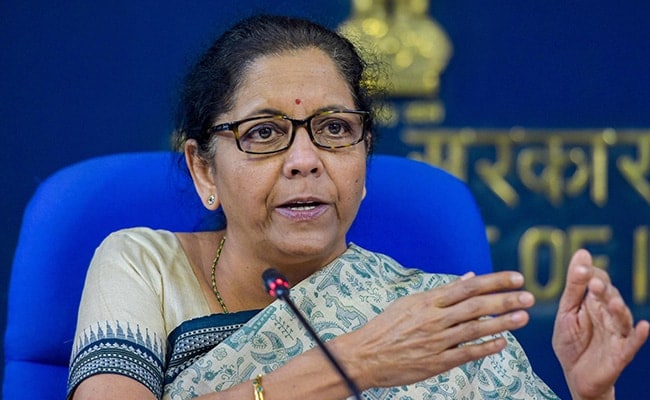
Finance Minister Nirmala Sitharaman today asked banks and other financial institutions to ensure that their customers must update nominees to help resolve the problem of unclaimed money in future.
"I want the banking system, the financial ecosystem including the mutual funds, stock markets to keep in mind that when someone deals with his (customer's) money, the organisations will have to think about the future and ensure that customers nominate their heirs, give the name and address," Sitharaman said speaking at the Global Fintech Fest (GFF).
According to a report, the banking system alone has more than Rs 35,000 crore of unclaimed deposits, while the overall quantum of the unclaimed money is said to be more than Rs 1 lakh crore.
The Reserve Bank on August 17 launched a centralised web portal UDGAM (Unclaimed Deposits - Gateway to Access information) to help people search and claim unclaimed deposits.
The portal, launched by RBI Governor Shaktikanta Das, has been developed by the central bank to help the public to facilitate and make it easier for them to search their unclaimed deposits across multiple banks in one place.
The finance minister said that it is essential to build a responsible financial ecosystem, and added that one laggard can cause a disruption, which can lead to trust deficit and the resultant crisis in the financial world.
She also noted that tax havens and round-tripping of money are a threat to responsible financial ecosystem.
"We equally should talk about the threats to a responsible financial global ecosystem and the global challenges thereof to build a responsible financial ecosystem," she added.
Listing out the threats faced by the financial system, she said there are physical border threats, which are conventional warfare and other things. Then there are cyber threats whose intensity, unpredictability, and also the depth and access have gone up too high today.
"As much as you build firewalls, there are more and more newer ways in which attacks are being made. Cryptos which are a threat as well as an opportunity is also an example of the urgent need global cooperation because we are not going to be able to have a responsible financial ecosystem which we cannot regulate." On how the fintech players have helped the country, the minister said in about last four years, the number of demat accounts has increased by 2.5 times from 4.1 crore in 2019-20 to 10 crore in 2022-23.
A record number of mutual fund SIPs are being registered, which helps in generating long-term wealth. Monthly SIP inflows have touched an all-time high of Rs 15,245 crore in July. When it comes to the assets under management of the mutual fund industry, it has increased tremendously in the last decade, growing more than four-folds from Rs 10 lakh crore in May 2014 to Rs 46.37 lakh crore in July 2023, she said.
On the increasing number of income tax return filings, she said the August data signals that the formalisation of the economy is now really wide and it is accessing so many different areas. Credit facilities, social security, pension, insurance, all of them are getting covered.
Though Maharashtra still continues to be the leader in income tax filing, other states are also moving up. In places like the north-east, Chhattisgarh, Jammu & Kashmir, the new I-T return filings have gone up to two digits, grown by double digits growth. This augurs very well for the financial ecosystem.
She also asked fintech companies to invest heavily in robust security measures, utilising advanced encryption and other measures to protect user data and financial transactions.
A secured system is what will build trust and therefore that is a must for the financial ecosystem to truly flourish, she said, adding, India can lead in making the financial ecosystem inclusive, resilient and sustainable as we have the tools but we have to make it responsible.
(Except for the headline, this story has not been edited by NDTV staff and is published from a syndicated feed.)

-
High US Salaries, No Green Card Certainty: The Financial Calculation Facing Indian H-1B Families

The suspension of PERM processing at eight technology employers does not cancel existing H-1B visas. What it does is force a question many Indian families have been avoiding: is the US salary worth tying your career and family plans to one employer?
-
Swiggy vs Eternal: Food Delivery's Two Rivals Are No Longer In The Same Race
Eternal is building a private AI assistant, dark.ai. Swiggy is still working out how to make Instamart pay, with an operating loss of Rs 895 crore in the July-September quarter while Blinkit stayed profitable.
-
Where You Live Shapes How You Get To Work | The Reason Why
Two-wheelers are the most popular way to get to work in India, accounting for nearly 43% of workplace commutes.
-
Unhedged Position: Can India See An Indonesia-Style Time Correction?
The Nifty is trading below levels it first clocked in 2024. Is there, then, as I have suggested in the headline, potential that the current time correction drags on painfully for the next three-five, even ten years?
-
Navigating Friction And Energy Realities: An Analysis Of Marco Rubio's October Visit To India
Occurring at a critical juncture marked by stalled trade negotiations and escalating geopolitical pressures over global energy supplies, the visit offers a profound window into modern US-India relations.
-
India Exports Capital. Why Not Export Trusteeship?
The big question, then, is whether India can build an institution that global borrowers, investors, banks, and lawyers can trust, even without an Indian connection.
-
France's Economy & Politics Are In Crisis | The Reason Why
Let's look at how the French economy and politics evolved under Nicolas Sarkozy, Franois Hollande and Emmanuel Macron.
-
You May Inherit The Business. You Must Earn Its Credibility.
Succession tests the founder's ability to share authority as much as it tests the next generation's readiness to assume it.
-
Signing Deals Is One Thing; Making Them Work Is Another | The Week In Whys
Sometimes, things don't turn out as planned. Indian companies have lost some bids to rivals, some projects won't produce until 2030.
-
FOMC Wall, PERM Suspension, Hospital Stocks | Talking Points This Week
A PERM suspension would directly affect green-card sponsorship rather than H-1B visas, so the near-term earnings impact could remain relatively limited. The key question is whether this marks a new phase in US scrutiny of Indian IT.









