Finance Minister Arun Jaitley Hints Not All Scrapped Currency Will Be Remonetised
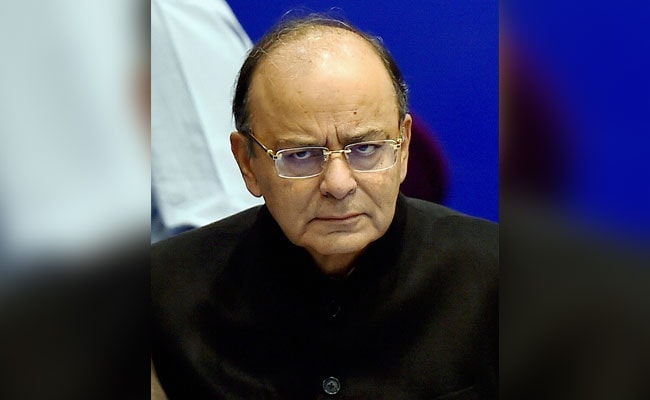
New Delhi: Finance Minister Arun Jaitley on Saturday hinted that not all of the Rs 15.44 lakh crore worth of currency junked will be remonetised through issuance of new notes as he said digital currency will fill the gap.
Calling the scrapping of old Rs 500 and Rs 1,000 notes as "a courageous step", he said the government could do it as India today has the capacity to take such decisions and experiment boldly.
The move will create a new Indian normal as the one that existed for the past seven decades is "unacceptable", he said, adding that demonetisation will help rid the economy of high cash circulation that had led to tax evasion, black money and currency being used for crime.
"One of the efforts of this exercise has to be that even though a reduced cash currency could remain, our conscious effort... (is) to supplement the rest with a digital currency," he said while addressing the annual general meeting of industry chamber FICCI here.
As many as 17,165 million pieces of Rs 500 denomination and 6,858 million pieces of Rs 1,000 banknotes were in circulation on November 8 when the government made the surprise announcement.
"The whole process of remonetisation is not going to take very long time and I'm sure very soon the Reserve Bank by injecting currency daily into the banking and postal system will be able to complete that," Mr Jaitley added.
Also, the push to use the digital mode to make payments has been gaining ground. "The manner it has taken place in the last five weeks is indeed commendable. Only a section of Parliament seems unaware of what is happening," he said.
Once the remonetisation process is complete, it will mark "the creation of a new Indian normal because the normal that existed for 70 years is an unacceptable normal", he added.
"The 70-year normal had become a way of life for almost every Indian. It was not merely a fact that you had a lot more cash currency, far larger cash currency as part of your GDP... the economic and social consequences of that are extremely adverse."
He made a point that dealing in that cash currency had led to a lot of aberrations in terms of tax non-compliance, currency being used for collateral purposes like crime, escaping the tax net and not getting into the banking system.
The government took "a somewhat courageous step" of withdrawing high demonetisation currency and went in for a large currency swap.
"The fact that India today has the capacity to take these decisions and capacity to enforce them, to experiment boldly even when at a time when the world is looking more inwards, marks an exception as far as India is concerned," the finance minister asserted.
Mr Jaitley also spoke of the country's "stamina" to sustain a decision like demonetisation, which has "clear long-term gains even at the cost of short-term inconveniences".
"Therefore, once we have that stamina notwithstanding fringe positions taken by national parties, one would always be able to implement these extremely successfully. Long-term benefits of these are going to be absolutely clear even if we bear the short-term pains," he said.
He seemed confident that the existing almost 75 crore debit and credit cards in the market, besides e-wallets, will help increase digital transactions. He also made a pitch that these transformations will have to be carried to their logical conclusion.
"There are, of course, even as we reform, domestic trends which are being visible on digitization of payments," Mr Jaitley said, adding that the government has clarity of direction as well as a broad shoulder and stamina to sustain these decisions.

-
High US Salaries, No Green Card Certainty: The Financial Calculation Facing Indian H-1B Families

The suspension of PERM processing at eight technology employers does not cancel existing H-1B visas. What it does is force a question many Indian families have been avoiding: is the US salary worth tying your career and family plans to one employer?
-
Unhedged Position: Can India See An Indonesia-Style Time Correction?
The Nifty is trading below levels it first clocked in 2024. Is there, then, as I have suggested in the headline, potential that the current time correction drags on painfully for the next three-five, even ten years?
-
Navigating Friction And Energy Realities: An Analysis Of Marco Rubio's October Visit To India
Occurring at a critical juncture marked by stalled trade negotiations and escalating geopolitical pressures over global energy supplies, the visit offers a profound window into modern US-India relations.
-
India Exports Capital. Why Not Export Trusteeship?
The big question, then, is whether India can build an institution that global borrowers, investors, banks, and lawyers can trust, even without an Indian connection.
-
France's Economy & Politics Are In Crisis | The Reason Why
Let's look at how the French economy and politics evolved under Nicolas Sarkozy, Franois Hollande and Emmanuel Macron.
-
You May Inherit The Business. You Must Earn Its Credibility.
Succession tests the founder's ability to share authority as much as it tests the next generation's readiness to assume it.
-
Signing Deals Is One Thing; Making Them Work Is Another | The Week In Whys
Sometimes, things don't turn out as planned. Indian companies have lost some bids to rivals, some projects won't produce until 2030.
-
FOMC Wall, PERM Suspension, Hospital Stocks | Talking Points This Week
A PERM suspension would directly affect green-card sponsorship rather than H-1B visas, so the near-term earnings impact could remain relatively limited. The key question is whether this marks a new phase in US scrutiny of Indian IT.
-
Everything, Everywhere, All At Once: Dalal Street's Week To Forget | Joining The Dots
Visa curbs, a Starlink spat and cancer drug caps: what connects this week's shocks for Indian markets
-
India Is Going Abroad For Critical Minerals. But It May Take Years To Pay Off | The Reason Why
Although India's steps are in the right direction, they remain modest compared with India's growing dependence.









