Federal Reserve cuts bond-buying but stresses easy policy
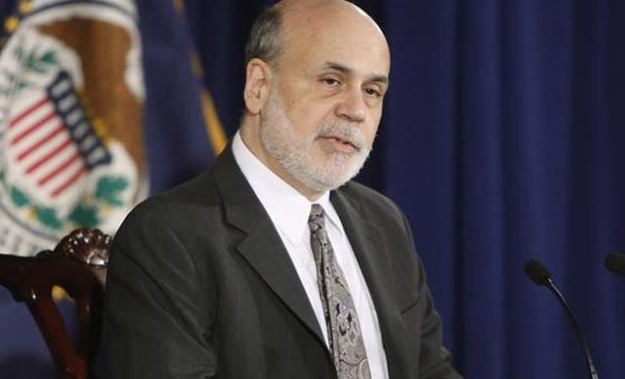
The US Federal Reserve trimmed its aggressive bond-buying program on Wednesday but sought to temper the long-awaited move by suggesting its key interest rate would stay at rock bottom even longer than previously promised.
In what likely amounts to the beginning of the end of its unprecedented support for the US economy, the central bank said it would reduce its monthly asset purchases by $10 billion, bringing them down to $75 billion.
This drove the Dow Jones industrial average and the S&P 500 to all-time closing highs. (Read more)
The move, which surprised some investors, was a nod to better prospects for the economy and labour market and marks a historic turning point for the largest monetary policy experiment ever.
(Read: 10 must-know facts about tapering)
Fed Chairman Ben Bernanke said that if US jobs gains continue as expected, the bond purchases would likely continue to be cut at a "measured" pace through much of next year. They would probably be wound down "late in the year, certainly not by the middle of the year", he said.
"The recovery clearly remains far from complete," Mr Bernanke told a news conference.
He said he consulted closely on the decision with Janet Yellen, the Fed's vice chair who is set to succeed him after his second four-year term at the central bank's helm ends on January 31. "She fully supports what we did today," he said. (Read more)
Stocks initially dropped, but quickly rebounded and touched their highest levels of the day as Mr Bernanke spoke. Similarly, bond prices slid but then bounced back. The dollar rose against the euro and the yen.
The Fed's extraordinary money-printing has helped drive US stocks to record highs and sparked sharp gyrations in foreign currencies, including a drop in emerging markets earlier this year as investors anticipated an end to the easing.
"They finally pulled a Band-Aid off that they've been tugging at for a long time," Rick Meckler, president of hedge fund LibertyView Capital Management in Jersey City, New Jersey. (What experts say)
The central bank's asset purchase program, a centrepiece of its crisis-era policy, has left it holding roughly $4 trillion of bonds, and the path it must follow in dialling it down is rife with numerous risks, including the possibility of higher-than-targeted interest rates and a loss of investor confidence.
The Fed said monthly purchases of both mortgage and Treasury bonds would be trimmed by $5 billion starting in January.
In a move aimed at forestalling a sharp market reaction that could undercut the recovery, the Fed said it "likely will be appropriate" to keep overnight rates near zero "well past the time" that the jobless rate falls below 6.5 per cent, especially if inflation expectations remain below target.
The Fed has held rates near zero since late-2008.
It was a noteworthy tweak to a previous commitment to keep benchmark credit costs steady at least until the jobless rate hit 6.5 per cent. The rate stood at 7.0 per cent in November, a five-year low.
End to an era?
The Fed's latest quantitative easing program, or QE, was launched 15 months ago to kick-start hiring and growth in an economy that was recovering only slowly from the Great Recession. The Fed's first QE program was launched in the midst of the 2008 financial crisis.
In fresh quarterly forecasts, the central bank lowered its expectations for both inflation and unemployment over the next few years, acknowledging the jobless rate had fallen faster than expected. It now sees it reaching a range of 6.3 per cent to 6.6 per cent by the end of 2014, from a previous prediction of 6.4 per cent to 6.8 per cent.
Three policymakers expect the first rate rise to come in 2016, up from only two in September, while 12 of the Fed's 17 top officials still see the move in 2015.
The Fed's asset purchases have stoked anxiety that they could unleash inflation or fuel hard-to-detect asset price bubbles. Even some within the Fed have worried about unintended effects.
Earlier on Wednesday, Brazil's finance minister issued a plea for the Fed to end its buying sooner rather than later to reduce market uncertainty that has kept emerging economies on edge.
But some have credited the asset purchases with stabilizing an economy and banking system that had been crippled by the 2008 financial crisis and with staving off what could have been a damaging cycle of deflation.
One policymaker, Eric Rosengren of the Boston Fed, dissented against the decision, which he felt was premature given the still high unemployment rate.
Recent growth in jobs, retail sales and housing, as well as a fresh budget deal in Congress, had convinced a growing number of economists the Fed would trim the bond purchases. The program is meant to put downward pressure on long-term borrowing costs to stimulate investment and hiring.
But many thought the central bank would wait until early in the new year, given persistently low inflation and the fact that the world's largest economy has stumbled several times in its crawl out of the 2007-2009 recession.
Copyright @ Thomson Reuters 2013

-
Navigating Friction And Energy Realities: An Analysis Of Marco Rubio's October Visit To India

Occurring at a critical juncture marked by stalled trade negotiations and escalating geopolitical pressures over global energy supplies, the visit offers a profound window into modern US-India relations.
-
India Exports Capital. Why Not Export Trusteeship?
The big question, then, is whether India can build an institution that global borrowers, investors, banks, and lawyers can trust, even without an Indian connection.
-
France's Economy & Politics Are In Crisis | The Reason Why
Let's look at how the French economy and politics evolved under Nicolas Sarkozy, Franois Hollande and Emmanuel Macron.
-
You May Inherit The Business. You Must Earn Its Credibility.
Succession tests the founder's ability to share authority as much as it tests the next generation's readiness to assume it.
-
Signing Deals Is One Thing; Making Them Work Is Another | The Week In Whys
Sometimes, things don't turn out as planned. Indian companies have lost some bids to rivals, some projects won't produce until 2030.
-
FOMC Wall, PERM Suspension, Hospital Stocks | Talking Points This Week
A PERM suspension would directly affect green-card sponsorship rather than H-1B visas, so the near-term earnings impact could remain relatively limited. The key question is whether this marks a new phase in US scrutiny of Indian IT.
-
Everything, Everywhere, All At Once: Dalal Street's Week To Forget | Joining The Dots
Visa curbs, a Starlink spat and cancer drug caps: what connects this week's shocks for Indian markets
-
India Is Going Abroad For Critical Minerals. But It May Take Years To Pay Off | The Reason Why
Although India's steps are in the right direction, they remain modest compared with India's growing dependence.
-
When Everyone Has AI, What Gives You An Edge?
India's young workforce is entering an uncertain world of work where powerful AI tools are becoming widely accessible. The advantage will belong to those who combine deep expertise with digital fluency, and the distinctly human capabilities that technology cannot manufacture.
-
Wrong Labels, High Pesticide Residues Holding Back Agri Exports | The Reason Why
India needs stronger domestic food-safety and labelling standards, with best practices becoming part of everyday business for farmers, traders and food companies.










