Fed Sees ‘More Restrictive’ Rates Possible If Inflation Persists
(Bloomberg) --
Federal Reserve officials solidified their resolve in June to keep raising interest rates for longer to prevent higher inflation from becoming entrenched, even if that slowed the US economy.
Policy makers increased interest rates by 75 basis points last month and backed hiking them at their next meeting in July by either 50 or 75 basis points, according to minutes of the Federal Open Market Committee's June 14-15 meeting released Wednesday. They viewed maintaining the central bank's credibility to control inflation as crucial.
“Many participants judged that a significant risk now facing the committee was that elevated inflation could become entrenched if the public began to question the resolve of the committee,” the minutes showed. “They recognized the possibility that an even more restrictive stance could be appropriate if elevated inflation pressures were to persist.”
The record was heavy with references to price pressures and why they might take time to ease. Officials “recognized that policy firming could slow the pace of economic growth for a time, but they saw the return of inflation to 2% as critical to achieving maximum employment on a sustained basis.”
Two-year Treasury yields, which are sensitive to Fed policy, pushed higher after release of the minutes and investors continued to bet the central bank would hike by 75 basis points later this month.
The Fed's aggressive push to curb the hottest inflation in 40 years has convulsed financial markets as investors fret that tighter monetary policy will tip the US economy into recession. The word “recession” was not mentioned once in the minutes, compared with 90 references to inflation.
“They can lose the battle on the economy, but they can't lose the war on the inflation anchor,” said Mark Spindel, chief investment officer at MBB Capital Partners LLC. “Powell's telling you, ‘We're not blinking'.”
Powell Comments
Officials hiked their benchmark rate to a target range of 1.5% to 1.75% in June and Chair Jerome Powell suggested they could do the same thing again in July.
He told reporters at a post-meeting press conference that another 75 basis-point increase, or a 50 basis-point move, was most likely on the table when policy makers gather July 26-27.
Officials went big last month -- despite previously signaling they favored a 50 basis-point hike -- after inflation data came in hot and a key indicator hinted that expectations for future price pressures could be accelerating among US consumers.
What Bloomberg Economics Says...
“Developments since the June decision -- intensifying recession chatter, slowing consumer demand, falling oil prices and lower inflation expectations than previously feared -- mean the FOMC is more likely to opt for a 50 basis-point hike this month than another supersized move. Still, the Fed has left both options open.”
-- Yelena Shulyatyeva and Andrew Husby (economists)
-- To read more, click here
Kansas City Fed President Esther George, who dissented against the increase in favor of a smaller hike, was the only one of the 18 policy makers who did not back moving by 75 basis points in June, the minutes showed.
Recession Fears
Several officials since that gathering have echoed Powell's characterization of the likely outcome of the July rate decision, even as recession fears mount.
The personal consumption expenditures price index, which the Fed uses for its inflation target, has risen 6.3% since May 2021 -- more than three times the central bank's 2% target.
Powell has said there are pathways for bringing inflation down while keeping the labor market strong, but acknowledged it will be a challenge.
Economists have downgraded growth forecasts on the heels of data showing weakness in consumer spending, a tightening of financial conditions and a decline in US manufacturing activity.
Mortgage rates, which have doubled since the start of the year, are also cooling the housing market and some businesses are seeing lower demand.
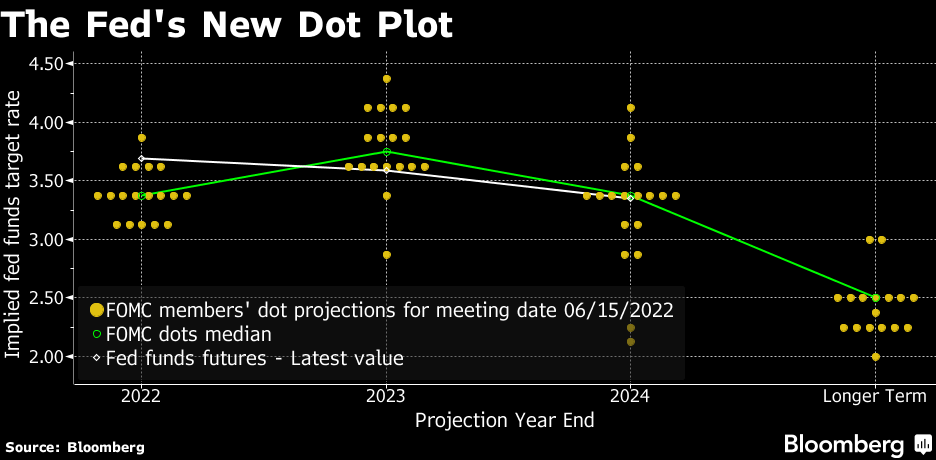
Odds of a US recession in the next year are now roughly one in three, according to Bloomberg Economics. Similar pessimism is evident in interest-rate future markets: Investors bet the Fed will reverse course next year, halting rate hikes sooner than officials forecast and beginning to cut rates by mid-2023.
“The FOMC was late to the inflation-fighting game, but they have certainly joined the battle now,” Stephen Stanley, the chief economist at Amherst Pierpont Securities LLC, wrote in an email. “The main question now is how restrictive the FOMC will need to get.”
(Updates with market reaction in fifth paragraph.)
More stories like this are available on bloomberg.com
©2022 Bloomberg L.P.

-
A New Samvat Wishlist: Inclusive Prosperity And Human Development

India has strengthened its economic foundations through infrastructure, digital access and enterprise. Its next growth chapter must deepen productivity, create better livelihoods and widen participation in prosperity.
-
Love, Sex Aur Dhokha: The Audacious Plot To Spy On Jensen Huang
A Taipei dinner, a Singapore chip buyer and a suspected Chinese asset: inside the alleged spy operation that got close to NVIDIA's Jensen Huang.
-
Ten Things I Learnt This Samvat
Patience can be a trap. Cheap stocks can stay cheap. Leverage can wipe you out. What did Samvat 2082 teach us? Niraj Shah writes on 10 lessons from the year gone by.
-
Talking Points This Week: Tech Nerves, FII Buying, And A Faraway Banking Shock
The global markets are not shining this Diwali. The exception in the large markets is, India.
-
Midterm Rally Lasted A Day. The Hard Reality Of A Divided US May Last Two Years | Opinion
Between a contested AI boom, a debt ceiling that arrives in 2027 and a president with every incentive to act alone, the next two years may prove more volatile than the first day's rally suggests.
-
Blue Wave Will Derail the AI Trade but Won't Dismantle the AI Era | Unhedged Position
The Democrats' sweep of the US Congress will see politics collide with economic forces both over the long and short term.
-
It's Time To Take The GST Council's Bet On Trust Global
Payment records can prove India's services exports, and clear, proportionate rules can bring foreign digital sellers into the tax net.
-
Opinion | India at 38: From Innovation Overperformer to Innovation Powerhouse
India now has 453 VC-backed deep science startups, 18 of them late-stage, after 117 percent growth since 2020. Laurus Labs, at USD 9.3 billion, is the most valuable deep science company in any middle-income economy outside China.
-
Navigating Energy Crossroads: S Jaishankar's Call For Diversified Supply Chains At G20 Ministerial Meeting
As geopolitical fault lines continue to test maritime trade routes and commodity flows, Jaishankar's message remains pertinent: true economic resilience requires open markets, protected transit lines, and a genuine commitment to multilateral cooperation rather than coercion.









