US Central Bank Holds Rates Steady, Sees No Strong Case For Moving In Either Direction
The Federal Reserve on Wednesday held interest rates steady and signaled little appetite to adjust them any time soon, taking heart in continued job gains and economic growth and the likelihood that weak inflation will edge higher.
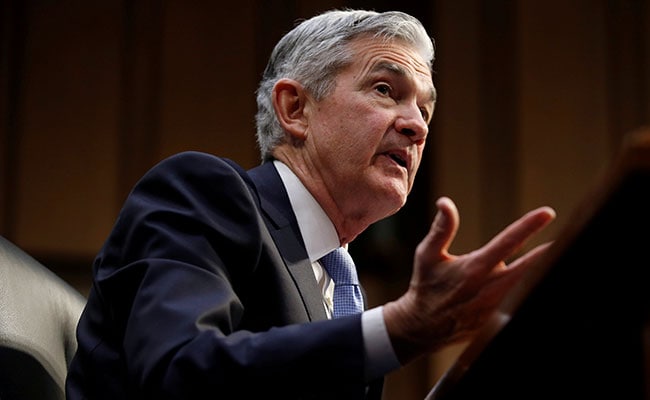
"We think our policy stance is appropriate at the moment; we don't see a strong case for moving it in either direction," Fed Chairman Jerome Powell said in a press conference following the end of the central bank's latest two-day policy meeting.
Overall, he said, "I see us on a good path for this year."
Fed policymakers said ongoing economic growth, a strong labour market and an eventual rise in inflation were still "the most likely outcomes" as the US expansion nears its 10-year mark.
"The labor market remains strong... economic activity rose at a solid rate" in recent weeks, the Fed said in a policy statement a day after US President Donald Trump called on it to cut rates by a full percentage point and take other steps to stimulate the economy.
The policy statement, and particularly Mr Powell's insistence the Fed saw no compelling reason to consider a rate cut in response to weak inflation, prompted a modest selloff in stock markets and pushed bond yields higher. The S&P 500 index fell 0.75 per cent, its largest daily decline since mid-March.
Interest rate futures also reversed direction, signaling a lower degree of confidence the next Fed move would be a rate cut, exactly the point Mr Powell was driving at in a "stay-the-course" message, said analysts at Cornerstone Macro.
"Nothing of what the (Federal Open Market Committee) did today... should be read as a signal that a future change in policy is coming."
The Fed also trimmed the amount of interest it pays banks on excess reserves to 2.35 per cent from 2.40 per cent in an effort to ensure its key overnight lending rate, the federal funds rate, remains within the current target band.
Inflation focus
The chief concern flagged in the policy statement was the currently "muted" level of inflation, which continues to fall short of the Fed's 2 per cent target. The statement suggested a recent decline in inflation may be more persistent than expected, and was no longer to be blamed simply on falling energy prices.
The most recent data showed a measure of underlying inflation running at 1.6 per cent, which would be a problem if it meant households and businesses had doubts about the economy's strength and were less willing to spend and invest.
Mr Powell told reporters the decline in so-called core inflation was likely mostly due to transient factors, and he predicted it would rise back to the 2 per cent target.
"If we did see inflation running persistently below (the target), that is something that we would be concerned about and something that we would take into account in setting policy," he said.
But for now, the Fed chief said, low inflation allows the central bank to be "patient" in deciding on any further changes to its overnight benchmark lending rate, which it left in a range of 2.25 per cent to 2.50 per cent on Wednesday.
"He is making the case that a rate increase is possible, not a foregone conclusion it's a cut only," said Brian Battle, director of trading at Performance Trust Capital Partners in Chicago.
The Fed raised rates four times in 2018 and, as late as December, had anticipated further rises in borrowing costs this year. Early this year it halted its tightening campaign on concerns about weak data in the United States and abroad.
The federal funds rate is the amount banks charge each other for overnight loans, and is the rate the Fed targets as its main way of controlling other borrowing costs in the economy. It neared the upper end of the target range last week, prompting the change in the interest paid on excess reserves.
Wednesday's policy decision was unanimous, a sign that the Fed remains steady in its pledge to keep interest rates unchanged until incoming economic data provide a compelling reason to do otherwise.

-
Unhedged Position: Can India See An Indonesia-Style Time Correction?

The Nifty is trading below levels it first clocked in 2024. Is there, then, as I have suggested in the headline, potential that the current time correction drags on painfully for the next three-five, even ten years?
-
Navigating Friction And Energy Realities: An Analysis Of Marco Rubio's October Visit To India
Occurring at a critical juncture marked by stalled trade negotiations and escalating geopolitical pressures over global energy supplies, the visit offers a profound window into modern US-India relations.
-
India Exports Capital. Why Not Export Trusteeship?
The big question, then, is whether India can build an institution that global borrowers, investors, banks, and lawyers can trust, even without an Indian connection.
-
France's Economy & Politics Are In Crisis | The Reason Why
Let's look at how the French economy and politics evolved under Nicolas Sarkozy, Franois Hollande and Emmanuel Macron.
-
You May Inherit The Business. You Must Earn Its Credibility.
Succession tests the founder's ability to share authority as much as it tests the next generation's readiness to assume it.
-
Signing Deals Is One Thing; Making Them Work Is Another | The Week In Whys
Sometimes, things don't turn out as planned. Indian companies have lost some bids to rivals, some projects won't produce until 2030.
-
FOMC Wall, PERM Suspension, Hospital Stocks | Talking Points This Week
A PERM suspension would directly affect green-card sponsorship rather than H-1B visas, so the near-term earnings impact could remain relatively limited. The key question is whether this marks a new phase in US scrutiny of Indian IT.
-
Everything, Everywhere, All At Once: Dalal Street's Week To Forget | Joining The Dots
Visa curbs, a Starlink spat and cancer drug caps: what connects this week's shocks for Indian markets
-
India Is Going Abroad For Critical Minerals. But It May Take Years To Pay Off | The Reason Why
Although India's steps are in the right direction, they remain modest compared with India's growing dependence.
-
When Everyone Has AI, What Gives You An Edge?
India's young workforce is entering an uncertain world of work where powerful AI tools are becoming widely accessible. The advantage will belong to those who combine deep expertise with digital fluency, and the distinctly human capabilities that technology cannot manufacture.









