Federal Reserve Cuts Interest Rates For First Time Since 2008
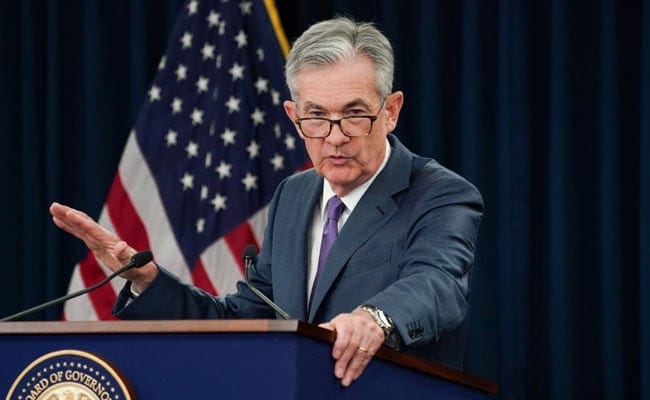
The Federal Reserve cut interest rates on Wednesday, but the head of the US central bank said the move might not be the start of a lengthy campaign to shore up the economy against risks including global weakness.
Fed Chairman Jerome Powell cited signs of a global slowdown, simmering US trade tensions and a desire to boost too-low inflation in explaining the central bank's decision to lower borrowing costs for the first time since 2008 and move up plans to stop winnowing its massive bond holdings.
"Let me be clear - it's not the beginning of a long series of rate cuts," Mr Powell said in a news conference after the Fed released its latest policy statement. At the same time, he said, "I didn't say it's just one rate cut."
Financial markets had widely expected the Fed to reduce its key overnight lending rate by a quarter of a percentage point to a target range of 2.00 per cent to 2.25 per cent, but many traders expected clearer confirmation of forthcoming rate cuts.
US President Donald Trump, who has repeatedly attacked the Fed's policy stance under Mr Powell and demanded that it push through big rate cuts, said on Twitter the Fed chief "let us down" by not telegraphing that an aggressive easing was coming.
US stock prices fell during Mr Powell's news conference. The benchmark S&P 500 index closed down 1.1 per cent for the day. Yields on two-year notes, a proxy for Fed policy rates, rose to 1.87 per cent.
Ken Polcari, managing principal at Butcher Joseph Asset Management, said Mr Powell's message was "not what the market was expecting to hear" even though most traders expected a rate cut. "He is not shutting the door, but he is also not saying there is another one coming in September, so hold on," Mr Polcari said.
Heading into Wednesday's Fed decision, the S&P 500 was up about 3 per cent since June 19, when the Fed first signalled a rate cut was likely as it pledged then to "act as appropriate to sustain" the record-long US expansion.
In a statement at the end of a two-day policy meeting, the Fed said it decided to cut rates "in light of the implications of global developments for the economic outlook as well as muted inflation pressures." It said it will "continue to monitor" how incoming information affects the economy and that it will "act as appropriate to sustain" the expansion.
"It's smart of them to go ahead and take out some insurance here. It's better than none at all," said Brett Ewing, chief market strategist at First Franklin Financial Services in Tallahassee, Florida.
The US dollar index gained ground to touch its highest in more than two years. The index, which measures the greenback against a basket of currencies, was up about 0.5 per cent on the day.
Two "no" votes
The Fed's policy decision drew dissents from Boston Fed President Eric Rosengren and Kansas City Fed President Esther George who argued for leaving rates unchanged.
"This is the most dissent we've had in the current Fed; we had two hawkish dissenters on this decision," said Eric Donovan, managing director of over-the-counter foreign exchange and interest rates at INTL FCStone.
Mr Rosengren and Mr George have raised doubts about a rate cut in the face of the current expansion, an unemployment rate that is near a 50-year-low, and robust household spending.
On the opposite flank was Mr Trump.
"What the Market wanted to hear from Jay Powell and the Federal Reserve was that this was the beginning of a lengthy and aggressive rate-cutting cycle which would keep pace with China, The European Union and other countries around the world," Mr Trump said after the Fed decision. "As usual, Powell let us down."
Mr Powell and other Fed officials in recent weeks have walked a middle ground, flagging risks like continued uncertainty on the global trade front, low inflation and a weakening world economy, but repeating the view the United States is fundamentally in a good spot.
The Fed said in its statement it continued to regard the labour market as "strong" and added that household spending had "picked up." But it noted business spending was "soft" and that measures of inflation compensation remain low.
The Fed said the rate cut should help return inflation to its 2 per cent target but that uncertainties about that outlook remain. Sustained expansion of economic activity and a strong labour market are also the most likely outcomes, the Fed said.
Several banks, including JPMorgan Chase & Co and Citigroup Inc, announced plans to lower their rates used as a benchmark for a wide range of consumer and commercial loans after the Fed decision. That will translate into lower interest rates on a wide range of loans and could drag on bank earnings in the coming quarters.
Underscoring its decision to ease policy across the board, the Fed also said it would stop shrinking its $3.6 trillion in bond holdings starting August 1, two months ahead of schedule. The Fed bought most of the bonds after the 2008 global financial crisis to stimulate a sluggish economy but in more recent months has been letting some of them expire without replacing them.
Mr Trump celebrated that move, saying, "at least he is ending quantitative tightening," a term for the bond-trimming policy that the Republican president said should not have started given tame inflation.
"Ending the quantitative tightening right here was also a good call," First Franklin's Mr Ewing said.

-
Navigating Energy Crossroads: S Jaishankar's Call For Diversified Supply Chains At G20 Ministerial Meeting

As geopolitical fault lines continue to test maritime trade routes and commodity flows, Jaishankar's message remains pertinent: true economic resilience requires open markets, protected transit lines, and a genuine commitment to multilateral cooperation rather than coercion.
-
Indians Are Travelling, But Not Every Journey Is A Holiday | The Week In Whys
Pilgrims, patients and working women are the real travellers, and the system hasn't quite caught up with them.
-
Getting To Work Costs Women More | The Reason Why
It is not just about women paying more than men. It is about women paying much more in cities than in villages.
-
AI Bias In Investing Cannot Be Eliminated, But It Can Be Governed
Framing is a particularly important example as identical financial information presented in terms of gains rather than losses can lead an LLM to reach a different assessment.
-
Joining The Dots | Dark Skies, Steady Diya: Why Hope Holds This Diwali
With war, a weak rupee and foreign outflows weighing on sentiment, policymakers at the NDTV World Summit and market veterans at NDTV Profit Ignite: Diwali Edition offered the same advice: stay invested and filter out the noise.
-
The Curious Case of Equitas Small Finance Bank And A CEO Who Quit For Stock
PN Vasudevan believes persistent investor concerns over a perceived conflict of interest had become a governance overhang on Equitas Small Finance Bank's stock, even as the lender improved profitability and asset quality.
-
Talking Points This Week: AI Cash Burn, A Tiger Comeback And An India That Still Finds Its Own Path
India is not immune to higher oil or tighter global liquidity, yet its earnings base is broader, its domestic policy levers are still available.
-
Foreign Investors Own Half Of HDFC Bank and ICICI Bank. An LTCG Cut Could Matter Most Here
Foreign portfolio investors have US$115 billion parked in HDFC Bank, ICICI Bank. If the government cuts long-term capital gains tax, Jefferies says returning foreign money could land here first.
-
'Never Seen This Level Of Negativity': Sandeep Tandon Says The Next Rally May Be Closer Than You Think
Veteran investor Sandeep Tandon says foreign selling is easing, large-caps are due a comeback and mid-caps are crowded, while he turns positive on gold, power and pharma this Diwali.










