Federal Reserve Cuts Interest Rates For Third Time This Year
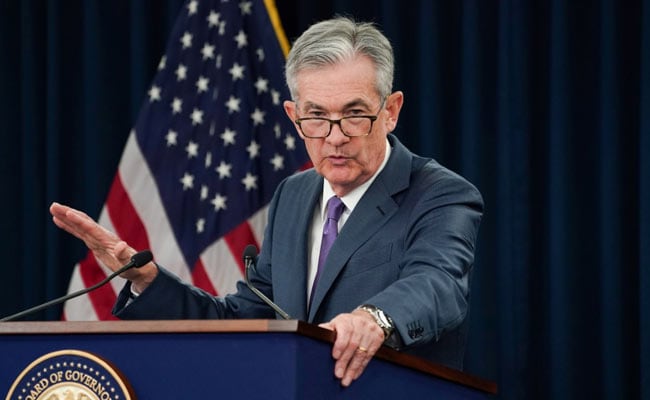
The Federal Reserve on Wednesday cut interest rates for the third time this year to help sustain US growth despite a slowdown in other parts of the world, but signaled there would be no further reductions unless the economy takes a turn for the worse.
"We believe that monetary policy is in a good place," Fed Chairman Jerome Powell said in a news conference after the US central bank announced its decision to cut its key overnight lending rate by a quarter of a percentage point to a target range of between 1.50 per cent and 1.75 per cent.
"We took this step to help keep the economy strong in the face of global developments and to provide some insurance against ongoing risks," he said. "We see the current stance of monetary policy as likely to remain appropriate as long as incoming information about the economy remains broadly consistent with our outlook."
Mr Powell's comments clash with President Donald Trump's demands that the Fed cut rates even deeper to boost economic growth that ebbed to a 1.9 per cent annual rate in the third quarter, well below the 3 per cent level Trump pledged would flow from a round of tax cuts and other actions nearly two years ago.
But the Fed's new stance also vouched for both the seeming durability of a US economic expansion that is now the longest on record.
In his news conference, Mr Powell ticked off an extensive list of reasons why he feels the economy is doing well, and likely to continue to do so under the current stance of monetary policy - from robust consumer spending, strengthening home sales, and asset prices he considered healthy but not to a level of excess.
The S&P 500 index closed at another record high on Wednesday.
As well, Mr Powell said, some of the risks that had most unnerved Fed officials, and convinced them lower rates were needed if only as "insurance," have seemed to abate in recent weeks.
The US-China trade war was "a step closer" to resolution, Mr Powell said, and it looked less likely that Britain would crash out of the European Union.
The outlook for the US economy continues to be for "moderate" growth, a strong labor market and inflation rising back to the Fed's 2 per cent annual goal, he said, and only "a material reassessment" of that outlook could drive the central bank to cut rates further from here.
DISSENTS
In the statement accompanying its decision to cut rates, the Fed dropped a previous reference that it "will act as appropriate" to sustain the economic expansion - language that was considered a sign for future rate cuts.
Instead, the central bank said it will "monitor the implications of incoming information for the economic outlook as it assesses the appropriate path" of its target interest rate, a less decisive phrase.
Kansas City Fed President Esther George and Boston Fed President Eric Rosengren dissented from the decision. They have opposed all three Fed rate cuts this year as unnecessary.
St. Louis Fed President James Bullard, who had dissented in September because he supported a bigger rate cut then, voted with the majority on Wednesday, an indication that views within the Fed may be coalescing around standing pat for now.
The rate cut was widely anticipated by financial markets, but expectations for additional cuts after October have diminished significantly in recent weeks. Contracts tied to the Federal Funds rate indicate an expectation of perhaps one rate cut next year.
While yields on longer-dated bonds showed little reaction, those on shorter-dated maturities that are more closely influenced by Fed policy expectations initially moved higher. The yield on the 2-year note rose to the highest since October 1 at about 1.67 per cent before settling back to earlier levels as Powell spoke.
"It's pretty much what was expected," said Jim Powers, director of investment research at Delegate Advisors.
"The more important outcome is they removed the phrase 'act as appropriate.' It looks like the market is taking that to mean that there will be a pause in the declining rate path they were on beforehand. That's what was expected, and that's generally a good thing," Mr Powers said.
UNUSUAL JUNCTURE
The central bank and US economy are at an unusual juncture.
Unemployment is near a 50-year low, inflation is moderate, and data earlier on Wednesday showed economic growth in the third quarter slowed but not as sharply as many economists expected and some Fed officials feared.
But parts of the economy, particularly manufacturing, have stuttered in recent months as the global economy slowed. Businesses have pared investment in response to the US-China trade war that both raised tariffs on many goods, and also made the world a riskier place to make long-term commitments.
While that has not had an obvious impact yet on US hiring or consumer spending, Fed officials felt a round of "insurance" rate cuts was appropriate to guard against a worse outcome. The Fed cut rates in July and again in September, and by doing so hoped to encourage businesses and consumers with more affordable borrowing costs.
The approach was successful in the 1990s when risks developed during another prolonged period of economic growth.

-
Unhedged Position: Can India See An Indonesia-Style Time Correction?

The Nifty is trading below levels it first clocked in 2024. Is there, then, as I have suggested in the headline, potential that the current time correction drags on painfully for the next three-five, even ten years?
-
Navigating Friction And Energy Realities: An Analysis Of Marco Rubio's October Visit To India
Occurring at a critical juncture marked by stalled trade negotiations and escalating geopolitical pressures over global energy supplies, the visit offers a profound window into modern US-India relations.
-
India Exports Capital. Why Not Export Trusteeship?
The big question, then, is whether India can build an institution that global borrowers, investors, banks, and lawyers can trust, even without an Indian connection.
-
France's Economy & Politics Are In Crisis | The Reason Why
Let's look at how the French economy and politics evolved under Nicolas Sarkozy, Franois Hollande and Emmanuel Macron.
-
You May Inherit The Business. You Must Earn Its Credibility.
Succession tests the founder's ability to share authority as much as it tests the next generation's readiness to assume it.
-
Signing Deals Is One Thing; Making Them Work Is Another | The Week In Whys
Sometimes, things don't turn out as planned. Indian companies have lost some bids to rivals, some projects won't produce until 2030.
-
FOMC Wall, PERM Suspension, Hospital Stocks | Talking Points This Week
A PERM suspension would directly affect green-card sponsorship rather than H-1B visas, so the near-term earnings impact could remain relatively limited. The key question is whether this marks a new phase in US scrutiny of Indian IT.
-
Everything, Everywhere, All At Once: Dalal Street's Week To Forget | Joining The Dots
Visa curbs, a Starlink spat and cancer drug caps: what connects this week's shocks for Indian markets
-
India Is Going Abroad For Critical Minerals. But It May Take Years To Pay Off | The Reason Why
Although India's steps are in the right direction, they remain modest compared with India's growing dependence.
-
When Everyone Has AI, What Gives You An Edge?
India's young workforce is entering an uncertain world of work where powerful AI tools are becoming widely accessible. The advantage will belong to those who combine deep expertise with digital fluency, and the distinctly human capabilities that technology cannot manufacture.









