US Central Bank Cuts Interest Rates, Signals Holding Pattern For Now
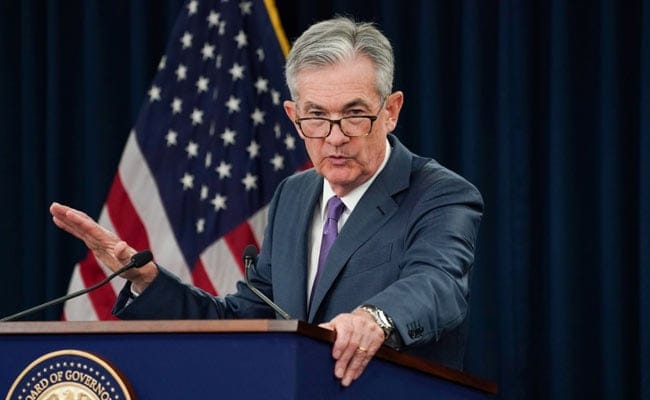
The Federal Reserve cut interest rates on Wednesday to help sustain a record-long economic expansion but signalled a higher bar to further reductions in borrowing costs, eliciting a fast and sharp rebuke from US President Donald Trump.
Describing the US economic outlook as "favourable", Federal Reserve Chairman Jerome Powell said the rate cut was designed "to provide insurance against ongoing risks" including weak global growth and resurgent trade tensions.
"If the economy does turn down, then a more extensive sequence of rate cuts could be appropriate," Mr Powell said in a news conference after the US central bank announced it had lowered its benchmark overnight lending rate by a quarter of a percentage point to a range of 1.75 per cent to 2.00 per cent. It was the second Fed rate cut this year.
But, Mr Powell said, "what we think we are facing here is a situation which can be addressed, which should be addressed, with moderate adjustments to the federal funds rate," noting that the US labour market was strong and inflation was likely to return to the Fed's 2 per cent annual goal.
"We are going to be highly data-dependent ... We are not on a pre-set course, we are going to be making decisions meeting by meeting," Mr Powell said, adding that the Fed would stop cutting rates "when we think we've done enough."
Mr Trump blasted Mr Powell, saying the central bank chief had "No 'guts,' no sense, no vision!"
"A terrible communicator," Mr Trump tweeted before Mr Powell had even begun his news conference.
Later, Mr Trump told reporters during a trip to California: "I think it's fine. I think that frankly they should have acted faster."
Underscoring divisions within the central bank, the quarter-point rate cut on Wednesday drew dissents from three of the 10 voting policymakers.
Kansas City Fed President Esther George and Boston Fed President Eric Rosengren called for no rate cut, and St Louis Fed President James Bullard wanted a bigger half-point rate cut.
Forecasts from all 17 policymakers released at the end of the meeting showed even broader disagreement, with seven expecting a third rate cut this year, five seeing the current rate cut as the last for 2019, and five who appeared to have been against even Wednesday's move.
Technical adjustments
The central bank also widened the gap between the interest it pays banks on excess reserves and the top of its policy rate range, a step taken to smooth out problems in money markets that prompted a market intervention by the New York Fed this week.
In a hint that the Fed may soon take bigger steps, Mr Powell acknowledged that strains in funding markets had been bigger than expected, and he said the central bank may need to resume increases to the Fed's balance sheet "earlier" than previously thought.
US stocks, lower ahead of the statement, extended their losses and the US Treasury yield curve flattened. The 10-year Treasury note yield inched up to 1.79 per cent.
The dollar gained ground against the euro and yen.
"Another rate cut from the Fed to try to shield the US economy from global headwinds," said Joe Manimbo, senior market analyst at Western Union Business Solutions in Washington. "Today's move was more of a hawkish easing in that the Fed's median forecasts for rates suggested no more cuts this year, while some officials dissented."
Still, traders of interest rate futures were betting on one more quarter-point rate cut this year.
New projections showed Fed policymakers at the median expected rates to stay within the new range through 2020.
"There is a lot of uncertainty" around rate-path views and the economic outlook, Mr Powell said.
There was little change in policymakers' projections for the economy, with GDP growth seen at a slightly higher 2.2 per cent this year and the unemployment rate to be 3.7 per cent through 2020. Inflation is projected to be 1.5 per cent for the year, below the Fed's 2 per cent target, before rising to 1.9 per cent next year.
The Fed also cut rates in July, the first such move since 2008, as it responded to risks from Mr Trump's trade war with China and other overseas developments.

-
Talking Points This Week: Tech Nerves, FII Buying, And A Faraway Banking Shock

The global markets are not shining this Diwali. The exception in the large markets is, India.
-
Midterm Rally Lasted A Day. The Hard Reality Of A Divided US May Last Two Years | Opinion
Between a contested AI boom, a debt ceiling that arrives in 2027 and a president with every incentive to act alone, the next two years may prove more volatile than the first day's rally suggests.
-
Blue Wave Will Derail the AI Trade but Won't Dismantle the AI Era | Unhedged Position
The Democrats' sweep of the US Congress will see politics collide with economic forces both over the long and short term.
-
It's Time To Take The GST Council's Bet On Trust Global
Payment records can prove India's services exports, and clear, proportionate rules can bring foreign digital sellers into the tax net.
-
Opinion | India at 38: From Innovation Overperformer to Innovation Powerhouse
India now has 453 VC-backed deep science startups, 18 of them late-stage, after 117 percent growth since 2020. Laurus Labs, at USD 9.3 billion, is the most valuable deep science company in any middle-income economy outside China.
-
Navigating Energy Crossroads: S Jaishankar's Call For Diversified Supply Chains At G20 Ministerial Meeting
As geopolitical fault lines continue to test maritime trade routes and commodity flows, Jaishankar's message remains pertinent: true economic resilience requires open markets, protected transit lines, and a genuine commitment to multilateral cooperation rather than coercion.
-
Indians Are Travelling, But Not Every Journey Is A Holiday | The Week In Whys
Pilgrims, patients and working women are the real travellers, and the system hasn't quite caught up with them.
-
Getting To Work Costs Women More | The Reason Why
It is not just about women paying more than men. It is about women paying much more in cities than in villages.
-
AI Bias In Investing Cannot Be Eliminated, But It Can Be Governed
Framing is a particularly important example as identical financial information presented in terms of gains rather than losses can lead an LLM to reach a different assessment.









