Is A Fed Rate Pause Coming? Watch These Words
(Bloomberg Opinion) -- The Federal Reserve speaks a bizarre language, and the difference between a “hawkish” post-meeting statement and a “dovish” one can boil down to a single tweaked word. Investors looking for signs that a “pause” in interest-rate increases is truly here would do well to keep a close eye on any changes to one key sentence when the central bank renders its decision on Wednesday.
Of course, the main development after the Fed's last meeting was that policymakers seemed to leave the door open to a possible end to increases — not imminently but at some point in the future. To realize that, you had to catch a nuanced evolution in the March 22 statement from the one issued seven weeks earlier on Feb. 1. Specifically, the Fed's post-meeting written statement went from this (in the third paragraph):
The Committee anticipates that ongoing increases in the target range will be appropriate ...
to this:
The Committee anticipates that some additional policy firming may be appropriate ...
If the Fed is truly intent on pausing, its leaders will let everyone know by altering that language a bit further.
A key mistake that many investors have made over the past year has been the assumption that the Fed lies. At the modern Fed, there's plenty of strange, coded language, but for the most part policymakers tend to say what they're thinking. This has been true since the chairmanship of Ben Bernanke, and Chair Jerome Powell has taken that communications baton from his predecessors. If Powell and his colleagues believe it's time to pause rate increases, they will probably say so from the get-go in the meeting statement released at the same time as the rate decision.
In those statements, policymakers have been following a tried and true communication formula that Bernanke used ahead of the 2006 pause. In December 2005, policymakers said that “some further measured policy firming [was] likely to be needed.” But then in January 2006, they dropped “likely” and instead wrote that “policy firming may be needed.” In the current go-round, that's essentially where we have been since March.
So what comes next?
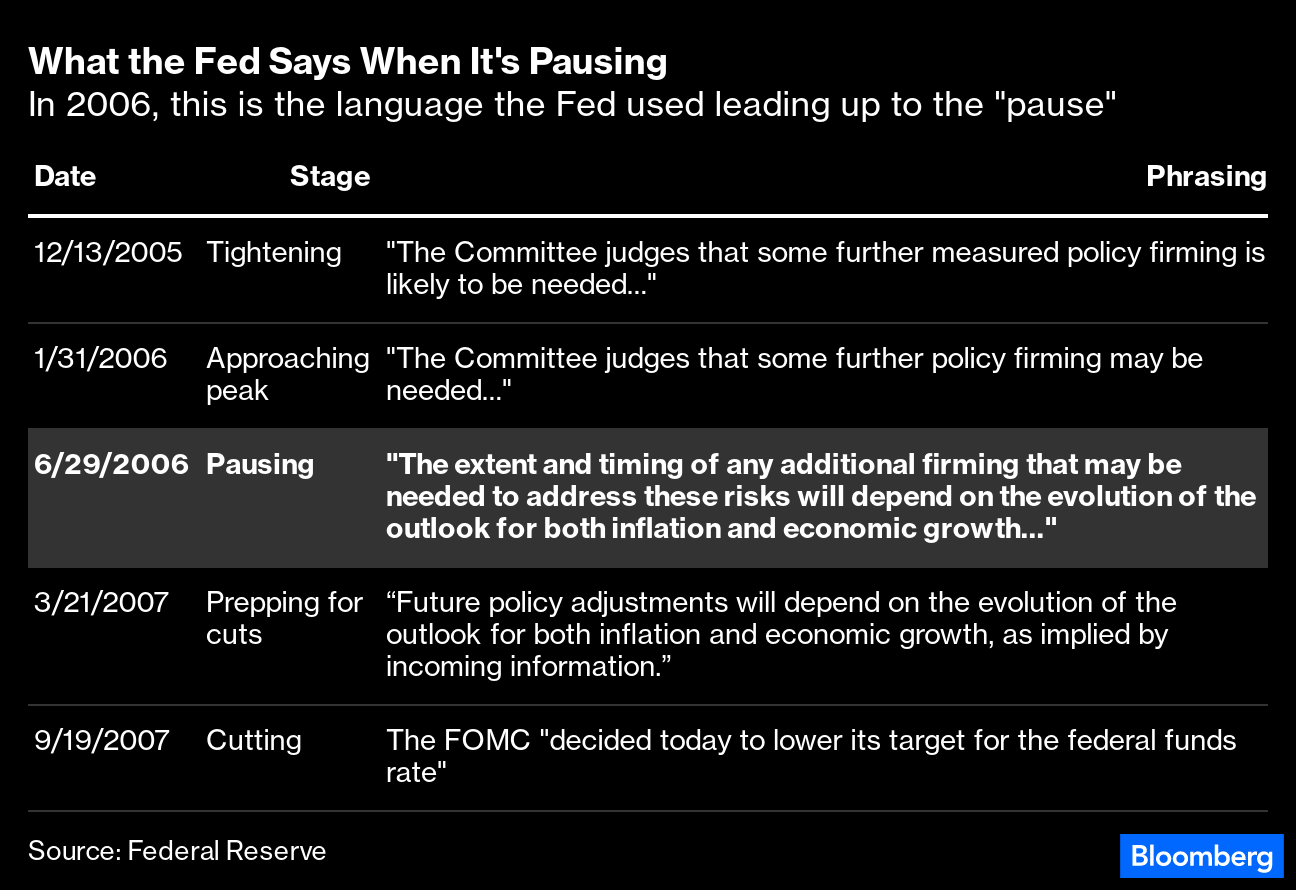
If the Fed truly decides to pause, investors should expect it to move to wholly noncommital language about future rate increases. The phrase from March — that “some additional policy firming may be appropriate” — should evolve to something even more squishy. In 2006, the pause came when the Fed's rate-setting committee moved to this:
The extent and timing of any additional firming that may be needed to address these risks will depend on the evolution of the outlook for both inflation and economic growth, as implied by incoming information.
Sometimes, the Fed reaches peak rates and policymakers don't know it yet. In December 2018, the Fed delivered the last increase of that cycle while keeping the statement somewhat hawkish. It wasn't until the following January 2019 that the statement evolved to something of a dovish pause:
The Committee will be patient as it determines what future adjustments to the target range for the federal funds rate may be appropriate...
Clearly, this year's inflation fight is unprecedented in the age of the transparent Fed, and there's no guaranteeing that policymakers will follow the same script. The key takeaway is that investors shouldn't have to wait for Chair Powell's 2:30 p.m. press conference to judge where policy is heading from here. If the Fed is truly pausing, policymakers will almost certainly tell us from the very beginning — albeit in their own bizarre little way.
More From Bloomberg Opinion:
- The Slow Dance Between Markets and Central Banks: John Authers
- BOE Shows ECB How to Shrink a Balance Sheet: Marcus Ashworth
- What a New Cold War Means for Central Banks: Daniel Moss
This column does not necessarily reflect the opinion of the editorial board or Bloomberg LP and its owners.
Jonathan Levin has worked as a Bloomberg journalist in Latin America and the U.S., covering finance, markets and M&A. Most recently, he has served as the company's Miami bureau chief. He is a CFA charterholder.
More stories like this are available on bloomberg.com/opinion
©2023 Bloomberg L.P.

-
Ten Things I Learnt This Samvat

Patience can be a trap. Cheap stocks can stay cheap. Leverage can wipe you out. What did Samvat 2082 teach us? Niraj Shah writes on 10 lessons from the year gone by.
-
Talking Points This Week: Tech Nerves, FII Buying, And A Faraway Banking Shock
The global markets are not shining this Diwali. The exception in the large markets is, India.
-
Midterm Rally Lasted A Day. The Hard Reality Of A Divided US May Last Two Years | Opinion
Between a contested AI boom, a debt ceiling that arrives in 2027 and a president with every incentive to act alone, the next two years may prove more volatile than the first day's rally suggests.
-
Blue Wave Will Derail the AI Trade but Won't Dismantle the AI Era | Unhedged Position
The Democrats' sweep of the US Congress will see politics collide with economic forces both over the long and short term.
-
It's Time To Take The GST Council's Bet On Trust Global
Payment records can prove India's services exports, and clear, proportionate rules can bring foreign digital sellers into the tax net.
-
Opinion | India at 38: From Innovation Overperformer to Innovation Powerhouse
India now has 453 VC-backed deep science startups, 18 of them late-stage, after 117 percent growth since 2020. Laurus Labs, at USD 9.3 billion, is the most valuable deep science company in any middle-income economy outside China.
-
Navigating Energy Crossroads: S Jaishankar's Call For Diversified Supply Chains At G20 Ministerial Meeting
As geopolitical fault lines continue to test maritime trade routes and commodity flows, Jaishankar's message remains pertinent: true economic resilience requires open markets, protected transit lines, and a genuine commitment to multilateral cooperation rather than coercion.
-
Indians Are Travelling, But Not Every Journey Is A Holiday | The Week In Whys
Pilgrims, patients and working women are the real travellers, and the system hasn't quite caught up with them.
-
Getting To Work Costs Women More | The Reason Why
It is not just about women paying more than men. It is about women paying much more in cities than in villages.









