‘Remove Modi, Scare Rahul’: Why Farmers Are Marching Again
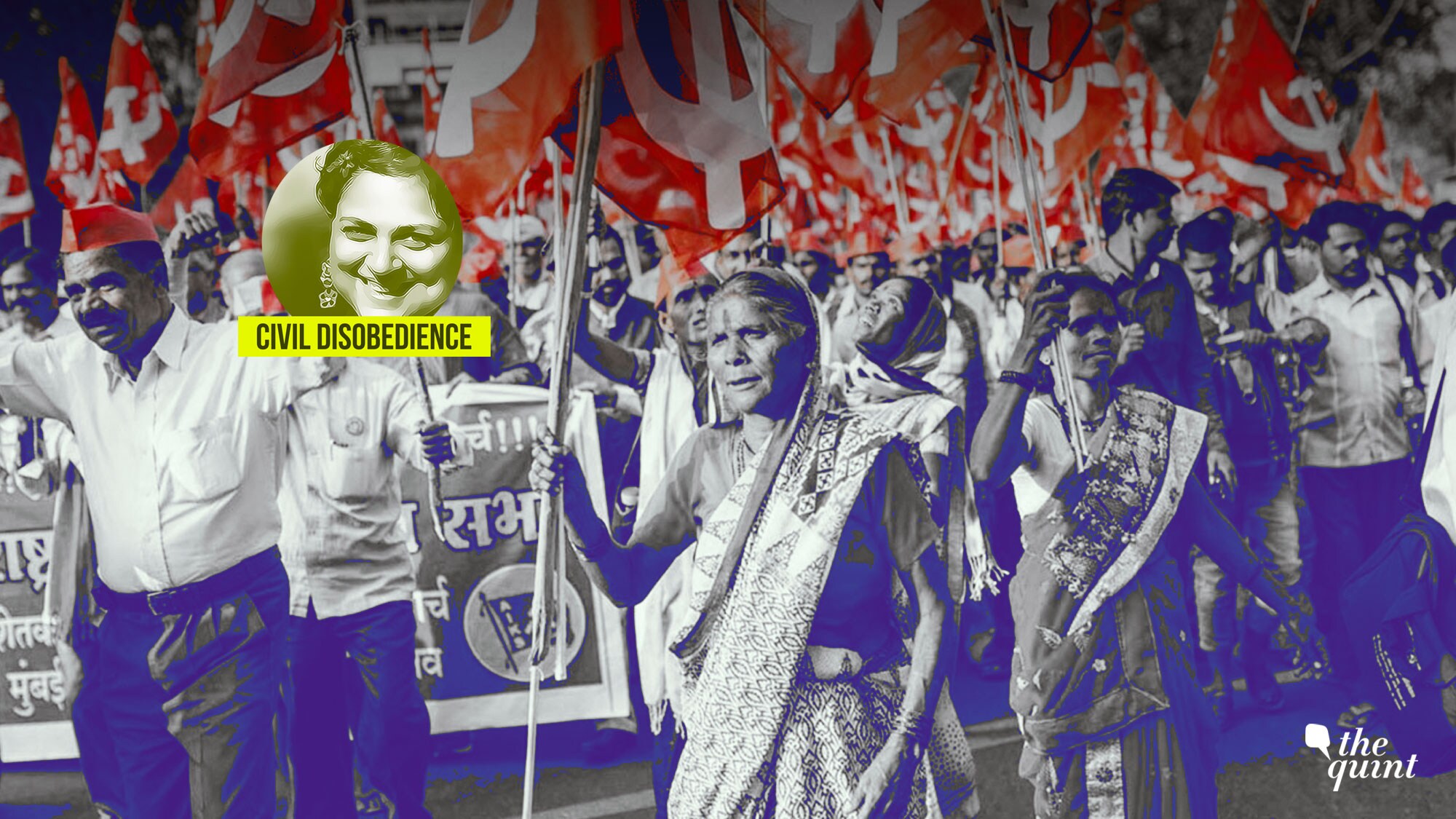
Jijabai Vasavi is a hundred years old. When she was born, India was under British occupation and World War 1 had just concluded. You might say, look at how the imagination of the world has changed in this time. Gandhi was only just getting his non-cooperation movement started. People in her part of the world in rural Maharashtra didn't have bicycles or electricity or cameras.

She would tell you, in these hundred years, what has altered most significantly is this: When she was a child, if you grew food, it was an absolute guarantee you would not starve.
Now, in 2018, if you are a farmer, it is almost certain you will.
Fighting for Dear Life
And so, it is that at the age of one hundred that she walked from her village Baradi in Nandurbar district for ten kilometres to get to the nearest town from where she got into a shared taxi.
From there to the train in the next town, and then another train, and after nearly twenty hours of continuous and taxing travel, she arrived in Mumbai, to join thousands of protesting farmers demanding many things, but essentially one thing — the right to live.
Too busy to read? Listen to this instead.
It's ridiculous that they grow food for the rest of the country to eat but are so consumed by debt from crop failure and no means to buy expensive fertilizer or even more expensive diesel for their tractors.
So that 3 lakhs of them have killed themselves in the last twenty years.
Raging On
“Enough is enough,” Jijabai and many others from her village said. This year has been a particularly bad crop in her district. The yield was half what it was from last year.
And Jijabai isn't a rich or a middling farmer. She is part of the 67 percent of agriculturists who own less than one hectare of land – whose earnings per month is about 6,426 rupees according to the NSSO or National Sample Survey Office data.
Her children and grand-children all work as daily wagers on other farms and on road and building projects and still it's hard to find enough to eat. Things are in fact so impossible that Jijabai decided to put herself and her tired body though this agonizing journey to make her voice count.
No Food Till Noon, But Fire in The Belly
Even though she was just a speck – one of the thousands of people to have arrived at Mumbai's Azan Maidan on 21 November, ahead of the long march to Delhi – she considered it vital enough for her to be there.
On that day, Sachinbhai — a leader from the Lok Sangharsh Morcha in Maharasthra said Jijabai woke up at 4 am with the others. And since the participation was entirely voluntary, most people, including Jijabai didn't have anything to eat all day. She had her first cup of chai after noon. But there was fire in her belly.
“She was full of anger,” Sachinbhai exclaimed.

With the system weighed so heavily against them, farmers across the country are preparing to be in Delhi's Ramlila maidan on 29 and 30 November, demanding that a special session of parliament be convened to raise crucial survival issues.
Some have been working extra hours all of last month and this to make extra wages and save up to afford this trip.Activist Pratibha Shinde
Her voice was barely audible after a day at the rally. “Sorry, I've lost my voice,” she said, apologetic, but happy to see the issue get some traction.
What the Farmers Need – And Now
At the other end of the country, K Balakrishnan from the ‘Jai Kisan Andolan' and Convener of the Tamil Nadu farmers' agitation, said even rich farmers are in distress with cyclone Gaja having destroyed their crop.
People who had 10,000 coconut trees are now begging on the road for a bottle of water.K Balakrishnan, ‘Jai Kisan Andolan'
This is why crop insurance, the guarantee of a minimum support price from the state, and the allotment of land promised to tribals is crucial, he explained. And in the case of farmers reeling from the effects of the cyclone, compensation that hasn't still been given.
Not a Farmer-Friendly Govt
Ramesh Chander from Jind in Haryana, echoes these sentiments. He also added that this government has been particularly harsh on farmers. Until 2014, there was at least a minimum guarantee of 50-55 days of daily wages under the MNREGA scheme. Now, in the non-agricultural season, there is no guarantee of getting daily wage work.
And the supplementary income from the sale of cattle once it's past its prime has stopped, thanks to the cow vigilante groups, he added. “The rate of purchase of milk has dropped and I can't sell my buffalo either,” Chander lamented.
“Toh abh ladai ke bagair chara hi nahi hai (there is no other recourse but to fight),” he said.
Adding that farmers groups – 200 of them were also being strategic in the timing of their agitation. “Yeh election ka saal hai, this is an election season.”
He's lost 30,000 rupees this agricultural season, and if he doesn't join the tidal wave of voices now, it will be a big opportunity lost. His survival could be at stake.
Why Do Farmers Want to March Again?
Avik Saha, Organising Secretary of the All India Kisan Sangharsh Co-ordination group or the AIKSCC summed it up in a catch-phrase he has coined for the march – “Modi Ko Harao, Rahul Ko Darao” (Remove Modi, Scare Rahul).
“Our job,” he clarified, “is to make it impossible to ignore farmers.”
The basic demands the massive collective would like the government to consider immediately are two: Freedom from debt and remunerative prices for their produce.
The politics of the movement is absolutely transparent. They would like to build pressure on the Modi government at a time when they are aware it is facing the heat on every front. And they would like to extract these basic promises ahead of the 2019 elections. The long-term goal is to build the 200 farmers groups that have signed on into a collective block.
Rich or Poor, All Farmers Are Fighting For One Cause
Lingraj, a farmers' activist from Odisha, said his organisation doesn't have money. So about a thousand farmers from that state will travel by train, unreserved. “You can classify the farmers by the routes they take from different parts of the country,” Avik Saha remarked.
Farmers from Bihar and Odisha can only travel unreserved, but in Karnataka, there are some who will be flying in.
But. Rich or poor, all farmers have fire in their belly. All of them have lost something. The rich have lost wealth, the poor are on the brink of survival.
For now, they have nothing to hold onto but their dissent. Farming is all that Jijabai knows. At a hundred plus years, she would like to be able to hold on to that one basic thing – the right to grow food and for it to be sustainable.
(Revati Laul is a Delhi based journalist and film-maker and the author of ‘The Anatomy of Hate,' published by Context/Westland and in stores from November 30th, 2018. She tweets@revatilaul. This is an opinion piece. The views expressed above are the author's own. The Quint neither endorses nor is responsible for them.)

-
Opinion | India at 38: From Innovation Overperformer to Innovation Powerhouse

India now has 453 VC-backed deep science startups, 18 of them late-stage, after 117 percent growth since 2020. Laurus Labs, at USD 9.3 billion, is the most valuable deep science company in any middle-income economy outside China.
-
Navigating Energy Crossroads: S Jaishankar's Call For Diversified Supply Chains At G20 Ministerial Meeting
As geopolitical fault lines continue to test maritime trade routes and commodity flows, Jaishankar's message remains pertinent: true economic resilience requires open markets, protected transit lines, and a genuine commitment to multilateral cooperation rather than coercion.
-
Indians Are Travelling, But Not Every Journey Is A Holiday | The Week In Whys
Pilgrims, patients and working women are the real travellers, and the system hasn't quite caught up with them.
-
Getting To Work Costs Women More | The Reason Why
It is not just about women paying more than men. It is about women paying much more in cities than in villages.
-
AI Bias In Investing Cannot Be Eliminated, But It Can Be Governed
Framing is a particularly important example as identical financial information presented in terms of gains rather than losses can lead an LLM to reach a different assessment.
-
Joining The Dots | Dark Skies, Steady Diya: Why Hope Holds This Diwali
With war, a weak rupee and foreign outflows weighing on sentiment, policymakers at the NDTV World Summit and market veterans at NDTV Profit Ignite: Diwali Edition offered the same advice: stay invested and filter out the noise.
-
The Curious Case of Equitas Small Finance Bank And A CEO Who Quit For Stock
PN Vasudevan believes persistent investor concerns over a perceived conflict of interest had become a governance overhang on Equitas Small Finance Bank's stock, even as the lender improved profitability and asset quality.
-
Talking Points This Week: AI Cash Burn, A Tiger Comeback And An India That Still Finds Its Own Path
India is not immune to higher oil or tighter global liquidity, yet its earnings base is broader, its domestic policy levers are still available.
-
Foreign Investors Own Half Of HDFC Bank and ICICI Bank. An LTCG Cut Could Matter Most Here
Foreign portfolio investors have US$115 billion parked in HDFC Bank, ICICI Bank. If the government cuts long-term capital gains tax, Jefferies says returning foreign money could land here first.










