Eyeing Return To Global Financial Map, Hong Kong Hosts Summit Amid Geopolitical Tension
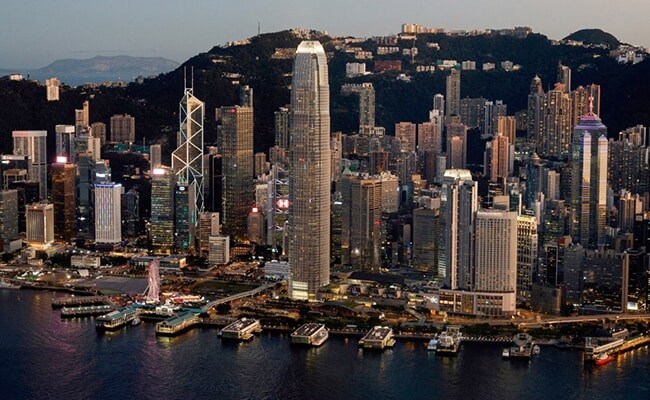
Hong Kong aims to restore its reputation as a global financial hub by playing host to a bevy of top Wall Street executives this week, defying critics who say a talent crunch and geopolitical tension will hobble its ambition.
The high-profile summit is the first in almost three years in the city since anti-government protests, the imposition of a sweeping national security law and strict COVID-19 containment measures clouded its status as a premier financial centre.
The Global Financial Leaders Investment Summit begins on Wednesday with participants including Goldman Sachs Chief Executive David Solomon, Morgan Stanley boss James Gorman, HSBC's Noel Quinn and Standard Chartered's Bill Winters.
Alongside the main theme of "navigating through uncertainty", the summit is widely expected to focus on whether Hong Kong can remain a global financial centre after almost three years of border controls and pandemic restrictions.
For foreign financial firms operating in China and Hong Kong, however, navigating Sino-U.S. geopolitical tension and a depleting pool of talent in what is commonly touted as "Asia's world city" will continue to prove challenging, analysts said.
"The Hong Kong government's overarching goal is clear: to establish the narrative that the city has reopened ... after years of COVID controls, protests and U.S. sanctions," said Chris Beddor, Gavekal Dragonomics' deputy China research director.
Global banks are playing their cards reasonably well in the face of a deteriorating political environment, he said, though there has been a shift among the expatriate workforce in Hong Kong in particular to other locations, such as Singapore.
"The geopolitical situation has deteriorated rapidly over the past two years or so, and the political environment in China has clearly shifted as well, both of which present hard-to-quantify long-term risks."
Underscoring the tension, two U.S. lawmakers last week urged top American bankers to cancel their attendance, saying participation would contribute to human rights abuses by China's government. Beijing rejects accusations of rights abuses.
COVID-19 Controls
The two-day summit, organised by the Hong Kong Monetary Authority (HKMA) - the de-facto central bank - has suffered at least two marquee participants dropping out after contracting COVID-19.
Blackstone President Jonathan Gray will not attend after testing positive for the virus, and will be replaced by Chief Financial Officer Michael Chae, a spokesperson said on Monday.
Citigroup CEO Jane Fraser will also not attend due to COVID-19 infection, Reuters reported on Thursday.
The city's Financial Secretary Paul Chan, one of the main speakers, also contracted COVID-19 during a visit to Saudi Arabia and will stay in that country for a "short while" to observe health requirements, the government said last week.
"The Financial Secretary will try his best to attend the Summit in person, and meet with participating financial leaders," a spokesperson said. "Where this is not possible, he will join by video or through a pre-recorded speech."
Those who make it will look for reassurances of the city returning to pre-pandemic normalcy, making it easier for them to move talent to Hong Kong.
HKMA head Eddie Yue told a local newspaper last week the event would send a clear message that "Hong Kong is back", and it would be the "fireworks which draw the eyeballs of global talent".
"I totally agree that the conference hopefully can be a very beautiful fireworks display," said Hong Kong-based Gary Ng, senior economist for Asia Pacific at Natixis. "But it depends on what happens after."
(Except for the headline, this story has not been edited by NDTV staff and is published from a syndicated feed.)

-
Unhedged Position: Can India See An Indonesia-Style Time Correction?

The Nifty is trading below levels it first clocked in 2024. Is there, then, as I have suggested in the headline, potential that the current time correction drags on painfully for the next three-five, even ten years?
-
Navigating Friction And Energy Realities: An Analysis Of Marco Rubio's October Visit To India
Occurring at a critical juncture marked by stalled trade negotiations and escalating geopolitical pressures over global energy supplies, the visit offers a profound window into modern US-India relations.
-
India Exports Capital. Why Not Export Trusteeship?
The big question, then, is whether India can build an institution that global borrowers, investors, banks, and lawyers can trust, even without an Indian connection.
-
France's Economy & Politics Are In Crisis | The Reason Why
Let's look at how the French economy and politics evolved under Nicolas Sarkozy, Franois Hollande and Emmanuel Macron.
-
You May Inherit The Business. You Must Earn Its Credibility.
Succession tests the founder's ability to share authority as much as it tests the next generation's readiness to assume it.
-
Signing Deals Is One Thing; Making Them Work Is Another | The Week In Whys
Sometimes, things don't turn out as planned. Indian companies have lost some bids to rivals, some projects won't produce until 2030.
-
FOMC Wall, PERM Suspension, Hospital Stocks | Talking Points This Week
A PERM suspension would directly affect green-card sponsorship rather than H-1B visas, so the near-term earnings impact could remain relatively limited. The key question is whether this marks a new phase in US scrutiny of Indian IT.
-
Everything, Everywhere, All At Once: Dalal Street's Week To Forget | Joining The Dots
Visa curbs, a Starlink spat and cancer drug caps: what connects this week's shocks for Indian markets
-
India Is Going Abroad For Critical Minerals. But It May Take Years To Pay Off | The Reason Why
Although India's steps are in the right direction, they remain modest compared with India's growing dependence.
-
When Everyone Has AI, What Gives You An Edge?
India's young workforce is entering an uncertain world of work where powerful AI tools are becoming widely accessible. The advantage will belong to those who combine deep expertise with digital fluency, and the distinctly human capabilities that technology cannot manufacture.









